This ANZAC Day, Soldiers and Whistleblowers Are Reprimanded, as Top Brass Play Two Up
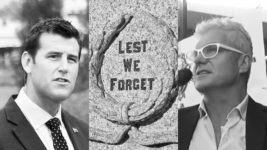
Today, ANZAC Day, is an extremely different occasion for Australia’s most decorated soldier, Ben Roberts-Smith, who’s now facing five counts of the war crime of murder. But for gaoled Australia Defence Force whistleblower David McBride, it will be much the same as the last. By contrast to both, the ADF’s top brass will likely enjoy the day having been left untarnished.
On this national day of remembrance, a lot of disdain will likely be experienced amongst a mass of civil society, however, as there are huge numbers outraged by the fact that the nation’s greatest war hero is facing war crime offences, whilst those who oppose the futility of war question why Roberts-Smith has been released on bail considering the gravity of the alleged crimes he’s been accused of.
As for the nation’s top ministers, they will continue to support the mass commission of Israeli and US war crimes, whilst washing their hands in regard to the punishment of BRS, and feign outrage if a journalist dare asks them about these conflicting positions, as whilst they’re fully aware of them, they prefer those sorts of contradictions to be left up the back of their minds.
McBride’s supporters are calling for the release of the ex-ADF legal officer, as his whistleblowing went a long way in exposing Australian war crimes to the public. The truth, however, is more complicated, as the military lawyer handed confidential ADF files over to ABC reporters, as he was attempting to draw attention to what he perceived as the potential wrongful prosecutions of Australian soldiers.
And if readers take the time to peruse the government’s official inquiry into war crimes perpetrated in Afghanistan by SAS troops, the Brereton report, they will be struck by how it’s at pains to repeatedly assert that all the “criminal behaviour was conceived, committed, continued and concealed” at “patrol commander level”.
Lawful acts and war crimes
Former Special Air Service Regiment (SAS) corporal Ben Roberts-Smith, who’s been awarded the nation’s top military honour, the Victoria Cross, was arrested on 7 April 2026, and was charged with five counts of the war crime of murder. He was remanded and then released on bail a week later. And the evidence gathered over the yearslong investigation is likely solid given the circumstances.
But there’s been a tsunami of backlash from Middle Australia about the arrest of its war hero.
Roberts-Smith undertook great acts of bravery whilst fighting during his six tours in Afghanistan, which saw him put himself in the line of fire to protect his own – they don’t toss you a Victoria Cross for nothing.
But BRS is also alleged to have murdered unarmed Afghans, pushed subordinates to commit murder, and has a fetish for drinking beer out of the prosthetic leg of someone he’s said to have murdered.
Rules of war have been around since ancient times. Current international humanitarian law (IHL) is comprised of turn of the 20th century Hague Conventions, which focused on war conduct and what is permissible, including protecting civilians and prisoners of war, and the post-World War II Geneva Conventions that focused on humanitarian treatment and the protection of noncombatants.
The key argument doing the rounds of the internet from those critical of the decision to prosecute Roberts-Smith is that they could never become an ADF soldier because the organisation doesn’t have his back. But even though IHL is all about attempting to preserve humane life, they’re insisting that the Australian military should look the other way if they murder a civilian in a warzone.
A similar situation exists with domestic law enforcement. Australian police are permitted to shoot a person if they’re posing a direct threat to the officer or someone else and there is no alternative. Police aren’t permitted to finish off injured criminals, however, and nor can they shoot a captured crook. And senior police aren’t permitted to get a rookie to rough up a civilian to break them in.
Most of the public disagrees if police departments don’t punish rogue cops who harm civilians, and most constituents would disagree if BRS got off after he “blooded” a subordinate by ordering the soldier to shoot their mother.
Free McBride
ADF whistleblower David McBride continues to stew in prison for his having blown the whistle on the ADF to the ABC, which led to 2017’s The Afghan Files, which exposed SAS war crimes to the public. The lawyer was sentenced to 5 years and 8 months prison time over three convictions relating to theft of documents and communicating ADF information. And he’s eligible for parole in August.
In his whistleblowing efforts, McBride didn’t have Roberts-Smith in his sights. The former ADF legal officer served two tours in Afghanistan over 2012 and 2013, and another part of his role was teaching the troops the Australian rules of engagement, which are ADF directives on how troops need to conduct themselves in war, and these incorporate IHL, or the law of armed conflict.
McBride made his disclosures following the chief of the Australian Defence Force David Hurley announcing rules of engagement reforms in late 2013. The lawyer had been puzzled as to why the head of the ADF was focused on changing the rules, and he was informed that a number of incidents in Afghanistan over recent years had warranted them.
A number of briefings relating to incidents that had been occurring in the Central Asian theatre of war were then provided to the lawyer as justification for the changes, but he couldn’t understand why they necessitated reform, and in terms of the required legal prerequisites to commence a prosecution, he considered the evidence far from the criminal standard of beyond reasonable doubt.
According to McBride, the ADF was moving to prosecute soldiers on flimsy grounds. So, he took the classified documents and gave them to ABC journalists, in an effort to protect the ADF soldiers, as they were his clients. But the ABC wasn’t interested in McBride’s original concerns, and in 2016, a journalist contacted him to explain he would instead be exposing the war crimes within them.
Lest we forget
The November 2020 Brereton report was the result of a four-and-a-half-year-long inquiry, which was initiated by the Inspector General of the ADF. The report found evidence of 39 murders of civilians and prisoners-of-war involving 19 members of the Australian special forces. And the inquiry is also understood to have been spurred by McBride and an independent academic raising these matters.
Military sociologist Dr Samantha Crompvoets was commissioned in 2015 by then ADF major general Jeff Sengelman, who was head of the Special Operations Command, to conduct a study on cultural issues in the unit, which was then deployed in Afghanistan: the longest overseas war that the nation of Australia has ever been engaged in.
Dr Samantha Crompvoets’ 2016 released report uncovered a culture of “blood lust” and “competition killing”, in which committing war crimes was equated with being a good soldier. The practice of “blooding” was identified, which involves new recruits being made to kill someone to get used to it. And one particular incident involved the slitting of two 14-year-old Afghan boys’ throats.
The head of the official inquiry was Paul Brereton, the former New South Wales Supreme Court justice, who’s now the chief of the National Anti-Corruption Commission or the NACC.
“While it would have been much easier to report that it was poor command and leadership that was primarily to blame for the events disclosed in this report, that would be a gross distortion,” the Brereton report reads.
“While, as will appear, commanders at troop, squadron and Special Operations Task Group level must bear some responsibility for the events that happened ‘on their watch’, the criminal behaviour of a few was commenced, committed, continued and concealed at the patrol commander level, that is, at corporal or sergeant level,” it continues.
The Office of the Special Investigator and the Australian federal police conducted the investigation into Roberts-Smith who is only the second Australian soldier ever to have been prosecuted over war crimes. The first was former SAS officer Oliver Schulz, who was charged in 2023 over the alleged murder of an Afghan civilian. Schulz has pleaded not guilty and will stand trial next year.
But one aspect of the criticism regarding BRS having been charged over his alleged killing spree does ring true, and that is that there seems to be something a bit off about pursuing him right now, after the Albanese government has been justifying the Israeli genocide in Gaza and Tel Aviv’s attempted genocidal colonisation of Lebanon, as well as the US-Israeli illegal war of aggression against Iran.
PM Anthony Albanese and foreign minister Penny Wong, once outspoken on rights and injustices in foreign lands, now appear with tightly pressed lips unable to criticise the wanton killing of children, a mass slaughter based on race, or the threat to wipe out an entire civilisation with nuclear bombs and god forbid if either of them ever mention that Israel or US president Donald Trump is involved.
But then again, our prime minister couldn’t even muster up the courage to comment on the arrest of Ben Robert-Smith.
When asked on the 7 April, what he thought about the arrest of BRS, Albanese said, “I have no intention of commenting on a matter that’s clearly before the courts.” When asked again a few minutes later he said, “I have no intention of prejudicing a matter that clearly is a legal matter and that’s before the courts, and any comment would do so.”
Whilst when a third request for Albanese to make a comment that reflected his paygrade was made, he said, “I’m not going to confirm anything to do with the legal matter. That is a matter that is very important that there not be political engagement in what is a matter that is now the subject of legal proceedings. So, I don’t intend to comment.”

Paul Gregoire

Receive all of our articles weekly
Related Articles
 The Roberts-Smith Atrocities Lay Bare the Lies of Australia’s Role in Afghanistan
 “I Am Proud of the Position I Have Taken”: ADF Whistleblower David McBride on Standing Up for Truth
 Ben Roberts-Smith: Bully, Liar, War Criminal
 McBride Heads to the High Court, After His Draconian Sentence Stands on Appeal
 In the Public Interest: An Interview With Former Military Lawyer David McBride
 Will Alleged Australian War Crimes Be Criminally Prosecuted?