Thorpe’s Legislating an End to Strip Searching Children and Shackling Birthing Women
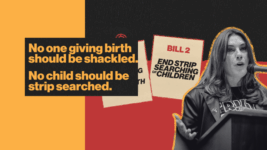
Senator Lidia Thorpe has two bills before parliament that seek to prohibit practises that are frankly deplorable. These comprise of shackling incarcerated or detained women during childbirth and the strip searching of children. And as these bills are undergoing the committee process, she’s inviting the public to assist in their passing, in terms of the signing petitions and submitting to the inquiries.
Both private members bills, the Crimes Amendment (Prohibiting Shackling During Childbirth) Bill 2026 and the Crimes Amendment (Prohibiting the Strip Searching of Children) Bill 2026 were introduced into parliament on 18 August 2026, by the Gunnai, Gunditjmara and Djab Wurrung senator.
Thorpe outlines that these practices that occur to women and children in custody are largely ignored by politicians and the media, which means that a large portion of the community have no idea these harmful practices continue to occur with official sanctioning. These practices are not necessitated. And federal intervention in these state and territory matters is possible, despite official denials.
The independent senator for Victoria is requesting constituents sign open letters that address Australian attorney general Michelle Rowland, in respect of banning the shackling of women during birth and strip searching of kids. And Thorpe is too requesting submissions to the Senate Legal and Constitutional Affairs Legislation Committee inquiries into strip searching kids and shackling women.
End the shackling of women giving birth
“No one giving birth is at risk of running away,” explained Thorpe, as she gave her 18 August second reading speech on the Prohibiting Shackling During Childbirth bill. “The main concern during childbirth is to get the medical care needed and ensure a safe delivery. Anyone who has given birth would agree that to be shackled whilst giving birth would be an incredibly violent and terrifying act.”
“Many jurisdictions have policies or guidelines that restrict or prohibit shackling during childbirth, but they usually contain exemption provisions, which unfortunately often result in shackling being applied anyway: people are cuffed to their hospital bed by an arm and a leg in the delivery room, their legs shackled together by a chain,” she continued. “Federal legislation is needed to end this.”
The proposed legislation seeks to insert new section 87A into the Crimes Act 1914 (Cth). This new law would require that “persons must not be restrained while giving birth”, and it would apply to detainees in hospital, in prison and in general. The prohibition holds to people while giving birth, in labour, immediately before entering labour and after birth. This holds regardless of any other law.
A further provision prevents Commonwealth, state and territory laws being passed prior to this one or in its wake having an effect. The new measures would outlaw chemical restraints, as well as environmental, mechanical and physical restraints. The legislation also highlights the “external affairs” power in the Australian Constitution that would serve to facilitate this federal intervention.
Thorpe further outlines that the shackling of women in custody during childbirth continues to happen across the country. She underscores that it is “completely unnecessary and ineffective, while being dangerous for both parent and child”. She adds that state and territory policies to end this practice have failed, and that many organisations, like Sisters Inside, are behind the call to end it.
Ending the strip searching of children
Thorpe stresses that research shows strip searching has no real effect on whether incarcerated kids get their hands on contraband in child prisons. She points to the Office of the WA Inspector of Custodial Services, which found that of 900,000 strip searches of adults in WA gaols between 2014 and 2019, prohibited items were only found on 0.28 percent of the time.
But the senator outlines that the data on the searching of kids in Australian correctional facilities is more scant. Data from NSW in April 2022 does reveal, however, that 127 strip searches of children at two youth prisons produced items on only three occasions.
The WA Inspector of Custodial Services further detailed in 2019 that technology that allows for body scanning or the X-raying of inmates means that the highly traumatic procedure of strip searching incarcerated peoples is unnecessary, as the electronic devices replace any need.
The widespread understanding is that this traumatic procedure basically amounts to a form of sexual assault by the state.
The Prohibiting the Strip Searching of Children bill again amends the Crimes Act 1914 to insert new section 90C into the legislation, which contains a law requiring that persons under 18 years of age are not to be strip searched. This would hold for child suspects, arrestees, those detained in either prison or hospital and children in custody or detained in general.
Just like the proposed ban on shackling women, this new law would continue to apply despite any Commonwealth, state or territory law to the contrary, and this ban further applies to partial strip searches. In NSW, kids in prison continue to be strip searched, but the law provides that the process takes place partially, so that both the top and bottom are separately searched at different times.
“Strip searching children also contravenes human rights and children’s rights under a number of UN conventions and treaties to which this country is a signatory,” Thorpe continued, during her reading speech on the bill. And these include the UN Convention on the Rights of the Child and the UN Rules for the Treatment of Women Prisoners and Non-Custodial Measures for Women Offenders.
Federal power to intervene in the states
The regular proposition from federal politicians is that they can’t intervene in state and territory matters. Prime minister Anthony Albanse has repeatedly told Senator Thorpe that he cannot intervene in issues, such as Aboriginal deaths in custody, as these are state matters, and this easy denial continues on, despite it not being correct.
Both of Thorpe’s private members bills note that the power the federal government has to intervene and stop practices that continue to take place in correctional facilities governed by state and territory law is the external affairs power that’s set out within section 51(xxix) of the Australian Constitution.
The open letter to the nation’s chief lawmaker states, “Attorney-General, your government has the power and duty to end this harmful practice. The High Court has confirmed that external affairs power under the Constitution, allows the Commonwealth to implement human rights obligations in areas that would otherwise primarily be matters for the states and territories.”
Further, NATSILS (National Aboriginal and Torres Strait Islander Legal Service) announced in last September that it had obtained new legal advice from senior barristers, via the Justice and Equity Centre, confirming that the federal government has the power to intervene in state and territory laws, like youth justice, via the external affairs power, under section 51(xxix) of the Constitution.
The advice from senior counsels Kate Eastman SC and Emma Dunlop was obtained at the same time that NATSILS was calling on Canberra to intervene in “dangerous new laws” being implemented by states and territories that result in rising incarceration of children, and further, measures that have targeted First Nations kids.
At the time, Thorpe supported the NATSILS calls for federal Labor to intervene in the overbearing measures being legislated to crackdown on youth crime, especially in jurisdictions like the Northern Territory and Queensland. And now the senator has these two long-sought reforms before the national parliament and these changes are supported by the recent legal advice.
Thorpe too made certain on 18 August that these reforms have been around since the Royal Commission into Aboriginal Deaths in Custody, as it recommended in 1991 to end the “violent or rough treatment of Aboriginal persons, including women and young people” by state authorities, and that they further “recognise that they owe a legal duty of care to young people in their custody”.
Image taken from the Office of Senator Thorpe’s promotional materials

Paul Gregoire

Receive all of our articles weekly
Related Articles
 NSW Police Are Illegally Strip-Searching Children
 Strip Search Class Action Confirms Numerous NSW Police Strip Searches Illegal
 Unlawful Strip Search Class Action Will Proceed, Despite NSW Government’s Attempt to Stop It
 Strip Searches: Minns Probes Whether Sexual Assault by the State Is Right for Kids
 NSW Police Use of Drug Dogs and Strip Searches Slammed as Ineffective and Unlawful
 What are the Rules for Strip Searches in New South Wales?