All-Pervasive Palantir-Built Surveillance System Is Monitoring Australians
Most of us understand the concept of Big Brother from George Orwell’s 1949 novel Nineteen Eighty-Four. Big Brother heads the Ingsoc government that runs Oceania, which is notable for the all-seeing-eye system it’s developed, in which citizens have no privacy. But most of us aren’t aware that this all-pervasive surveillance network is now being developed by US company Palantir.
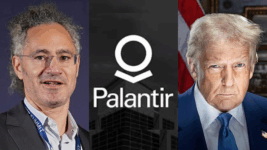
Palantir is an AI-powered software company that integrates databases to create ever more detailed profiles of systems and citizens. The company is the brainchild of US tech investor Peter Thiel and is headed by CEO Alex Karp. The company got up in 2003, due to major funding from the CIA. And Palantir is closely linked to the Trump White House, which is pushing for a Big Brother-esque system.
The platforms that Palantir has developed can integrate data silos to identify new connections and patterns about subjects. The Trump administration’s mass deportation drive utilises Palantir systems to track down migrants. The Israeli state has developed upon its AI tech to better murder Palestinians in Gaza. And increasingly, US government databases are being integrated into Palantir systems.
This growing threat to privacy and many more basic rights is already incorporating Australian data and details. The Australian Defence Department commenced using Palantir in 2011. Their systems are now used by multiple departments and private companies, such as Coles, and Crikey recently revealed US president Donald Trump is pushing to integrate the biometric details of Australians.
Karp, who’s long been blasé about the systems his company develops sometimes killing people, has recently released a 22-point manifesto about his vision for the future of the United States, which would involve merging private big tech firms and government.
So, whilst Orwell’s classic has long been considered prophetic, it didn’t identify the involvement of private corporations in creating the coming dystopian nightmare.
Big tech panopticon
Trump signed a 20 March 2025 executive order calling for the elimination of all data information silos, which means ensuring that different agency databases should share information both within departments and across them. And the order reflects the work that Palantir platforms do, and the systems are considered able to detect connections and patterns that humans are unlikely to.
Palantir has already integrated Department of Home Security databases and developed the ImmigrationOS platform, which uses AI and data mining to track undocumented immigrants. The New York Times reported in May 2025 that Palantir representatives were talking to the Social Security Administration and the Internal Revenue Service about investing in its data platforms.
The Times too reported that the idea of merging information silos to identify fresh data points is “no pipe dream”, as it was aware that the Trump administration had already sought hundreds of details about US citizens and others. And critics have been warning that such data points could be weaponised against migrants and those opposing Trump.
When Trump employed tech billionaire Elon Musk to head the Department of Government Efficiency, these databases are what the richest man in the world had access to. Some of Musk’s DOGE team were ex-Palantir. Musk and Thiel both headed PayPal circa 2000. They developed its fraud detecting system, and on selling the company they garnered enough to become wealthy investors.
Karp has denied that the company he fronts is mining US government databases in order to assist the Trump administration in surveilling the public. And as the Palantir CEO denied his company is creating a big tech panopticon, he also was waxing lyrical about the competition between the US and China in developing artificial intelligence, and this particularly involves AI military capabilities.
Our techno-authoritarian future
Karp and Palantir legal counsel Nicholas W Zamiska published a treatise in 2025 entitled The Technological Republic: Hard Power, Soft Belief and the Future of the West, which critiques the US tech industry, or Silicon Valley, as being too complacent in its progress and outlook, as well as calling it out for not doing enough to assist the United States, as well as its people and its allies.
In mid-April, Palantir posted a 22-point manifesto that comprised of the key concepts the Palantir vision entails. This includes Silicon Valley becoming more integrated into government, as big tech “owes a moral debt to the country that made its rise possible”. This should see big tech becoming involved in defence of the US, which would include developing AI military systems before others do.
Karp and Zamiska consider that the global community is leaving behind the atomic age, whereby nations were deterred from attacking others due to the threat of nuclear war, as the planet is entering a new stage of AI military deterrence. And as US power has led to an extraordinarily long period of global peace, it should be leading the way on AI-driven military deterrence.
Silicon Valley must play a role in dealing with violent crime. National conscription should be instated, so all citizens take part in the defence of the country. And point number 21 insists that not all cultures are equal and some are more so “dysfunctional and regressive”.
“The limits of soft power, of soaring rhetoric alone, have been exposed,” outlines point 4 of the Palantir manifesto. “The ability of free and democratic societies to prevail requires something more than moral appeal. It requires hard power, and hard power in this century will be built on software.”
So, whilst some have criticised Karp as a nutter for what is laid out in this manifesto, figures like Musk and Thiel are advocating for techno-authoritarian states, which would comprise of societies run by technocrats, business leaders and CEOs. Democratic rights would be curbed in this vision for the future, and technology would be employed to ensure they are stymied.
Donald Trump is watching you
Since Trump again came to power, Australia’s vassal state status in terms of the superpower has become ever more evident. This has been seen as compliant top federal ministers are now unable to comment on many international matters, as well as in the pressure the White House applied to local universities to stop diversity hiring and recognising more than two sexes or lose their funding.
The US announced last November that it was actively monitoring “migration crime” in this country and those of other allies, via its local embassies and consulates, while it came to light in March this year that they would also be launching propaganda campaigns to refute anti-US sentiment in Australia, while further proactively running pro-American campaigns in the local public sphere.
Palantir only became a widely known entity beyond the tech world when it was publicly listed in 2020. But Australian organisations have long been incorporating Palantir systems. Financial transaction monitor AUSTRAC has been using Palantir platforms since 2017, and the Australian Signals Directorate (ASD) began applying its systems in 2013.
Crikey has just exposed that the Trump administration is pushing for the Australian Home Affairs Department to provide access to the biometric data of local citizens and other people linked to Australia, so our nation can then become part of a visa free travel arrangement. And the site further explained that Australia’s sovereign wealth fund is heavily investing in Palantir.
Private Australian companies are also increasingly using Palantir to improve the running of their businesses. These include Coles, Westpac, Rio Tinto and Qantas.
And whilst these businesses likely don’t have a focus on building a surveillance state, the point is that details relating to regular Australians are being fed into a vast network of linked databases, and while the implications may not be so obvious, Trump’s desire for an all-pervasive surveillance system does seem to hint towards potential outcomes.

Paul Gregoire

Receive all of our articles weekly
Related Articles
 Trump’s Regime of Mass Surveillance, Targeting and Silencing: Coming to a Country Like Yours
 Governments Likely to Use Bondi Massacre to Justify AI-Powered Mass Surveillance
 Albanese’s Looming Deportation Drive Might Bring Trump’s Nightmare Home
 Surveillance State Subsumes Sydney School
 Surveillance State Grows Under the Cover of COVID
 A Creeping Surveillance State: An Interview With the Human Rights Law Centre’s Emily Howie