The Walumarra Legal Centre Is Open, Explains NSW Aboriginal Land Council Lawyer Daniel Byers

The New South Wales Aboriginal Land Council has announced the establishment of the Walumarra Legal Centre, which is a free and culturally informed service that will serve the network of 121 Local Aboriginal Land Rights Councils located in this state, and the development comes on the back of the NSW government having sought to legislatively undermine the state system of Aboriginal land rights.
Located on Dharug land at the NSWALC head officer on Argyle Street in Parramatta, the Walumarra Legal Centre has been providing specialist legal support since its official opening on 1 July 2026, and principal solicitor Amy Derrick, who heads the legal team, has been providing expert legal support in areas such as employment, property and commercial law.
“Aboriginal Land Rights were never intended to exist only on paper. They must be backed by practical support, strong institutions and real investment in our communities. Walumarra is part of that commitment,” said NSWALC chair Dr Raymond Kelly at the time that the pro bono legal centre was launched to the public.
“The NSW Aboriginal Land Rights Network has consistently told us that access to culturally informed legal support is critical. Walumarra is our response to that call.”
‘Walumarra’ is a Wiradjuri word meaning to protect, guard and stand guardian. This reflects the purpose and the vision of the new legal centre. And the recent NSW government proposal to weaken the framework of laws contained in the Aboriginal Land Rights Act 1983 (NSW) has revealed that there is a heightened need for this type of service to assist Local Aboriginal Land Councils.
Bad faith legislating
Introduced on the 17 March, the Crown Land Management Amendment (Statutory Review) Bill 2026 represented a stealth attack on the Aboriginal Land Rights Act 1983 (NSW), via amendments made to other pieces of NSW legislation. Indeed, the Minns government quietly introduced these laws disguised as minor administrative changes, without raising their proposed impact on land rights.
The NSW Aboriginal land rights system is the most robust in the country. It makes “unused and unneeded Crown land” claimable to Aboriginal land councils. Yet, The Australian reported in March that there are concerns that choice pieces of Sydney real estate are ending up in the hands of land councils, and other parties, including the state government, consider this to be a problem.
The properties that have caused consternation are the site of Paddington Bowls Club, the Talus Street Reserve, the site of the Northern Suburbs Tennis Club, along with the Cronulla Marina and the Matraville Fire Station. NSW land and property minister Steve Kamper has claimed that “vital and frequently used infrastructure” is being lost, and these successful land claims were made in error.
Yet, the attempt to change the law to prevent such handover in the future has come on the back of the High Court ruling last year that the then minister was right in determining that La Perouse Local Aboriginal Land Council did have the right to claim the site of the Paddington Bowls Club in 2021, despite CSKS Holdings having been granted a lease in 2010, as by 2016, the land had not been used.
Pro bono services
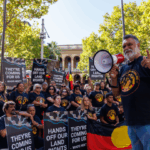
The NSW government’s attempt to quietly rein in the NSW land rights system did succeed in uniting the various Local Aboriginal Land Councils, however. Staff and members of the councils from across the state converged in Parramatta to hold a general meeting earlier this year, and they also staged a protest outside of NSW parliament. And these actions resulted in NSW Labor shelving the bill.
Sydney Criminal Lawyers spoke with NSWALC general counsel Daniel Byers about the need for the Walumarra Legal Centre and the reasons why it’s important that it is run in a culturally safe manner, while the lawyer further filled us in on what’s happening in respect of the Crown Land amendments and how the land council now considers the prospect of these laws that are on hold for the moment.
Daniel, the New South Wales Aboriginal Land Council has established a new pro bono legal service to serve the needs of this state’s Local Aboriginal Land Council Network and the communities linked to it.
The Walumarra Legal Centre will be servicing the needs of the communities that sit within the local Aboriginal Land Council areas.
So, what sorts of services will this free legal setup be providing to these communities? And why has the network determined that such a service is necessary now?
Local Aboriginal Land Councils play an integral role in the land rights system in NSW, advocating for the interests of Aboriginal people in their area and delivering a wide range of programs tailored to their community needs, spanning across caring for country programs, environmental management, social housing, cultural heritage protection, cultural burns, health and educational and training opportunities.
Before the opening of the Walumarra Legal Centre, the NSWALC legal team had already been providing accessible legal support to Local Aboriginal Land Councils across the state.
In fact, we delivered a pilot program that provided approximately 250 hours of free legal assistance over the 12 months prior to launching the legal centre to ensure the model we were developing was going to meet the needs of the network.
Through the pilot program, we saw the growing need for timely, accessible and culturally safe legal support and we knew there was an opportunity to establish something more dedicated and permanent.
That’s why the Walumarra Legal Centre came to fruition.
The Walumarra Legal Centre opened on 1 July 2026. The centre’s principal solicitor Amy Derrick notes that several cases have already been dealt with since then.
Can you talk about what sort of matters the legal service has been dealing with so far?
In the six weeks since the Walumarra Legal Centre officially opened on 1 July, the team has guided and advised over 40 Local Aboriginal Land Councils through various issues, such as leasing and property matters, employment matters, commercial arrangements, grant funding and general enquiries.
During this time, the team have taken every feasible measure to ensure this legal service is of a high quality, culturally led, timely and a means to genuinely move the needle for Aboriginal communities across NSW.
Can you discuss further why it’s important to ensure that the legal advice is culturally safe, and what sort of issues can arise if First Nations people don’t receive appropriate legal assistance?
Aboriginal people and Aboriginal community-controlled organisations (ACCOs) need to be able to engage with lawyers with confidence that their circumstances, culture and connection to community and Country are understood and respected.
We know that when clients feel that legal services are not culturally safe, people are less likely to seek advice early, may not fully engage with the legal services, or may not feel comfortable providing the information needed for a lawyer to properly understand their matter.
For Local Aboriginal Land Councils, in particular, that can mean legal issues are not addressed until they have become more complex or costly, or that opportunities to protect and advance the interests of their members and communities are missed.
Culturally informed legal support also recognises the impact that past and present experiences and traumas can have on whether, and when, Aboriginal people feel comfortable seeking legal assistance.
Early access to appropriate legal support can be critical in addressing issues before they escalate and, ultimately, achieve better outcomes.
Culturally informed legal support also recognises the unique challenges and experiences of Aboriginal people in this country and understands that these can differ significantly from those experienced by non-Aboriginal people.
The Walumarra Legal Centre opened about four months after the NSW Minns government tabled the Crown Land Management Amendment Bill 2026, that were presented in such a way, as to conceal their purpose, which was to erode the Aboriginal land rights system in this state.
This was due to several choice pieces of real estate having come under Aboriginal Land Council control. This caused the LALC network to unite to pushback against these proposals, and this stalled the changes.
So, how is this matter progressing at present?
The Crown Land Management Amendment Bill 2026 was introduced on 17 March this year without prior consultation with those most directly impacted by the proposed changes: Aboriginal Land Councils and communities.
While the NSW government claims the bill was introduced purely to reduce edge cases or minor technicalities, we know this is not the case.
Aboriginal land rights and community assets are not competing objectives, and they never have been.
Indeed, we often see that formerly disused or underutilised Crown land is activated for community purposes once transferred to Local Aboriginal Land Councils.
Since the bill’s introduction, NSWALC and the wider Aboriginal Land Rights Network have continued a united, staunch opposition to protect land rights not only for communities now, but for future generations.
And lastly, Daniel, the NSW LALC network and the system of Aboriginal land rights law in this state has come under legislative attack, which resulted in uniting the network.
So, does the NSWALC expect that NSW Labor will pull back on its undermining of Aboriginal land rights, or is the peak body gearing up for a period of ongoing struggle as the state appears determined to steal back its past gains?
So far, we have submitted a formal complaint to the Human Rights Commission and paused participation in the National Agreement on Closing the Gap.
These actions, I believe, not only highlighted the inherent problems with the bill, but also challenged the common underestimation of Aboriginal leadership, advocacy and bravery.
NSWALC deputy chairperson, Leeanne Hampton, put it well: “We are done being a political football.”
The future of this bill remains uncertain. But one thing we have secured is the right to be heard.
Through the protests and demands for meaningful consultation, the Land Rights Network have been able to put their concerns, needs and aspirations directly to government and advocated for changes that protect the rights and interests of Aboriginal Land Councils and communities.
Image of the NSW Aboriginal Land Rights Council demonstration against the Minns government attempts to weaken local land rights on Gadigal land in Sydney in May 2026 supplied by NSWALC

Paul Gregoire

Receive all of our articles weekly
Related Articles
 NSW Aboriginal Land Council Lodges Discrimination Complaint Against Minns Government
 Cuts to Legal Aid NT Adult Services Will Disproportionately Impact First Peoples
 NT Law-and-Order Drive Forbodes Landgrab, Says Justice Not Jails Stephen Enciso
 Court Ruling Proves Land Grants Covering Wiradjuri Are Illegal: Interview With Uncle Paul Towney
 The Constitution “Has Never Been Part of Our Law”: Aboriginal Tent Embassy’s Jessica Savage on the Voice
 Aboriginal Tent Embassy Sydney Is Raising the Unfinished Business of Sovereignty