“A Blunt Tool”: NSW Court Quashes Government’s Blanket Ban on Protest Marches
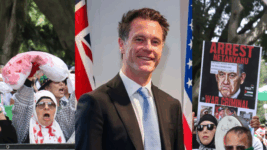
Three justices of the New South Wales Court of Appeal struck down the Minns government’s law enabling the blanket banning of protest marches on Thursday, 17 April 2026, describing the law as a “blunt tool”. And as activist groups and a stella legal team saw the unconstitutional regime torn down, the analogy of a blunt tool certainly lent itself to many aspects of how NSW is being governed.
Known as the public assembly restriction declaration law, or by the unfortunate acronym of PARD, NSW Labor passed these laws, which allowed the NSW police commissioner to declare large sections of Greater Sydney subject to a ban on protest marches for up to 3 months after an incident has been declared terror-related, as a kneejerk reaction to the Bondi Beach massacre last Christmas.
Activist organisations, The Blak Caucus, Palestine Action Group and Jews Against the Occupation ’48, raised the legal challenge against the law they considered unconstitutional, with the case being put by criminal defence lawyer Nick Hanna, argued by barrister Felicity Graham and strongly supported by NSW Council for Civil Liberties president Timothy Roberts and NSW Greens MLC Sue Higginson.
The PARD law and its repeal have too caused a gigantic grey area. This involves the fact that 3,000 NSW police officers unleashed brute force upon 20,000 protesters gathered on Gadigal land before Sydney Town Hall. This occurred because the people had sought to march in defiance of an unconstitutionally imposed PARD and top ministers have refused to apologise for the state violence.
This murky pit of state-sanctioned violence further involves the brutalised constituents having been protesting the official state visit of Israeli president Isaac Herzog, in concurrence with a two-year-long demonisation campaign against civilians actively calling for an end to Israel’s genocide in the Gaza Strip, which is being progressed by certain NSW officials, and primarily, NSW premier Chris Minns.
Not so sharp
Minns “was told by everyone that these laws were unconstitutional. He rammed them through anyway, in a bloody-minded, undemocratic way, and then unleashed the most shocking scenes of police brutality that we have seen in decades”, Palestine Action Group spokesperson Josh Lees told the press directly following the handing down of the ruling.
The activist further declared that Minns “needs to resign”.
The 14 December 2025 Bondi Beach massacre was perpetrated by two ISIS-inspired killers, who targeted a Jewish religious event, murdering 15 people. This devastated the state. Yet, the premier then made public statements accusing the organisers of the Palestine solidarity demonstrations as “unleashing forces that they can’t control” that had contributed to the terror attack.
“For two and a half years, we have been protesting to stop the ongoing genocide in Gaza, the endless wars waged by Israel and the United States and supported down the line by our government, which have slaughtered hundreds of thousands of people… and all along, instead of standing with us, our government has tried to crackdown on our right to protest,” added Lees in a further statement.
The NSW premier has told the press in the wake his law being struck down that he doesn’t “regret moving that legislation at all”, as introducing amendments, like the PARD law, is “tricky” due to “a necessary infringement on constitutional principles” that is involved in such lawmaking.
In an apparent reference to the incident involving police violence delivered to Herzog protesters, Minns said he wasn’t denying “there weren’t clashes”. The NSW premier then further insisted that “there are other constitutional principles, the right of individual citizens to go about living their life free of intimidation, persecution or violence”, which had also been involved in his failed law regime.
And Lees further added on Thursday, that Chris Minns has been at the forefront of ongoing attempts to erode the right to protest in this state. “He’s passed law after law after law, trying to ban protests against a genocide in this state – that is his legacy. And today, he’s been defeated yet again, in his attempts to ban protests in this state.”
An unconstitutional regime
The PARD law was rushed through during emergency sitting days of NSW parliament in response to the Bondi massacre held right before Christmas. This included passing gun reforms, and regardless of agreeance with those measures, there were at least legitimate questions raised around the need for gun law reform, after a mass shooting that involved a huge arsenal of legally acquired weapons.
But a law enabling blanket bans on protest marches in the wake of a mass shooting wasn’t so obvious. The major link appeared to be the hocus-pocus-esque suggestion of the premier that pro-Palestinian protest organisers had been “unleashing forces” directly contributing to the targeting of the Jewish event. But a quick Google search reveals the Palestinian cause has nothing to do with ISIS.
NSW police commissioner Mal Lanyon then imposed a PARD across Gadigal land in the NSW Police Central Metropolitan Region, on Dharug land in the North West Region and on Dharawal, Dharug and Gundungurra land in the South West Region on Christmas Eve 2025: the same day the laws took effect. And the top cop was then required to decide on whether to revoke the ban every 14 days.
This meant that the Form 1 process was suspended across these regions. The Form 1 process involves civilians organising a protest march submitting a notification to the NSW police commissioner outlining its details, and if no objection is made, the procession has been authorised, and regular road obstruction summary offences do not apply to those marching.
Stationary protests were permitted to continue under a PARD. But the laws also involved a move on power, which entailed police having the ability to move on public assemblies that were in a PARD zone but weren’t marching if they were found to be obstructing other people. This additional law was too extremely controversial as move on powers are specifically banned in relation to protests.
NSW Chief Justice Andrew Bell and Justices Julie Ward and Stephen Free agreed with the contention of the three activist groups, that the PARD law infringed upon the implied right to freedom of political communication contained in the Australian Constitution, because the law imposed a clear burden on the right within the PARD zone, and therefore, it was unconstitutional and illegitimate.
As Lees reminded the public on Thursday, this is the second time in six months that the highest court in NSW has struck down a Minns-enacted antiprotest law found to be unconstitutional. The first time involved a move on power relating to protests near places of worship, which was again directly linked to a police violence incident that saw a senior police officer assault legal advisor Hannah Thomas.
Pissing on social cohesion
“As a community we should be deeply concerned about the antidemocratic attitude of the Minns government,” said NSW Council for Civil Liberties president Timothy Roberts. “The premier has proven he cannot be trusted with our democratic freedoms, but the responsibility for his unconstitutional grab for power does not end with him.”
“Ministers Penny Sharpe, Jihad Dib, David Harris and Paul Scully, all gave evidence in budget estimates this year putting on the record their individual and united cabinet support for the abhorrent laws,” the respected lawyer added, just for good measure.
“They should be united in receiving our condemnation for undermining the democracy that put them in power.”
The NSWCCL further posits that the Minns government and the NSW police “have knowingly wielded unconstitutional powers to harass and silence citizens protesting peacefully”. And the council has repeatedly underscored during this period that the state had illegitimately placed “unprecedented authority” upon the NSW police commissioner to wield political powers without any oversight.
The Council for Civil Liberties also explained that the Form 1 process that the Minns government determined should be shut down over certain periods, was originally designed to establish lines of communications between civil society organisations and law enforcement. And the government predicated its “repressive agenda” on the “horrifying attack against the Jewish community in Bondi”.
“It is beyond time for the NSW Labor parliamentary caucus to renew its leadership and hold those to account who abused their position to damage our democratic institutions at a time when we need them to be at their strongest and most trustworthy,” concluded Roberts.
Paul Gregoire
Receive all of our articles weekly
Related Articles
 The Blanket Ban on Protests in NSW Has Been Lifted, But the Damage Has Been Done
 NSW Government’s Blanket Protest Ban: A Massive Gifting Away of Our Basic Rights for Xmas
 NSW Police Bash and Brutalise Herzog Protesters into Submission
 Protesters Be Wary: The NSW Premier Is Launching a 24/7 Police State with Rifles
 NSW Protest Ban Extended for Genocidal Israeli President’s Visit
 NSW Police Commissioner Refuses to Apologise for Unprecedented Brutality