AUKUS Nations Are Increasingly Framing Leftwing Activists as Terrorists
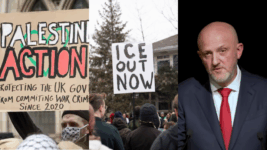
The charging of more than a dozen leftwing protesters with terrorism offences in the United States and the sentencing of eight of them to a combined 450 years’ imprisonment on 23 June 2026, marked a significant step in the shift to framing activists as terrorists. The US protesters were convicted over a 4 July 2025 action that targeted Texas’ Prairieland Detention Centre and turned ugly.
The US development came on the back of four Palestine Action activists in the United Kingdom, who’d taken part in an August 2024 direct action that targeted an Elbit Systems weapons facility and also turned ugly, being sentenced as terrorists in the British courts on 12 June 2026.
Sydney Criminal Lawyers has been aware for some time that activists in Naarm-Melbourne have been raided by terrorism police in relation to some rather elaborate protest actions over 2026.
And this use of counterterror police on activists in Victoria, coupled with other reports that riot police had raided a leftwing activist in New South Wales, started to take on starker relief, when a Woolwich Crown Court judge in the UK recently determined the Elbit Systems action was terrorist-related and therefore, the participants convicted in relation to it, should be sentenced as such.
The initial charging of two members of the Prairieland Detention Centre protest as terrorists occurred last October, and this was only a month after US president Donald Trump had signed an executive order declaring ‘antifa’, a loose network of leftwing activists, to be a terrorist organisation, while this too followed the UK having listed Palestine Action as a terrorist group in July 2025.
And whilst the initial idea that this shifting approach could be afoot in Australia had only been based on state police forces having taken an intensified interest in pro-Palestinian/leftwing activists, the fact that ASIO boss Mike Burgess included “far-left activists”, alongside neo-Nazis and Islamic extremists, in his 2026 annual threat assessment tends to further suggest a shift underway.
Antifascists as terrorists
Antifa is short for antifascist. Antifa groups commenced mobilising in the 1930s in response to the Nazis in Germany and Italy’s fascists. But there is no specific antifa organisation. Protesting under the banner of antifa is like proclaiming one is leftwing. So, when Trump designated antifa as a terror group, it was a convenient way to frame leftwing activists as terrorists when the circumstances suit.
The Prairieland Detention Centre is an ICE (US Immigration and Customs Enforcement) facility where undocumented migrants are being detained prior to being deported under Trump’s mass deportation regime that began in January 2025. So, those involved in the demonstration that has been classified as a terrorist action were protesting the system that is tearing apart American communities.
The main thrust of the late-night demonstration in Texas was to set off fireworks outside the facility to communicate with the detainees via the noise. However, this being the United States, some of those involved in the direct action legally brought lawfully acquired firearms along for protection and when a police officer drew his weapon, one protester shot the lieutenant in the shoulder.
The key charges laid commonly against most of the activists were providing material support for terrorists and riot.
Benjamin Song was considered the ringleader of the “antifa cell”. He suggested bringing the firearms and the ex-US marine reservist shot the officer. Song claims he shot the cop as he was going to shoot a protester, and the officer admitted he’d had his gun pointed at the back of an activist running away at the time. Song was sentenced to 100 years over crimes that included attempted murder.
Maricela Rueda was sentenced to 70 years over riot, conspiracy to use explosives and to conceal documents. Five further activists were sentenced to 50 years last week. But the sentence that’s caused the most disturbance was the 30 years given to Daniel Rolando Sanchez-Estrada, who was not at the protest, but moved a box of leftwing zines on request of his wife Rueda after the fact.
Seven more Prairieland Detention Centre protesters were sentenced on 1 July to lessor periods inside, ranging from 22 months to 15 years, with one extreme 50 year sentence having been laid on Wednesday as well.
Civil liberties advocates in the States are warning that these court outcomes may have set a precedent for how protests and direct actions may be treated by the courts in the future.
Anarchy in the UK
A violent act or property damage is considered an act of terrorism and not a simple crime, when it is has been committed with the intent to threaten the government or intimidate the public in order to advance a political, ideological or religious cause. Due to the particular motivations behind terrorism, these acts receive heightened and much harsher sentences than regular crime.
Known as the Filton 4, the UK protesters sentenced as terrorists last month over a direct action nearby Bristol, had only been tried by a jury under criminal offences. But due to a special law not available in this country, the judge was able to determine after conviction that their acts had a “terrorism connection” and this then warranted much longer sentences than would be expected.
These Palestine Action activists conducted their action prior to the government declaring their group a terrorist organisation. In fact, the almost £1.2 million-worth of damage to over 40 drones and other weapons that the four protesters caused at the Israeli arms weapons manufacturer Elbit Systems facility near the UK city of Bristol was part of the reasoning behind the terrorism designation.
This protest had too taken a dark turn, when 23-year-old Samuel Corner struck UK police sergeant Kate Evans with a sledgehammer. Corner was sentenced to 7 years and 8 months for property damage and another count of grievous bodily harm. The younger of the three co-offenders received 4 years and 8 months prison time, whilst the two others each received 5 years.
These sentences are much lesser periods in prison than their US counterparts received last week. However, the UK sentences were still considered extreme due to the crimes committed and the motivations behind them. And this case again involved the framing of leftwing activists taking protest action as terrorists.
Shifting gears down under
Courts in AUKUS nations – Australia, the UK and the US – have traditionally treated protest-related property damage and other crimes that don’t include violence to a person with a degree of tolerance to protect basic rights, like the right to protest and the freedom of political communication, in these democratic societies. However, these recent US and UK cases reverse this position.
Besides counterterrorism police in Victoria investigating and raiding nonviolent protesters, there have been other signs that Australian authorities are taking a harder line towards leftwing activism. This has been seen in particular with the Crisafulli government in Queensland having outlawed specific political slogans and then arresting activists in relation to uttering these words.
The first wave of taking a hasher approach to leftwing protests occurred in April 2022, when the NSW major parties enacted laws that can see activists who obstruct major facilities, roads, tunnels or bridges sentenced to up to 2 years in prison. Similar harsh laws aimed at silencing dissent and tailored to suit their jurisdictions were then passed in Tasmania, Victoria and South Australia.
The initial wave of repressions had been focused on climate defenders, and it had attempted to frame them as serious criminals. But the recent shift in approach relating to activists across AUKUS nations has rather been focused on the massive rise in pro-Palestinian activism, which has made it difficult for Israel to quietly continue its genocide in Gaza.
And whilst no serious case involving a direct action and violence has transpired here, the framing of pro-Palestinian – and in turn, leftwing – activists as potential threats to national security has been key prior to any sentencing taking place overseas, and it would appear that local authorities are shifting public perception in regard to leftwing activism, so that it appears more terroristic in nature.
The clearest sign of this of late has been ASIO’s annual threat assessment 2026, which this year involved director general Mike Burgess lumping “anarchists and revolutionary groups” or “far-left activists” into the same national security threat basket as neo-Nazis, Islamic extremists, issue-motivated extremists and hostile nation-states, as they’re all evidently united via antisemitism.
“Anarchists and revolutionary groups can be antisemitic,” Burgess said, during his 24 June 2026 address. “This gets surprisingly little media coverage, but Australian companies with perceived links to Israel are being subjected to repeated acts of vandalism and arson by far-left activists.”
“I recognise criticism of the government of Israel is not of itself antisemitic,” the top spy added somewhat ominously, “but some of the threatening statements made by the perpetrators go well beyond political protest or commentary.”
Main image: Photos of US ICE demonstrators and a UK Palestine Action demonstrator from Shutterstock. Mike Burgess by Australian Security Intelligence Organisation is licensed under CC BY 3.0
Shutterstock IDs 2723773633 and 2650101111
Paul Gregoire

Receive all of our articles weekly
Related Articles
 “Far-Left Activists”, Antisemitism and Expanding Powers All Featured in ASIO’s Threat Assessment
 Counterterror Police Are Increasingly Dawn Raiding Pro-Palestinian Activists
 NSW Police to Continue Raiding Herzog Protesters to Sully Police Watchdog Inquiry
 NSW Police Are Raiding, Arresting and Charging the Herzog Protesters They Assaulted
 Protesters Be Wary: The NSW Premier Is Launching a 24/7 Police State with Rifles
 The Demonisation of Antiwar Activists Is Afoot, Explains Wage Peace’s Margaret Pestorius