Breaking the Wall of Silence: Shoebridge on the Inaugural International Parliamentarians for West Papua Meet in Canberra
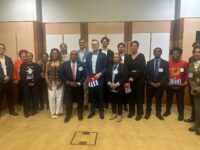
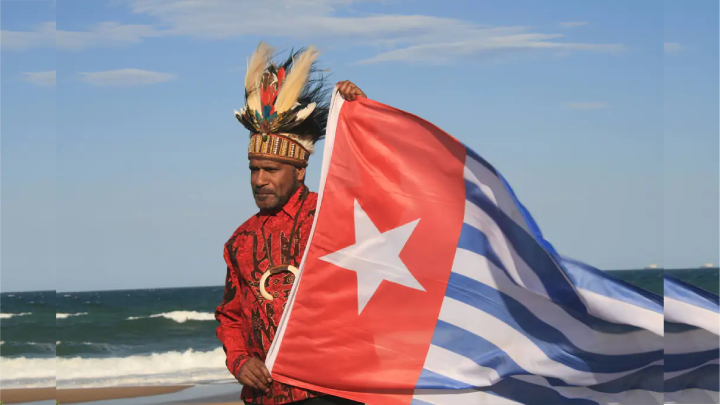
Australian Greens Senator David Shoebridge hosted the inaugural meeting of the Australian chapter of International Parliamentarians for West Papua on Ngunnawal and Ngambri land in Australian Parliament House in Canberra on 17 August 2026, with a delegation present that included United Liberation Movement for West Papua (ULMWP) president Benny Wenda, who was in from London.
Wenda and the rest of the West Papuan delegation from Naarm-Melbourne told members of the Australian Greens, federal Labor and the Coalition about the 60-odd years of Indonesian occupation that the West Papuan people have and continue to endure. And the ULMWP president called on parliamentarians to put pressure on the Australian government to take action.
Young West Papuan student voices further gave testimony about the ongoing displacement and murder of West Papuan villages in the highlands, due to Indonesian military aerial attacks. There are currently about 122,900 displaced locals, as a result of the ongoing attacks that have targeted people living in various regencies and commenced in Nduga, under the Jokowi government, in 2018.
These attacks on highland villages have been intensifying exponentially under the October 2024-installed government of Indonesian president Prabowo Subianto, who earned himself the reputation of being a murderous butcher-like war criminal, when he was a general leading Indonesian forces in East Timor and West Papua back in the Suharto era.
The United Nations gave Jakarta temporary administrative control over West Papua in 1963, as the former Netherlands colonisers were leaving the region, which was based on the proviso that the West Papuan people be granted the right to vote upon their own statehood later down the track. But a rigged vote was staged in 1969, which guaranteed that West Papua remained in Jakarta’s control.
“Happening to neighbours”
Shoebridge told the meeting that it was all about “truth-telling”. The Greens senator further explained that despite the good relationship that Australia maintains with Indonesia, it’s the duty of good friends to raise issue when the other has failed, especially in the area of human rights. And he underscored that West Papuans have a right to control their own destiny.
The recent meeting was made all the more vital by the fact that the Prabowo government has embarked upon the largest deforestation project on the planet. This is the Merauke Integrated Food and Energy Estate Megaproject, located in South Papua province, and it is set to unleash stark environmental and economic damage upon the entire Melanesian region.
Sydney Criminal Lawyers spoke to Australian Greens Senator David Shoebridge about the lack of acknowledgement in respect of the plight of the West Papuan people on the part of Canberra, and the need for our government to broach the subject of the occupation with Jakarta during its diplomatic dealings with a nation that it is vital this country continues its good relationship with.
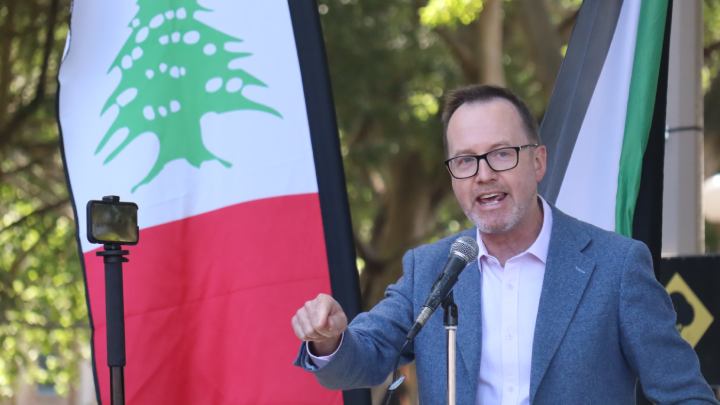
David, the Australian chapter of International Parliamentarians for West Papua held its first public meeting on Monday 17th August at Parliament House in Canberra. You hosted it.
So, can you tell us about the organisation and what the meeting involved?
This is a genuinely international grouping of politicians from democratic countries, who are consciously forming a global alliance to support basic freedom in West Papua.
This meeting of the IPWP in the national capital was the first time that we’ve had West Papuan leaders and members of the West Papuan diaspora inside Australian Parliament House to speak the truth about what’s occurring.
When you hear directly from West Papuans who have experienced military violence, dispossession and ecocide, and you realise that this is a human rights crisis literally on Australia’s doorstep, it’s hard to explain the decades of silence.
This is trying to break through those walls of silence, so that the Australia parliament and the Australian people can show solidarity with the struggle in West Papua.
So, this was seriously the first time that a delegation has been to Parliament House in Canberra to speak about the plight of the West Papuan people?
Yes. This was the first time a formal meeting took place within Australian Parliament House, with West Papuan leaders and members of the West Papuan diaspora, speaking directly to parliamentarians.
Of course, we would have always wanted more parliamentarians in the room. We did have representation from the Greens, and we also had a Labor MP and a Coalition MP in attendance, and this was also an important milestone.
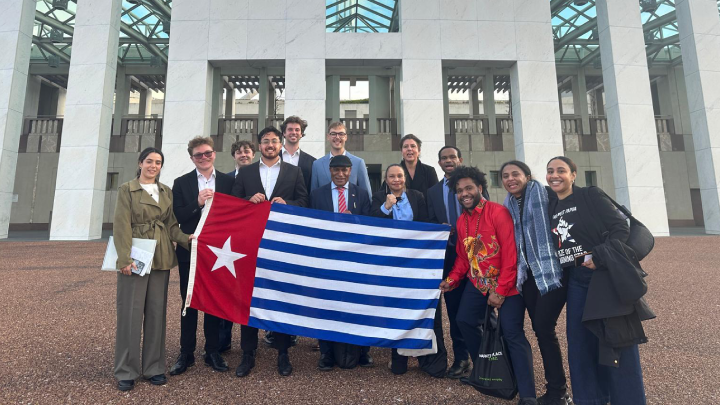
A West Papuan delegation from Melbourne and London attended the meeting last week. This included the presence of United Liberation Movement for West Papua president Benny Wenda.
So, what did members of the West Papuan delegation tell you about the plight of the West Papuan people at present?
There have been repeated reports coming from West Papua about the nature of Indonesian state violence directed against West Papuans and the economic and political drivers behind that.
What we heard in Canberra was the human story: young West Papuans who’d seen their village destroyed, the army helicopters arriving, the displacement.
We heard directly about the scale of the ecocide, the deforestation and the climate impacts. We heard that directly from West Papuans – that had a distinct power to it.
This wasn’t being filtered through the media. This was the lived experience of our closest neighbours.
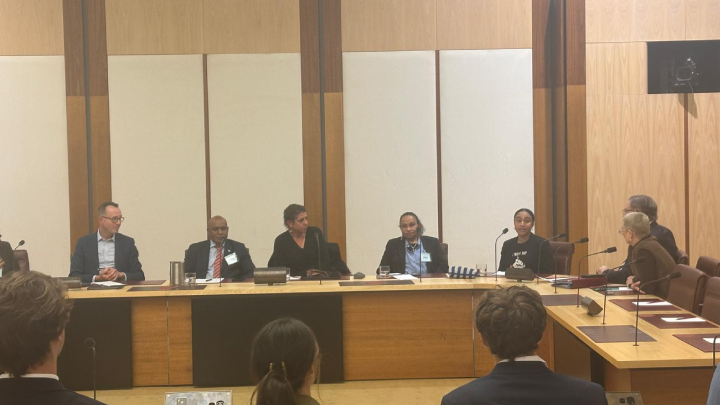
The meeting in your office took place in the wake of our prime minister having signed the Australia–Indonesia Treaty on Common Security, also known as the Jakarta Treaty, on 6 February this year. This arrangement seeks to establish greater defence and investment cooperation between the two nations.
These developments, along with a long list of earlier such diplomatic dealings, took place without any mention of West Papua. However, Benny considers that this country, being the largest in the Pacific, has a moral obligation to safeguard West Papuans.
So, what are your thoughts on how the Australian government should be approaching West Papua in its diplomatic dealings with Jakarta?
It’s extraordinary how successive Australian governments have refused to look at what is occurring in West Papua and have also refused to take any significant action to support the rights of West Papuan people to live a life where they can celebrate their culture, speak their languages and be free from oppression.
This is a basic fundamental human right. There was a moment in 2019, when Australia together with 100 other nations around the world called for Indonesia to allow a UN human rights inspector into West Papua.
But there has been no action since 2019, and no pressure coming from Australia to allow that inspection to occur.
The Greens believe fundamentally that Australia and Indonesia should be good and close friends. We have a shared geographic destiny, and it is important that there be collaboration, but that can’t be collaboration at any cost.
Good friends tell each other hard truths. That has been missing in the Australia-Indonesia dialogues that have focused so much on external security threats and the perceived threats of China, while failing to even reference the human rights struggle that’s occurring in West Papua.
The Indonesian government has embarked upon the largest deforestation project on the planet, which is the Merauke Integrated Food and Energy Estate Megaproject. This commenced in 2024 and it will produce sugarcane, rice, palm oil and other products.
This is occurring at a time when the planet is in climate crisis, and the West Papuan people have produced their own Green State Vision policy, which seeks to preserve their wilderness and that of the planet.
So, how do you consider this development appearing at this point in time? And what will it mean for the West Papuan people?
There is a climate bomb about to be set off in the middle of West Papua, with 1.2 million hectares of ancient virgin forest being cleared, which will release something in the order of 800 million tonnes of carbon dioxide unless it is stopped.
To Australia’s great shame, we have been silent about the climate risks of that. And of course, for the people on the ground in West Papua, the ecocide, the displacement and the cultural and economic destruction that is associated with that, is on an appalling scale.
When you look at what Australia has done in the face of this proposed project, we’ve seen Australian investment through the CSIRO and Australian government science grants.
So, we’ve not been part of the solution but part of the problem, as we’ve been investing in pest resistant cane sugar that makes part of this project economically viable.
We are still waiting for answers from the government on how it allowed public money to be used to make this extraordinary attack on both rights and the environment economically viable.
From the perspective of a Greens Senator, and just from the perspective of an Australian citizen, I can’t understand how we allowed Australian public money to subsidise this damage.
And lastly, David, under current Indonesian president Subianto Prabowo, Indonesian military assaults on West Papuan villages have been escalating and as we’ve just noted, the largest deforestation project on the planet is well underway.
So, what sort of immediate steps could the Australian government and others be taking to assist in the turning around of this situation? And what would you say regular people in this country could be doing to assist in the plight of the West Papuans?
I’d say to Australians, get informed and find out what’s happening. The distance between Australia and West Papua is about 250 kilometres, so it is closer than the drive from Sydney to Canberra.
This is happening to our neighbours in our neighbourhood.
The wall of silence from the Australian government also shields active complicity. Australia has a sordid history of training Indonesian military units that are then sent into West Papua to engage in violence and displacement.
The latest security treaty between Indonesia and Australia threatens to continue down that deeply unprincipled path.
These are things that Australia can fix. I urge Australia to yes be calling on Indonesia to show respect for the people of West Papua, but also to call on Australia, as the largest state in the Pacific, to start matching our actions with what I consider to be the Australian values of human rights and decency.
Main image of International Parliamentarians for West Papua Australia chapter meeting supplied by the United Liberation Movement of West Papua

Paul Gregoire

Receive all of our articles weekly
Related Articles
 Indonesian Government Enters a New Phase in the Occupation of West Papua
 The West Papuan Legislative Council Has Held Its Inaugural Meeting in Jayapura
 Benny Wenda Demands End to Indonesia’s Genocidal Attacks in West Papuan Highlands
  West Papua’s “Mandela” Filep Karma Dies Under Mysterious Circumstances
 Canberra Abandons West Papua at Jakarta War Talks: An Interview With AWPA’s Joe Collins
 Wenda Confirms West Papua is Readying to Gain Independence from an Indonesia in Chaos