Disrupting the Largest Ever Coal Mine Extension Presser: Interview with Rising Tide’s Zack Schofield
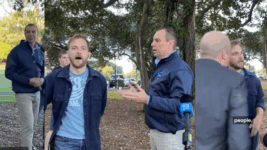
Having watched in horror the mudslide tsunami crashing down a valley from Tibet into Nepal on 26 August 2026, it was quite a shock to read the subject line of NSW Greens MLC Sue Higginson’s 30 September email that read, “Largest coal mine ever in NSW Approved”. And then on viewing Rising Tide’s Zack Schofield’s disruption of the presser announcing the deal, his actions made perfect sense.
Schofield was forthright in his approach of the press conference held on Gadigal land at New South Wales Parliament House in Sydney. The veteran activist confronted Minerals Council of NSW CEO Stephen Galilee over his seeming jubilation regarding the Hunter Valley Operation coal mine extension, which is the state’s largest ever, being progressed as the climate crisis is accelerating.
Zack explained to Galilee that he’s a young person from Newcastle, and he questioned how a coal mine extension might be something to celebrate when the prediction is that half a million people are set to die globally this summer due to the excessive heat of the heightened El Niño cycle. And the Rising Tide member further condemned the CEO as not having the region’s best interests at heart.
Galilee told Zack that he didn’t have to make his point because the activist’s “aggressive” behaviour was making it for him. But that doesn’t seem to add up these days, when you factor in that it’s the children of the day, the kids of regular mums and dads, that are looking forward to a hellscape future of which the Minerals Council of NSW, and other types like it, are heavily investing in at present.
These days it’s normal to scroll through a social media feed and see footage of cities across the planet with rivers cascading down main roads or hills surrounding urban areas set ablaze, so Schofield’s raised voice making strong statements about collapsing weather systems is really a rather tame crime in comparison.
The 2019-20 Black Summer bushfires saw more than 20 percent of mainland forest burn to the ground. At that time the key climate goal was to cut emissions to net zero by 2050 to prevent temperatures rising above 1.5°C, which has since been breached periodically. And warnings back then about rising by 3°C by 2090, now consist of warnings of a potential rise of 3°C by 2050.
Sydney Criminal Lawyers spoke to Rising Tide’s Zack Schofield about why he was so forthright in his disruption of the Minerals Council of NSW press conference about the largest ever coal mine expansion in NSW history, that over the last half decade the figures regarding climate thresholds have dramatically been brought forward and that runaway climate change is already upon us.
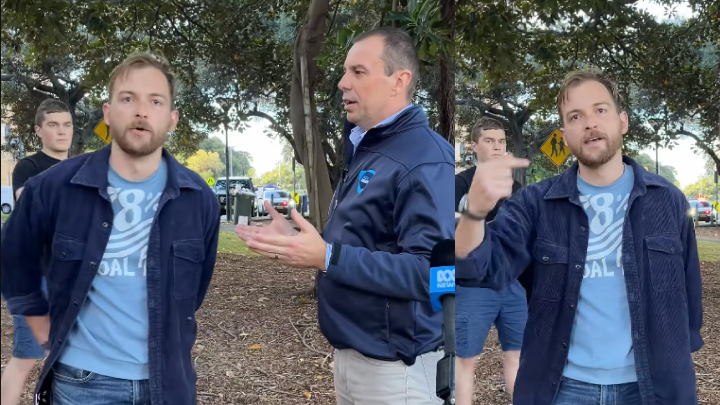
Zack, you disrupted a 30 September 2026 press conference being given by Minerals Council of NSW chief executive Stephen Galilee, as he was announcing the approval of the Hunter Valley Operation coal mine extension, which is the state’s largest ever such extension.
Your approach to the disruption was quite assertive and it revealed a person quite sure of the position they were putting.
So, can you explain why you disrupted this press conference? And what was the significance of the announcement?
I disrupted a man called Stephen Galilee. Stephen is the CEO of the Minerals Council of NSW, which is the peak mining body in this state. And I usually deal with issues that concern NSW, because I’m originally from the Hunter, and specifically, Newcastle.
I am from Rising Tide, which is based in Newcastle, as the local coal port is the largest in the world.
We export about 1 percent of total global carbon emissions. So, we have a massively outsized impact on the global climate crisis.
The reason I disrupted Galilee, who makes his money from convincing governments to approve new coal and gas projects, is because the NSW government has approved the single largest coal expansion in the history of the state.
This is the Hunter Valley Operation coal mine expansion, which is owned by US company Glencore and Chinese-owned Yancoal.
The significance of undermining this particular press conference is that for so long in this state, people who represent the coal and gas lobby have had free range to essentially dictate our government’s climate policy.
This is particularly since Chris Minns came to power, as he has declared himself publicly as a Labor party premier who is specifically pro-coal and gas. Minns wants to open more coal mines.
We don’t believe that men who choose their own profits over our generation’s lives deserve peace, frankly.
They certainly don’t deserve the chance to celebrate their wins without disruption, because the wins of the coal and gas industry come at the expense of every living thing on this planet.
This is particularly so, in terms of those of us who are too young to have the institutional power that they can purchase from our politicians, like Chris Minns.
I learnt of the coal mine extension approval on the same day when NSW Greens MLC Sue Higginson sent out an email announcing that under the Minns government, the largest coal mine expansion project ever proposed in NSW had been greenlighted.
This seems quite an outrageous development considering what we have been witnessing around the world in terms of extreme weather events.
You’re a member of Rising Tide. How is the broader climate movement taking this development? And how can the Minns government be making such unprecedented fossil fuel decisions at this point in time?
The expansion of this mine means digging coal at the north mine site until at least 2045 and at least until 2042 at the south mine. What this means is that NSW Labor is entirely captured by corporate interests.
NSW Labor has no compunction about that really. The movement sees this as a clear piece of evidence to support that. The fact is that the Labor party was supposedly elected on a climate mandate.
There is one last opportunity for the federal Labor climate minister to disallow this extension going ahead, which would be based upon Environment Protection and Biodiversity Conservation Act 1999 (Cth) (EPBC Act) requirements.
If federal Labor continues to just wave this through, we will have the most unequivocal evidence possible that the Labor party at the moment – we know it’s a rightwing party, we know it is a pro-corporate party – but we will now know that it is a complete climate denying party.
This is not particularly surprising to us because under Albanese, the Australian government has approved more coal and gas projects than Scott Morrson ever did.
This was the infamous climate denying Liberal prime minister, Scott Morrison, that Albanese thrashed in the so-called climate election.
The movement is seeing the writing on the wall. We understand that the government needs to be replaced, not made better.
So, it’s really promising that on the same day that this coal mine extension was announced, Senator David Shoebridge took the leadership position in the Greens.
Shoebridge then said clearly, on the very same spot where I disrupted Galilee several hours later, that the Greens party plans to replace Labor, and not to attempt to make them better.
That is an attitude that the whole progressive movement needs to take to heart.
As noted, the Hunter Valley Operation coal mine extension is shocking as one would expect the NSW government to be acting otherwise in the face of rising climate hazards.
So, how would you say this development compares to the fossil fuel industry in other parts of the country? Is the NSW development an anomaly, or are other such approvals taking place elsewhere?
The two main campaigns being run by the broader climate movement relate to offshore gas drilling off Western Australia in the Browse project area.
Of course, Western Australia is a Labor controlled state captured by the fossil fuel industry. Roger Cook, the WA premier, was one of the key protagonists in pressuring Albanese not to go ahead with the Greens-supported changes to the EPBC Act, which were amendments that would have made it easier to disapprove coal and gas projects.
And in the Northern Territory, a completely beleaguered Territory under the thumb of gas companies in particular, is moving towards massive fracking expansion, which is supported by Labor.
These projects have huge amounts of momentum behind them and so much money invested into them.
The money that is gained by those gas corporations is then reinvested into purchasing politicians, whether through direct donations, or through the constant revolving door of former resource ministers going straight into gas lobbying jobs. We have seen that happen in the Northern Territory.
So, it’s a very good business model if you purchase a politician or you purchase a policy, which gives your company unrestricted rights to destroy the planet for profit. That happens all the time under the Labor governments that we see across Australia.
You have this under the Liberal governments as well. However, it is particularly galling to see a supposedly leftwing, proworker party, who have control of most of the nation’s major jurisdictions, not only waving through these projects, but doing it proudly.
As I said when I disrupted Stephen, the Hunter is an important place. It is an important place to me. I grew up there, and I understand that workers and families need job security.
But the Hunter is not more important than any place else on the planet. It is certainly not more important than an entire generation of human beings.
So, it’s a disgrace that Labor is arguing that the mineworkers in the Hunter should take this deal, which involves purchasing their families’ livelihoods at the expense of every other living being on the planet.
That is such a disgrace, when we could be investing in alternative industries in the Hunter and bringing back manufacturing and agriculture. We could use public money to remediate the mine sites and create jobs that way.
That is what the Labor party should be doing, not kowtowing to foreign owned mining corporations.
So, what they’re suggesting we must do is not the only alternative?
It never has been. The fact is that it is the easiest alternative for federal politicians who are either more scared of the mining corporations than they are of the Australian people, or they’re genuinely looking forward to the cushy promises of corporate jobs after they leave politics, which is a regular occurrence.
But either way, they’re traitors to the Australian people.
Many suggested that the recent mudslide tsunami in Nepal was a sign of things to come in terms of the heating planet. However, last week, the flooding continued in Nepal, as did more landslides.
And further, right across social media, there were clips of parts of the US state of New Jersey and the Spanish region of Catalonia underwater, and the entire 50 districts of Bangkok were declared disaster areas due flooding.
So, it kind of appears that runaway climate change is already upon us. How does it appear to you?
That’s entirely correct. The fact is that we keep reaching tipping points. We keep discovering that things are progressing much faster than we thought they would.
The number that chills me to my bone is from the UK Institute and Faculty of Actuaries, as it released a report at the beginning of last year called Planetary Solvency. Actuaries are a professional group that manage corporate risk.
Planetary Solvency is about their anticipation of the risks that they expect will eventuate giving our current climate trajectory. And these actuaries found that if we breach 3°C of warming by 2050, which we are on track to do, then we can anticipate about 4 billion people dead by the end of this century.
That is well within my lifetime. That is about the global population right now. This is because of the impacts of the climate crisis. That is through direct climate disasters, like floods or fires, or that could be via famine, water scarcity or the wars due to the geopolitical instability caused by all those effects.
Exactly how that is reflected across the world is something that we will have to discover for ourselves as we attempt to live through this.
But this is the world that people like Anthony Albanese have helped to create. This is the world that we have been moving towards since governments knew there was a climate crisis, due to the use of these resources, and then they all decided to do nothing about it.
I really don’t know how one can consider actively contributing to this issue right now, as anything short of evil.
The fact is that whenever people prioritise their own profit over humanity or over all other people, that is a dark path that they are choosing to walk down.
This is the path that our government has now chosen to walk down.
So, you’re saying that the new science is 3°C by 2050, but in my mind, that used to be 3°C by the end of the century?
Yeah, that’s right. And we have already breached the 1.5°C of the Paris Agreement that was set about 10 years ago. And almost nothing that we are doing is going to reduce that at the moment.
The largest reduction in polluting industries has been done, almost unilaterally, by China, and they can’t do it alone, particularly, when petrostates, like Australia and the US, continue to gleefully approve projects that undo all of the progress that we have made with renewable energies.
Without concerted political action that makes our governments more afraid of the consequences of opening new coal and gas mines than they are of the coal and gas industry, then we are simply not going to see policy that aligns with the science.
And lastly, Zack, both major parties in this country are climate deniers in terms of their actions. The rising One Nation party is more extreme than those forces. So, the only party in parliament which openly admits the planet is in crisis and is determined to do anything about it is the Greens.
This nation is about to co-host the 2026 COP with Türkiye, which has long had no real bearing on averting global heating, and in general, the West has taken a shift against climate action due to the influence of the US Trump administration.
So, does Rising Tide still see a viable way in which grassroots people can bring about a change? And if so, how can this happen at a point when the crisis is pouring in out of the sky now?
We have to keep in mind that we can make change. The alternative can only lead to nihilism.
Whether we believe that we can make change to a scale that will solve the crisis, I don’t want to pretend that, because we find ourselves in a totally unprecedented set of historical circumstances.
This crisis started long before I was born, and it will carry on for generations to come, if those generations have a world left.
We can’t solve the crisis on our own, but we can make the world a better place. We can do our part for the world and for future generations.
And as we are staring down a crisis that is so existential in nature, it is incumbent upon all of us to ask ourselves what is the point to living and what is the point of existing in this world, if it is not to try and make it a better place and if it’s not to try and fight for our neighbours?
A group like Rising Tide, which is a grassroots group, without access to money and power, is not yet at a point where it can force governments to change, as it wants to be. But I do make a point of saying it is not there yet.
But Rising Tide makes the world a better place, because it brings people into an organisation that is used to and encourages breaking bad rules that need to be broken, working together at scale for a common cause, taking care of each other and overall, living as though we have the power that we want to take off these multinational corporations.
Rising Tide is about courage and deciding to get stuck in, regardless of the circumstances that we are staring down the barrel off.
I want to say that it is important to talk about strategy, because I don’t want people to join us just because they think it is the right thing to do, but I want them to join because we might actually get some wins on the board.
I still think that is true regardless of this coal mine approval. There was a lot of momentum behind the approval. But what we can do is build off the justified rage at the government, at the coal and gas industry, when people see this approval, and funnel that into mass actions down the track.
Images of Zack Schofield disrupting the Minerals Council of NSW press conference taken from supplied Rising Tide footage

Paul Gregoire
Receive all of our articles weekly
Related Articles
 Employee Can be Suspended Pending Outcome of Serious Criminal Charges
 What is Stalking in New South Wales?
 Thorpe Delivers Bill to Establish Rights of Indigenous Peoples in Law
 Sydney Criminal Lawyers® Weekly Rundown – Articles from 27 June to 3 July 2022
 “Disgraceful” Police Officer is Allegedly at It Again
 The Erosion of Australia’s Responsibility to Its People: ISIS Brides, IDF Returnees and Gaza Activists