NSW Government Refuses Free Public Transport Despite Rising Unaffordability
On Monday afternoon, 13 April 2026, the US Trump administration was hours away from blocking the Strait of Hormuz, while a week prior, Washington’s focus had been opening it, and with the cost of oil soaring to over $100 a barrel again, so too are those prices rising at the local bowser.
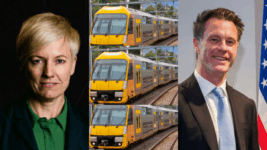
But New South Wales premier Chris Minns continues to refuse to make public transport free for all NSW constituents.
“There’s no such thing as free public transport, at the end of the day someone’s paying for it, and NSW consumers will pay for free public transport,” the NSW premier told the press on 1 April. And he added that he would be making some changes for struggling NSW families, but he wants to “make sure it is based on evidence, and I want to make sure it makes a material difference to fuel supply”.
Minns was rolling out these rationalisations a day after Tasmania made its public transport free until 1 July 2026, and Victoria had commenced free public transport for 30 days. And if the NSW top minister wanted evidence, well, Queensland made all public transport 50 cents a trip in 2024, and six months in, it had resulted in a 16 percent increase in its use, and this system continues to this day.
These examples from other states prove there is such a thing as free public transport, as do the more than 100 cities globally that provide it. Of course, the premier is right, that someone would have to pay for free public transport and that would be the public via taxes. But NSW Labor wouldn’t have to raise taxes to do this, it would simply have to redistribute the tax dollars already coming its way.
And just like Minns is well aware that public transport could be free, and hence had no good reasons to provide constituents as to why he is denying them this favour during a global oil crisis, NSW Greens MLC Cate Faehrmann is too aware it could be free, and that’s why she called on him to “immediately introduce a period of free public transport” three days before he refused the initiative.
No can do
“The premier is clearly putting the interests of large corporations and higher income earners ahead of those who are less well-off,” Faehrmann told Sydney Criminal Lawyers this week. “He would rather see taxpayer dollars continue to flow to the big end of town, with revenue from tolls going to private operators and owners of privatised public transport networks.”
“The premier says he is concerned about revenue loss from free public transport – however reducing the fuel levy is a very significant revenue loss, worth billions,” explained the NSW Greens transport spokesperson. “The state government already subsidises around 80 percent of every single trip on buses, trains and ferries.”
The federal government announced on 30 March it was halving the “fuel excise on petrol and diesel for three months”. This reduction on the flat sales tax was established as Tasmania and Victoria were making public transport free. And on 2 April, PM Anthony Albanese announced that GST wouldn’t be collected on fuel for the same period, bringing a total saving of 32 cents per litre for consumers.
But as Faehrmann infers, the premier continues to encourage reliance on petrol cars in the interests of the industries involved, and as for consumers who are struggling to make ends meet with the dual fuel and cost-of-living crises, well, they can forget about a free ride. Indeed, the cuts NSW Labor made during the rush to curb rising costs were to ease restrictions on freight to keep goods moving.
“Free public transport would provide a massive economic stimulus at a time when our economy desperately needs it by putting more money in people’s pockets, increasing travel around cities and making our neighbourhoods and communities accessible, thriving places to live,” said Faehrmann, who’s a member of a party that does put people first and isn’t captured by the fossil fuel industry.
Minns spruiks electric cars to solve crisis
US president Donald Trump threatened to destroy the whole civilisation of Iran on Tuesday, 7 April. However, on the following day, a ceasefire was called on the US-Israeli illegal war of aggression on Iran, which is precisely the reason why petrol is so costly. This truce led to a temporary dip in local petrol prices, but the ceasefire is now over and the US is blocking the Strait of Hormuz.
Faehrmann has reiterated this week that considering the on-again, off-again ceasefire right now would be “a great time to introduce free public transport”. She added that the “Minns government should be encouraging people to use public transport as an alternative to driving”, and “making fuel cheaper only increases demand at a time when we want to conserve fuel and reduce demand”.
On the day prior to refusing to make public transport free for any period during the crisis, the NSW premier told the press that he considers there is a problem with the NSW economy being so reliant on Middle Eastern oil, so the state needs more electric cars and charging stations for them. But this was of little comfort to outer western suburbs commuters who needed to get to work the next day.
“Many essential workers are reliant on public transport, and these are the people who are feeling the pinch the most,” Faerhmann continued. “Free public transport would incentivise greater use of existing public transport networks, help free up fuel supply for essential services and regional and agricultural areas, and it would provide relief to those who need it most during a cost-of-living crisis.”
Permanent free public transport is possible
One can imagine that the NSW Greens collectively guffawed, as the premier raised shifting towards electric vehicles at the beginning of an oil crisis that no one has any idea of when it is going to end, as this is no quick fix solution. Although if NSW Labor or the Liberals had paid attention to the Greens long-term campaigning for such climate-friendly reforms, the state could be sitting a lot prettier now.
“Public transport is an essential service and should be free and in public hands. It should not be run by private corporations. Taxpayers fund public transport,” insisted Faehrmann, whose party actually ran on a platform in the 2023 state election that included making public transport free. “The Greens will prevent any further privatisation of our essential public assets,” Cate added.
Global expert on public transport, Monash University Professor Graham Currie told the Guardian that making public transport free would be relatively easy for government and would provide a quick fix. The same article raised the point that often wealthy inner-city residents benefit most from such reforms but try telling that to someone commuting from Campbelltown to the city every day.
However, perhaps the premier didn’t prioritise electric cars until it became convenient during a war of aggression launched by Israel and the US, while the Greens have been raising it for years in terms of the climate crisis, which has been put on the backburner in terms of the news cycle, simply because Tel Aviv has been on a mass murder spree for 30 months now, with US backing.
Faehrmann further explained this week that transport is the third largest greenhouse gas emitter on this continent, and making public transport free would reduce reliance on cars and lower those emissions that are frying the planet.
“The Greens have a plan to increase regional bus services and encourage local manufacturing of our own buses, trams, trains and ferries,” Faehrmann said in conclusion.
“We want to make transport accessible for everyone and increase investment in active transport infrastructure, such as cycling.”
Paul Gregoire
Receive all of our articles weekly
Related Articles
 Free Public Transport for the Homeless in Victoria
 The Ever-Increasingly and Unfounded Encroachments of Policing Powers in Public Places
 Iran Warns of Unprecedented “Global Economic Crisis”, if Trump Strikes Electricity Plants
  Iran, the Gulf of Oman and the US False Flag Predilection
 Albanese Plants Australian Bodies on the Ground in Illegal US-Israeli War on Iran
 Global War, Anyone? Trump’s Got One Brewing With Iran