Protections for Politicians Enhanced Due to Rise in Politically Motivated Violence
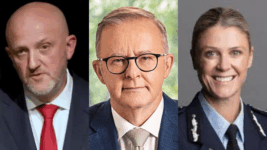
Australian politicians are to receive heightened law enforcement and security protections, due to an increasingly fraught domestic security environment that has seen at least ten people charged with making violent threats towards politicians since September 2025, which has included neo-Nazis being detected in a chatroom sharing ideas about kidnapping prime minister Anthony Albanese.
The Herald reported last week that Australian home affairs minister Tony Burke met with a cross section of federal parliamentarians on Monday, 30 March 2026, to discuss a $150 million initiative that would beef up policing and security measures for pollies, including at their homes, as well as at electoral offices and high-risk public events.
The meeting was a closed-door affair, but sources revealed that the package would include temporarily enhanced police patrols when MPs are feeling unsafe at home, more officers deployed to high-risk events and extra security would be present at electoral offices. Further reforms include monitoring MPs’ social media accounts and ensuring their details aren’t available online.
The local move to protect MPs has been further predicated upon global events, as despite a reluctance to admit it, Israel’s perpetration of the 30-month-long Gaza genocide has led to widening social divisions globally, as has the rise of an authoritarian US Trump regime, while the current US-Israeli illegal war of aggression on Iran has been pushing the globe towards end times.
The need for heightened MP security is also based on a dramatic rise in the number of Australian federal police investigations involving politically motivated threats over the financial year 2024-25. Yet, there are some ministers who are further exacerbating and confusing the local political climate by framing certain civil society protesters as some kind of domestic terrorists.
Rising tensions down under
Several recent police investigations have led to the charging of people threatening PM Albanese. A man was arrested last year for harassing Senator Lidia Thorpe, who has long been subjected to serious threats of harm. And a high-profile case saw Sydney neo-Nazi Joel Davis spend four months on remand over his making a highly ignorant statement about a politician.
These threats against parliamentarians have been escalating since Israel commenced its barbarous genocide on the Palestinians of Gaza. However, the heightening of threats against local politicians really began spiking during the COVID-19 period, with its much maligned lockdowns, with former Victorian premier Dan Andrews a favoured target, with even a mock gallows produced for him.
Neo-Nazi Davis, who was just released on bail, was part of the National Socialist Network, which had been gaining traction via its staging of high-profile rallies, which included some that specifically targeted Jewish people. But the NSN has since disbanded, following Labor having enacted a federal hate group law that would have forced its shutdown and facilitated its members arrest.
ASIO director general Mike Burgess has been warning about rising online radicalisation since the COVID era, with particular concern being given to the accelerating increase in far-right, white supremacist actors during the pandemic. And both the previously remanded Davis, who threatened Independent MP Allegra Spender, and Stefan Eracleous, who’d been harassing Thorpe, were Nazis.
But an often overlooked aspect to why tensions in Australia are rising, along with accompanying threats of violence, is the fact that the Israeli state has been mass murdering Palestinians in Gaza for the past 30 months, and rather than outright condemn this, major party politicians have been making excuses for it, which seems to convey that mass slaughter is okay on occasion.
Surging politically motivated violence
The move to enhance security for Australian members of parliament further reflected that the AFP had investigated 950 politically motivated threats of violence over the 2024-25 financial year, which was a 63 percent increase on the entire combined total number of investigations dealing with such threats over the previous four financial years.
Section 4 of the Australian Security Intelligence Organisation Act 1979 (Cth) defines politically motivated violence, as “acts or threats of violence” aimed at achieving a political objective, in this country or overseas, which includes acts or threats of violence against the Australian government or any other government. And this definition of politically motivated violence includes terrorist acts.
Violence perpetrated by an individual, or others on their behalf, which seek to assist in or achieve the overthrow of a government are further defined as politically motivated violence, as are the federal offences around international terrorist activities using explosive or lethal devices, local terrorist offences and state-sponsored terrorism.
Further acts that are considered to be politically motivated violence include entering foreign incursions or recruiting people to take part in such conflicts, as well as crimes involving hostages, the seizing of ships, the hijacking of planes, as well as threatening the safety of planes whilst in flight.
Crimes against internationally protected persons also fall into this category. Such people include Australian and foreign officials, or officials from intergovernmental agencies or designated overseas missions, as well as family members of any of these categories of protected persons.
The ASIO Act came into effect in 1979, and it included the definition of politically motivated violence. Although this definition was updated to include terrorism, via the Security Legislation Amendment (Terrorism) Act 2002 (Cth), which was drafted and enacted in response to the 2001 9/11 terror attacks on the New York World Trade Centre.
There is no specific consensus definition relating to politically motivated violence or terrorism in international law.
However, Australia’s definition of politically motivated violence is broader than those of many other nations, especially as it includes terrorism, as some countries actually define terrorism solely as politically motivated violence, while Australia defines terrorism as having a political, religious or ideological motivation.
Muddying a dangerous climate
“The government recognises that the threat level is rising but continues to draw a false equivalence between political protest and violent extremism,” the Herald quoted Greens Senator Dr Mehreen Faruqi as stating last week. “This only serves to politicise genuine critiques of the government and doesn’t keep anyone safer.”
The Minns government, in particular, has been conflating political protest with violent extremism.
New South Wales premier Chris Minns proclaimed in the immediate wake of the 14 December 2025 Bondi massacre, which involved two ISIS-inspired killers targeting a Jewish religious festival to gun down 15 people, that it was partly spurred by Sydney’s Palestinian solidarity movement, which was not only an absurd assertion, but it was also dangerous.
The Israeli-aligned Minns suggested that the organisers of the then 26-month-old pro-Palestinian weekly protests that had been taking place on Gadigal land in Sydney, had actually been “unleashing forces they can’t control”, which the premier suggested had gone on to contribute to the terrorist attack, despite the fact that ISIS is opposed to the Palestinian cause.
The NSW premier has been demonising the local Palestine solidarity movement and its organisers since the Gaza genocide began in October 2023. But for Minns to then seriously single out innocent people and to suggest that they were partly to blame for the mass shooting by extremists in Bondi, risked inviting violent retribution upon these individuals.
Yet, then again, NSW premier Chris Minns has increasingly been applying “divide and rule” tactics to his governance of the NSW constituency, and his most masterful stroke in this mission to demonise certain parts of the public is that he’s framed all this under the banner of attempting to promote social cohesion.
Paul Gregoire
Receive all of our articles weekly
Related Articles
 Fixated Persons Unit Was Monitoring Friendlyjordies Long Before the Langker Arrest
 There is Broad Social and Political Agreement on the Need to Reform NSW Firearms Laws
 Banning Political Slogans: The Absurd New Way to Stamp Out Pro-Palestinian Support
 “Actively Increasing the Divide”: NSWCCL’s Timothy Roberts on the Lack of Apology for Police Violence
 Sovereign Citizens and Other Far-Right Extremists Pose a Far Greater Threat Than Muslim Teens
 Former Deputy NSW Premier Under Investigation Over Scuffle with Cameraman