NSW Police are Withdrawing Criminal Charges Brought Under Unconstitutional Protest Ban
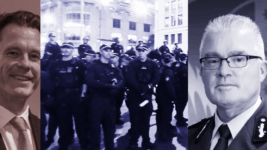
New South Wales police commissioner Mal Lanyon confirmed to ABC Radio on the morning of 13 May 2026 that criminal charges brought under the unconstitutional protest ban law in relation to the 9 February rally against the official visit of Israeli president Isaac Herzog will be withdrawn pending review. That afternoon saw the first charges dropped and a number of other cases adjourned.
The top cop’s announcement affects 30 protesters charged with criminal offences relating to the anti-Herzog rally held on Gadigal land outside of Sydney Town Hall, whilst a ‘public assembly restriction declaration’ (PARD), or a blanket ban on protest marches, was imposed in the Sydney CBD. This event was controversial as it involved the mass brutalisation of civilians by the NSW Police Force.
The NSW Supreme Court struck down the PARD law as unconstitutional on 17 April. It had allowed the police commissioner to impose a ban on protest marches in a specified area following an incident being declared as potential terrorism. And Lanyon explained on Wednesday that charges laid in relation to a “major events” declaration that same night are also now under review.
The withdrawal of actual charges, after Lanyon had suggested this may be the case immediately following the striking down of the PARD law a month ago, brings further weight to the calls for NSW premier Chris Minns and NSW police to issue an official apology for the mass brutalisation of a crowd of 20,000-odd pro-Palestinian demonstrators by around 3,000 NSW police officers on duty that night.
But instead of apologising for the unprecedented state violence, Minns has suggested that NSW police officers did as they were told and that any further debate around this should wait on the delivery of the report from the NSW police watchdog’s inquiry into the events on the night. Yet, the forthcoming report from the oversight body now appears likely to be full of holes.
Illegitimate charges under an illegitimate law
“They were charged under various sections, so our prosecutors are reviewing the evidence, and also the lawful nature of the directions given,” Lanyon told the ABC on Wednesday morning. “You’d be aware that there was a major events declaration in place at the time where that was used for giving directions… the decision of the PARD does not invalidate that.”
“So, we’re working through each one of that but certainly, if it is reflective of a PARD decision, which has since been overturned, those matters will be withdrawn,” the top cop added.
Following Lanyon’s radio appearance, the lawyer of Palestinian Australian man Eyad Shadid, Nick Hanna, was informed that the police prosecutor had told Downing Centre Local Court that it was dropping the charges pressed against his client in respect of his actions during the Herzog protest, and this was due to the review finding the charges had been laid under an unconstitutional law.
The PARD law was rushed through in the wake of the December 2025 Bondi massacre, and it had allowed the commissioner to ban protests marches in a specified zone for up to 90 days after a potential terrorism incident was declared, and while the law didn’t stop stationary rallies, the court found it undermined the implied freedom of political communication in the Australian Constitution.
On the night of the anti-Herzog protest, a PARD was in place in the Sydney CBD. A legal stationary protest took place before Sydney Town Hall that night and participants had sought to march to NSW parliament. This was denied by NSW police because of the prohibition, and when the demonstrators stood their ground, the police eventually kettled them in and unleashed excessive force upon them.
Shadid’s charges of failing to follow a direction and hindering police were dropped because they related to the PARD law. Fourteen more anti-Herzog protesters had their matters adjourned on Wednesday, as their charges are now under review. And these defendants’ cases are all the more controversial as some involved dawn raids by police just to charge people in relation to the protest.
A watchdog full of holes
The NSW premier and Lanyon have refused to apologise for the police brutality seen at the anti-Herzog rally. And when NSW Greens MP Jenny Leong attempted to present Minns with over 100 community testimonies about the violence, he refused them and said he would wait for the report on the incident from police oversight body the Law Enforcement Conduct Commission (the LECC).
However, the Klaxon reported last week that the LECC report into the unprecedented level of police violence, which was called prior to the PARD law being struck down, is likely to be limited in terms of what is revealed to the public about police operations on the night because the law permits the police commissioner to declare evidence as “police information” and then it cannot be revealed.
Section 179 of the Law Enforcement Conduct Commission Act 2016 (NSW) provides that the police commissioner can declare any information provided by themselves or any other officer to the LECC as critical police information, which then ensures it cannot be disclosed to the public because it could prejudice an investigation or prevention of crime or it may not be in the public interest to do so.
Journalist Anthony Klan further noted that the commissioner issues a “secrecy notice” when details are to be withheld from any third parties. Yet, in terms of how many Lanyon has issued to the police watchdog over the Herzog protest inquiry, the LECC refuses to disclose the number citing “secrecy obligations”, whilst the NSW police also refused because the matter is part of an ongoing inquiry.
Bucking against the democracy
The refusal to apologise to the public for the mass police brutality has left many in the constituency feeling uneasy, and this has only been compounded by the court finding that the law was illegitimate and yet, the state continues to justify the police actions on the night.
So, the overriding message appears to be that unlawful police violence remains on the menu under a Minns government.
NSW Greens MLC Sue Higginson, who has been outspoken in her condemnation of the police actions at the anti-Herzog protest, said on Wednesday afternoon that Lanyon’s admission in respect of dropping charges reveals that Minns’ unconstitutional PARD law had “directly contributed to wrongful arrests and legal chaos that unfolded at Town Hall”.
The NSW Greens justice spokesperson added that the top cop’s announcement also underscores that the illegitimate law is what permitted the police to unleash upon the mass of civilians with violence, which is a point she’s been repeatedly raising since the NSW state doubled down on justifying the NSW police actions on the night and insisting officers were simply doing as they were asked.
“People were wrongfully arrested and brutally assaulted because the Minns Labor government chose to impose unconstitutional antiprotest laws on the people of NSW,” Higginson said in a 13 May statement. “All charges against every person charged that night at Town Hall should now be dropped. The entire police operation was built around unlawful restrictions that had no legal force.”
“Premier Chris Minns has exposed the people of NSW to massive civil liability risks as a result of wrongful arrests, excessive force and assaults against members of the community. That liability sits squarely with his government,” the solicitor said in ending. “The courts have once again pulled Chris Minns back into line after he chose authoritarianism over democratic rights and peaceful protest.”
Paul Gregoire

Receive all of our articles weekly
Related Articles
 No Apologies: Threat of Police Violence Stands After Protest Ban Ruled Unconstitutional
 Minns Condemns Court’s Overturning of His Unconstitutional Protest Ban with Flawed Logic
 NSW Protest Ban Extended for Genocidal Israeli President’s Visit
 NSW Government’s Blanket Protest Ban: A Massive Gifting Away of Our Basic Rights for Xmas
 NSW Police Commissioner Bans Protests, Suppressing Fundamental Democratic Rights
 “A Blunt Tool”: NSW Court Quashes Government’s Blanket Ban on Protest Marches