Lenient Penalty for First NSW Police Officer Convicted of Aboriginal Death in Custody
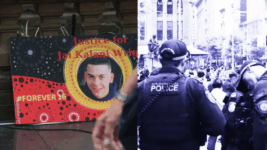
The sentencing of New South Wales police sergeant Benedict Bryant over the killing of Dunghutti teenager Jai Kalani Wright took place on 4 June 2026, ending the case that involved the first ever conviction of a NSW law enforcement officer in relation to an Aboriginal death in custody, and while the police officer has been sentenced to prison, it’s the kind of time that can be served at home.
The matter holds further significance for the entire nation, as it most likely marks the first time any Australian police officer has ever been held accountable by a court in relation to the custody death of a First Nations person.
Bryant crashed the unmarked police car he was driving head-on into the stolen trail bike that Wright was riding on Gadigal land at an intersection in the Sydney inner city suburb of Eveleigh, early morning on 19 February 2022. The incident involved the sergeant ploughing his vehicle into the boy on a bike at high speed, after he’d been ordered not to continue the pursuit of Wright.
NSW District Court Judge Jane Culver found Bryant guilty of the offence of dangerous driving causing death on 28 November 2025 and then sentenced the former segreant to “2 years imprisonment” last week. Yet, this is to be served via an intensive correction order (ICO), which is legally considered a custodial sentence, but it is actually served under strict conditions and supervision in the community.
This outcome is being hailed as the first time that a law enforcement officer in NSW has been held accountable for the death of an Indigenous person, who was killed whilst in the custody of state law enforcement. And whilst Wright’s family is satisfied that justice has been served, there are those who question whether the penalty imposed reflects yet another police officer haven gotten off lightly.
Unprecedented accountability
The Dunghutti teen’s father, Lachlan Wright, told the press following the sentencing that he was satisfied as the conviction “shows that something went terribly wrong and people have to be held accountable”. He asserted that how severe the penalty was had been of less importance than seeing the officer being held responsible and added that “a conviction is a conviction no matter what”.
During the case, Crown prosecutor Philip Strickland SC put to the court that as Bryant was an officer of 22 years’ pedigree, and as he’d been told not continue the pursuit of the 16-year-old teen, he should have been well aware that pulling out in front of the boy in an unmarked police car at that point would unlikely result in the teen stopping, and Judge Culver agreed with the lawyer’s assertion.
Bryant is still a serving officer, despite being convicted over Wright’s death, although his employment is under review. Not only does the police sergeant have to serve 2 years custodial time at home, but the convicted man has to further undertake 500 hours of community service, and he’s also had his driver licence suspended for the next 3 years.
Judge Culver reiterated last week that Bryant should have known that the boy was unlikely to stop at that point. Wright was not the only teen being pursued by police and the pursuit of multiple teens had been underway for some time when the collision occurred. She further noted that Bryant showed little remorse, and he was rather more focused on appealing the outcome of his case.
But regardless of whether the officer’s punishment is steep enough, the fact that a NSW police officer has been held accountable in relation to an Aboriginal death in custody is not only a first, but it may set a precedent for future such cases. Although, as the presiding judicial officer mentioned, Byrant is now seeking to appeal the outcome of his case to the higher court.
A crisis only worsening
The 15 April 2026 marked 35 years since the Royal Commission into Aboriginal Deaths in Custody handed down its final report, which made 339 recommendations on how to improve what was a crisis in such deaths in the 1980s. Yet, despite this in-depth investigation and subsequent ongoing campaigns focusing on the custodial deaths of First Peoples, this issue is only getting worse.
Thirty three Aboriginal and/or Torres Strait Islander individuals died in either police or corrective services custody nationwide over the 12 months to June last year, according the Deaths in Custody in Australia 2024-25 report. This is the highest number since records started being kept in 1979, and it too involved 12 individuals in NSW, which marked the highest ever in this state over 12 months.
Currently, there have been 16 Indigenous deaths in custody over 2026, and since the handing down of the Royal Commission report in April 1991, at least 634 First Nations deaths in custody have transpired.
The sixth recommendation of the Royal Commission outlines that custody deaths are fatalities that occur in the custody of law enforcement, corrective services or youth justice authorities. These can happen as a result of “traumatic injuries” sustained or lack of proper care in such custody, along with those that occur when officers are trying to detain or are attempting to prevent someone’s escape.
The eleventh recommendation was to require that a coronial inquest take place following a death in custody. In terms of Aboriginal deaths in custody, numerous such inquiries have found that use of force or neglect have played a factor, however few have gone on to recommend that prosecutors consider charging those involved, and in terms of convictions, well, Bryant’s is likely the first ever.
Incremental shifts
Cases of police and corrections officers being charged in relation to a First Nations death in custody, do seem to have been on a slight rise over recent years, but this has hardly extended to a series of corresponding convictions. A number of these cases have resulted in charges being laid by police departments, due to the circumstances of a case and following its internal investigation.
Former Western Australian police officer Brent Mitchell Wyndham was charged by his employer with manslaughter and murder over the shooting death of Yamatji woman JC on Yamatji land in the WA town of Geraldton in September 2019. And despite circumstances involving her being surrounded by eight police officers at the time, he was acquitted of her killing in October 2021.
The Northern Territory Supreme Court heard that then NT police constable Zachary Rolfe had fired the final two of three shots directly into the ribcage of 19-year-old Warlpiri Luritja man Kumanjayi Walker, whilst his partner was holding him down, in November 2019. Yet after NT police charged him, a jury acquitted Rolfe in 2022, of murder, manslaughter and even violent act causing death.
The inquest into the death of 43-year-old Wiradjuri man Dwayne Johnstone came to an abrupt halt in October 2022, when NSW state coroner Teresa O’Sullivan ended the inquiry early and referred the case that involved an unnamed prison guard shooting the handcuffed and shackled remandee three times in the back as he tried to escape in March 2019 to the NSW Director of Public Prosecutions.
This development was an anomaly in NSW, when looking back over recent decades. And O’Sullivan’s determination to hand over the case to the DPP resulted in the then 57-year-old unnamed officer being charged with manslaughter, and this was later upgraded to murder. Yet, this likely first ever charging of an Australian prison guard over such a death resulted in acquittal in late 2023.
But O’Sullivan again ended an inquest into an Indigenous custody death early in January 2024. This time it was in relation to Jai Wright. And as we now know, this resulted in the first ever conviction of a NSW police officer in relation to a First Nations custodial death, and it likely accounts for the first time that any Australian police or corrections officer has been convicted over such a death.
But the idea that accountability, at least in NSW, is finally coming in relation to preventable First Nations deaths in custody is somewhat tainted, when, at the same time that this is occurring, the highest numbers of First Peoples are dying in the custody of police and corrections and no determined action is being taken by any Australian government to combat this rise in fatalities.

Paul Gregoire

Receive all of our articles weekly
Related Articles
 First Ever Conviction of an Australian Police Officer Over Aboriginal Death in Custody
 NSW Police Officer Charged Over Jai Kalani Wright’s Death in Custody
 Coroner Refers Jai Wright Death in Custody to the DPP for Potential Criminal Charges
 NSW Police Officer in Unmarked Car Chases 12-Year-Old Gomeroi Boy on Foot
 Still No Justice for Aboriginal Deaths in Custody 35 Years After Royal Commission
 Kumanjayi White’s Killing Has Shifted the Debate on the Aboriginal Deaths in Custody Crisis