The Criminal Offence of Riot in New South Wales
Three men were arrested on Friday, 19 June 2026 and charged with a long list of crimes, including the offence of riot. The arrests were in response to New South Wales police officers having been called out to a park on Awabakal land in the Newcastle suburb of Mayfield at about 1pm on Sunday, 14 June 2026, and then finding about 150 to 200 people gathered in the area.
Of the large group at the location on Mayfield’s Ingall Street about 30 to 40 individuals were riding around on unregistered trail bikes in the parkland and also on surrounding streets. And on finding such a sizable gathering with obvious illegal behaviour taking place, attending officers promptly closed roads nearby the scene and redirected traffic due to safety concerns.
One woman at the site was arrested following an alleged assault. However, she was later released pending inquiries. And two unregistered motorcycles were also seized on the day and taken in for forensic investigation.
Attending officers attached to Newcastle City Police District later established Operation Horizon to investigate the incident. And following extensive inquiries, officers executed a search warrant at a home in the Newcastle suburb of Wallsend at about 7 am last Friday morning.
Three men were arrested during the raid. Then a 20-year-old male, a 22-year-old and a 25-year-old man were all taken to Waratah police station for questioning. And during the search of the premises, officers seized a further four motorbikes, a scooter, a taser and 0.55 grams of methamphetamine, as well as helmets, clothing and electronics.
The men aged 25 and 20 were charged with seven offences each, while the 22-year-old had six listed against his name. And all of these men were charged with the offence of riot, along with other crimes that included property damage, driving a conveyance without consent, drug possession, reckless driving, never licensed person driving on road and custody of suspected stolen goods.
The three men were refused bail and were due to appear in NSW Bail Division Court 6 last Saturday, while Operation Horizon investigations are ongoing.
The crime of rioting in NSW
Section 93B of the Crimes Act 1900 (NSW) contains the offence of riot, which carries a maximum penalty of 15 years in prison.
For the prosecution to establish that any particular man charged in relation to Operation Horizon are guilty of riot, it must prove each of the following elements of the offence:
- He was one of twelve or more persons present together,
- He used or threatened unlawful violence,
- He intended to use violence or was aware his conduct was violent,
- The conduct of the group was for a common purpose, and
- The conduct of the group as a whole would cause a person of reasonable firmness who might be present at the scene to fear for his or her personal safety.
The section further explains that it’s immaterial, or not necessary, for the prosecution to prove that those involved were threatening violence simultaneously, whilst the ‘common purpose’ doesn’t have to have been declared or discussed, as it can be inferred by the actions of the group.
Violence is defined under section 93A of the Crimes Act as conduct that includes violence against property as well as that involving persons. Violence is not confined to conduct that causes or had the intent to cause injury or damage, and it can include “other violent conduct”, such as the throwing of an object at another person that could cause them harm, but the projectile fails to hit its target.
The crime of riot can be committed even if no person of reasonable firmness was present to feel fear brought about by the group of rioters and neither does a riot have to be conducted in a public place, so it’s possible for a riot to occur in privately owned areas.
Defences against a charge of riot
There are a number of defences that the three men charged with riot may be able to raise if the circumstances involved during the incident reflect the contention they raise against the charge.
Subsection 93D(1) of the Crimes Act provides a statutory defence against a charge of riot, which involves a ‘mental element’. So, a person cannot be found guilty of riot unless they’re found to have intended to cause violence or that they were aware that their conduct “may be violent” or was threatening violence.
Duress is a common defence that can be raised against riot. It applies when a defendant argues that they perpetrated their wrongdoing with the aim of avoiding a threat of harm that had been made against them or someone else. In order for duress to stand up in court, it must be shown that the threat the individual was attempting to avoid was serious enough to warrant the lawbreaking.
Another defence that can be raised against a charge under 93B of the Crimes Act is the defence of necessity, which involves the person charged arguing that they perpetrated their crime in order to avoid an immediate and much greater harm or danger. The larger peril that the accused was trying to avoid through their action must be shown to have justified the acts that they’ve been called out on.
Contained in section 418 of the Crimes Act, the defence of self-defence can also be raised against a charge of riot. Self-defence involves an accused arguing that they perpetrated their wrongdoing in order to prevent themselves or another from being harmed, or it can also be raised when they were attempting to avoid the unlawful deprivation of their own liberty or that of another.
Preventing the destruction of property and stopping unlawful trespass are further reasons that can warrant the raising of self-defence in a court. However, self-defence cannot be cited in respect of property damage or trespass, when the defendant’s actions have caused the other person serious injury or death.
A further statutory defence can be raised against riot, the defence of mental impairment or cognitive impairment, which involves an accused putting to the court that they were not criminally responsible for their crime, as they’d been suffering mental or cognitive impairment or both. This defence is held in section 28 of the Mental Health and Cognitive Impairment Forensic Provisions Act 2020 (NSW).
Public order offences
The offence of riot sits under part 3A of the Crimes Act, which contains a number of crimes that are referred to as ‘public order offences’. These types of offences are crimes that involve causing alarm, distress or disruption to the public. Other key public order offences are affray, or crimes involving explosives, firearms or knives in public.
Then NSW Liberal attorney general John Dowd introduced the Crimes (Amendment) Bill 1988 into NSW state parliament on 19 October 1988. This legislation served to abolish the common law offences of riot, rout and affray, and it created the statutory offences of riot and affray to replace them. The bill inserted riot into section 93B of the Crimes Act, where it continues to sit.
The new laws were based on similar British offences that were and continue to be contained in the Public Order Act 1986 (UK).
Prior to the creation of the statutory offences in NSW, the offences of riot and affray had been common law offences, as in its early days of the British colony of New South Wales, English common law was adopted as its own.
The British courts then passed the New South Wales Act 1823 (UK), which created the position of NSW Chief Justice, and that official was charged with the passing of local laws on the proviso that those created were not “repugnant” to the laws of England.
Following this development, the Australian Courts Act 1828 (UK) was passed in England, and it officially transferred the common law and existing statutes of that country so that they applied in NSW, as well as in Tasmania, which was then referred to as Van Diemen’s Land.
Offences that remained in common law, like riot and affray, were eventually codified and legislated in this state in order to make them more precise, as common law offences are often vague, as they’ve been created via judges’ determinations and passed down through case rulings.
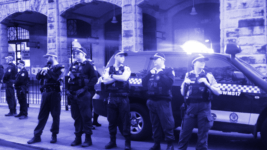
Main image of NSW police is a photo taken by Paul Gregoire

Paul Gregoire


Ugur Nedim
Receive all of our articles weekly
Related Articles
 The Law, Defences and Penalties for the Public Order Offence of Riot in NSW
 Western Sydney Riot: Why Would a Community Be Mistrustful of NSW Police?
 Sparked by the Cronulla Riots: NSW Police Emergency Public Disorder Powers
 The UK Far Right Riots Should Be of Concern, as Australia Is Awash with White Nationalists
 NSW Police Ram Cars, Abuse and Arrest Innocent Men for ‘Driving Whilst Muslim’
 NSW Police Assaulted Hannah Thomas Then “Reversed Engineered” Charge to Frame Her as Rioter