NSW Police Trapped and Brutalised Anti-Herzog Protesters, Report Confirms
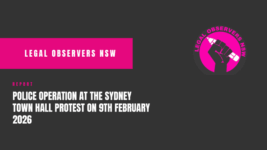
New South Wales Legal Observers has just released its damning report on the operation that involved the NSW Police Force unleashing 3,000 of its officers to use excessive force upon a crowd of around 20,000 pro-Palestinian demonstrators rallying against the official state visit of Israeli president Isaac Herzog on Gadigal land at Sydney Town Hall on a Monday evening last summer.
Released on 3 July 2026, the 33 page document titled Police Operation at Sydney Town Hall on 9th of February 2026 meticulously details multiple incidents of police brutalising civilians, when standard operating procedures had obviously been paused to facilitate the unlawful physical punishment of constituents mobilising on a political position that the NSW Minns government didn’t agree with.
The state-sponsored visit of Herzog was protested by those opposing the ongoing Israeli state genociding of the Palestinians of Gaza. Those at the rally sought to march from Town Hall to NSW parliament, which was not out of the ordinary. Yet, what was an anomaly was a newly legislated and since-struck-down law that established a blanket ban on protest marches through the CBD that night.
A telling part of the Legal Observers NSW report involves the organisation documenting that the NSWPF was blocking all exits from the protest site, whilst simultaneously ordering the crowd to disperse, and the reason officers were violently attacking and brutalising civilians, in a manner unprecedented in its scale, was due to their not leaving the area that police had sealed off.
The appearance of the LONSW report provides some sorely missing accountability regarding the unbridled use of force by NSW police, ahead of the Law Enforcement Conduct Commission releasing its findings on the incident, as senior NSW ministers and NSW police have rather repeatedly justified the actions of officers on the night, confirming that they were simply doing as they’d been told.
Kettling in and charging down civilians
“A recurring and serious complaint raised with LONSW concerned the deployment of aggressive police formations and tactics that, rather than deescalating tensions, served to inflame protests and constituted a disproportionate use of force,” the recently released document reads.
“Reported tactics included kettling, charging, the obstruction of protestors’ egress routes, and the deliberate manoeuvring of protestors into positions of clear and foreseeable danger.”
As did those present on the night of the protest, NSW Legal Observers notes that the questionable use of “kettling” by NSW police at the anti-Herzog protest, which played a key role in unfolding events. Kettling is a controversial crowd control technique used by law enforcement that involves officers creating a physical barrier with their bodies, so civilians are trapped within a confined area.
LONSW reports that following a stationary rally, police had kettled the crowd into a confined area around Sydney Town Hall. The entrances to Town Hall train station had been blocked. And despite exit routes being open at earlier points, at the time the excessive force was applied, these were too blocked, while crowds denied entry into the main site early on, were also kettled in adjacently.
“While the crowd was kettled, police began ordering protestors to disperse and leave the entire vicinity, without providing any viable or safe means for them to do so in a timely and orderly manner, or in a way that had proper regard to the varying needs of a clearly diverse crowd,” NSW Legal Observers adds. “Despite this, police adopted what can be described as a ‘charging down’ tactic.”
The charging down of the crowd involved lines of police officers, “side by side and several officers deep”, running in this formation at force into the crowd of civilians who’d been kettled in. This occurred as civilians were also being ordered to move on. And the consequences of these manoeuvres were “forceful pushing, confrontations and the deployment of OC spray on protesters”.
The NSW Legal Observers report underscores that the charging down of civilians was a tactic repeated throughout the operation in other areas of the CBD in order to push crowds down George Street and Bathurst Street. And this left protesters, including the elderly and those with disabilities, with the “stark choice between fleeing for safety or risking being overrun by police”.
“No holds barred” policing
The chapter titles listed on the NSW Legal Observers report’s “Table of Contents” page reads like a checklist of how law enforcement officers are not expected to act in the field. It includes titles like “Forcibly Held to the Ground/Knelt On”, “Multiple PO Restraining Vulnerable Victims”, “Police Provocation” and “Police Deployment of Chemical Weapons”.
The report details incidents involving police placing the full force of their bodies on civilians who were already being held down on the ground, to the point that officers were likely risking causing serious injury to them, as well as instances of officers kneeling on people. And some of these incidents show officers attempting to restrain people who weren’t even attempting to resist.
The report notes that multiple elderly people and people with disabilities were physically assaulted by officers. The notorious case of a 69-year-old woman who was forcefully pushed over by a NSW officer is detailed. This officer repeatedly shouted at the woman to get up, whilst she responded that she couldn’t. The woman, who’d suffered fractured vertebrae, was dragged away by another officer.
Another detailed example of what transpired involved a mother with her eight-year-old son having both been pepper sprayed, whilst not having heard any direction to leave the vicinity beforehand, and on then attempting to leave, they found all exists blocked, and they then had to avoid a “stampede” of civilians trying to escape police by sheltering inside a 7 Eleven store.
There are also multiple scenarios involving medics present to assist with any potential injuries that might have transpired on the night, being repeatedly set upon by officers, who attempted to have them disperse from the area while they were trying to medically assist other civilians who’d been injured by police.
NSW Legal Observers further reports that it had received multiple testimonies about the “disproportionate and, at times, indiscriminate” use of OC or pepper spray on civilians. “Point blank” spraying of people in the face was reported, as was the use of the chemical weapon upon civilians who were attempting to comply with police directions.
A modicum of truth amongst a deluge of denials
Legal Observers NSW had seventeen voluntary legal observers deployed to the Herzog rally. Legal observers attend protests, not to take part in them, but to monitor any confrontations between the public and law enforcement in order to record and report on these activities. Legal observers are a protected group under the UN Declaration on Human Rights Defenders.
Apart from their assessment of the 9 February police operation at the Herzog protest, the public is also awaiting the report by police watchdog the Law Enforcement Conduct Commission, in order to bring about some broader accountability to an incident that mirrored the NSW police brutality unleashed at the initial Mardi Gras parade in 1978. Yet this time, it was on a much larger scale.
But there’s been speculation around how thorough the LECC inquiry might turn out to be, as it has come to light that there is a law that permits the NSW police commissioner, currently Mal Lanyon, to declare any information that he or any other NSW police officer provides to the inquiry as “police information”, which automatically results in such evidence being officially removed from the inquiry.
At this point, five months after the NSW police operation at the protest happened, if the LECC inquiry report does not result in some solid findings and recommendations that result in some substantive actions seeking to reconcile the mass lawbreaking by the state’s law enforcement agency, then the actions of the NSW Police Force on this night will continue to remain affirmed and legitimate.
NSW premier Chris Minns, NSW police minister Yasmin Catley and NSW police commissioner Lanyon have all, despite the substantial footage documenting it, repeatedly refused to apologise for the police brutality that occurred on the night and have instead insisted that law enforcement actions involved officers correctly performing duties, as they’d been asked to.
Indeed, at present, the dearth in any apology has rather left civil society with the understanding that such unlawful police brute force could be unleashed again if a group of demonstrators gathers to convey their dissent over a position that is at odds with that of NSW authorities.
Main image: Front cover of the NSW Legal Observers report
Paul Gregoire

Receive all of our articles weekly
Related Articles
 NSW Police Bash and Brutalise Herzog Protesters into Submission
 NSW Police to Continue Raiding Herzog Protesters to Sully Police Watchdog Inquiry
 NSW Police Liberally Deployed Potentially Lethal Pepper Spray at Herzog Rally
 NSW Police Are Raiding, Arresting and Charging the Herzog Protesters They Assaulted
 The State Set the Scene for Police Brutality: NSWCCL President Timothy Roberts on the Herzog Rally
 NSW Premier Ignores Civilian Evidence Regarding Police Brutality at Herzog Protest