The Australian Defence Minister’s AI Bonanza Is All About US Sovereignty
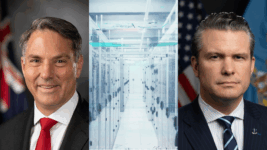
Australian defence minister Richard Marles posted to Instagram on 2 September 2026, as he was jogging at Pier 39 in the San Francisco Bay Area. Marles was there meeting with Silicon Valley “tech companies, with frontier companies, about AI”. Yet, plans to further shackle our nation to Trump’s America, via artificial intelligence deals, is dubious when US control over the tech will remain.
AI infrastructure is what was on the minister’s mind, when he met with US tech heavyweights, like OpenAI chief Sam Altman, Nvidia’s Jensen Huang and Anthropic’s Dario Amodei, last week. But in his clip, Marles fails to mention that these companies are predominately seeking to expand their datacentre presence in Australia, as these facilities have fallen out of favour with the US population.
After exiting California, Marles headed to Washington DC to meet with his US counterpart secretary of war Pete Hegeseth, and the pair discussed expanding the US force posture initiatives that already involve US forces on the ground locally. Force posture arrangements allow the US to launch wars from this continent. And three initiatives, plus the AUKUS pact, comprise US force posture.
“I see a throughline there of growing American force posture in Australia, and we think that’s really important in terms of providing deterrence in the Indo Pacific – providing stability and peace in the Indo Pacific,” Marles, also the deputy PM, told the press in DC. And the minister has already been heralding increased US force posture ever since he struck this pose at the 2024 AUSMIN meet.
So, while Marles set out, during his jog last week, that his meetings with Silicon Valley were about Australia getting “the benefits” of advances in artificial intelligence, the benefits this nation appears to be angling for will mean that not only is this continent dotted with US military presence, but that will now be accompanied by the growing presence of US data facilities covering the local landscape.
Storing US data for US entities in local facilities
Federal assistant minister for science Andrew Charlton joined Marles on the trip to the US and waxed lyrical to The Australian over the weekend about AI frontier labs now seeking to expand their operations, as the social license to build more datacentres in the US has run out. So, the advantage of moving their operations to Australia is a dumbed down public not privy to datacentre threats.
Charlton further elaborated that Silicon Valley operators have welcomed prime minister Anthony Albanese’s July 2026 Australian standards for AI commitment, which will comprise of legislation introduced early next year, that will establish a regulatory framework for datacentres. The PM also insisted that there will be protections for intellectual property in terms of local artists and musicians.
Despite Marles’ enthusiastic sales pitch, the mass building of datacentres locally won’t equate to an AI boom, as the data being stored will remain the property of US entities, the training of AI models down under will again benefit the Silicon Valley companies running the centres, and Australians will have to pay for any new technology that has been produced in part via local installations.
Just as the “benefits” of the US military presence down under amounts to a situation where this nation would find it hard not to follow the US into war, while it further invites its opponents to strike at this country, the datacentre bonanza Australia is starring down involves massive use of water to cool the systems and electricity to power them, which make them an environmental nightmare.
Prior to his US jaunt, Marles was quoted in the Herald as suggesting that the AI race is the most critical moment for Australian self-reliance since World War II, when, in fact, the reliance involved in this equation rests upon the US and not this country. And he added that he was in a hurry to offer AI giant Anthropic a second home in Australia.
“Accelerate force posture initiatives at Australian bases”
In his DC meeting with Hegseth, Marles discussed increasing US military presence on Australian soil, at a moment in time when Washington, under the Trump administration, has become a rogue entity that can no longer be relied upon as a strong ally to partner with. And while the US has been illegally warring on Iran, its presence in this country is all about opposing China.
The force posture agreements that Marles wants to expand were established in 2014 and currently comprise of 2,500 US marines rotating through Garramilla-Darwin, as well as ever-increasing interoperability between both nation’s air forces and the US has a special arrangement where it can access dozens of local bases, and when it decides to upgrade such a facility, the US takes control of it.
Then Australian PM Scott Morrison in September 2021 embroiled this country in the AUKUS pact, which includes the US and the UK. This proposition is supposed to ensure that Australia acquires eight nuclear-powered submarines. However, ever since it was announced the viability of Australia ever acquiring any of these submarines to the cost of $368 billion has been in doubt.
Hegseth hit the nail on the head when he publicly admitted that the AUKUS deal is all about the extra “sea days” that US Navy submarines will make up in terms of being stationed at the overhauled US base HMAS Stirling, which is located on Noongar land, off the coast of Western Australia on Meandip-Garden Island. So, the critical part of AUKUS for the US is a submarine base down under.
The Guardian has reported new data related to US military presence on this continent, which involves 17 US controlled facilities, 24 Australian facilities that US military and corporate entities can access, 51 Australian facilities with US military access and 18 with US corporate access. There are 41 Australian facilities with no US access and 17 Australian facilities with US access unresolved.
Australia has been hosting US bases, like Pine Gap and North West Cape, since the late 1960s. This has always been understood to be a plus for the nation in terms of national security as it guarantees US protection. But this year has seen that myth debunked, as when the US and Israel first attacked Iran in February 2026, Tehran responded by attacking all the US bases located in the Gulf States.
So, US bases actually make countries like Australia a target.
Shackled to the MAGA White House
When it’s all boiled down, Australia hosting US data in local facilities may be a short-term windfall in terms of finances, but water and energy shortages are a high price to pay for some upfront spending money. And the AI bonanza that Marles is promising from a pier on the US west coast is rather grim when it’s factored in that US companies will continue to own and control all their AI systems.
And while Marles was racing over to the US to roll out the red carpet to AI executives, and offer a second home to Anthropic, it should be noted that a recent development involving that frontier AI company revealed just how reliant Australia will remain on US companies in terms of cutting-edge artificial intelligence technology.
Anthropic briefly removed access to its recently released Mythos 5, the most powerful cybersecurity tool on the planet, to all of its partners using the advanced AI model outside the US, following an order from the Trump administration in June because the tech was too risky. And this meant that Australian partners who had just taken up the earlier version were denied access to the new one.
Despite the Trump White House having declared it was going to allow AI to be developed without any restraints, the US president signed a 2 June 2026 executive order, which requires all artificial intelligence companies to hand over their frontier AI models for US government analysis prior to release to ensure that the new technology poses no risks.
The US is currently in a race with China to develop the best AI model on the planet. But many AI experts have been sounding the alarm about the potential for this technology, once it gains its own agency, to turn around and murder all of humanity. So, in this regard, even though AI guardrails remain scant, some consider it should be treated like life-threatening nuclear technology.
“We are meeting with tech companies, with AI frontier companies, about artificial intelligence and how we can get the benefits for our society – how we can get the benefits of that for our national sovereignty” defence minister Marles further said from the dock of the bay in San Francisco last week.
The deputy prime minister further underscored that he was over in the States to secure these AI deals, and he was “doing it in a way, which ensures that we are protecting our workplaces, protecting our creativity, and making sure that we are keeping Australians safe”.

Paul Gregoire

Receive all of our articles weekly
Related Articles
 The Incremental Gifting of Australian Military Control to the United States Is Alive and Well
 The Soft US Military Takeover of Australia Is Simply a “Pooling of Sovereignty”
 “Doing the Bidding of the United States”: Senator Shoebridge on the Dan Duggan Extradition
 Australian Integration into Palantir’s Global Surveillance Panopticon Is Not Inevitable
 The Albanese Government Legislates Away Local Sovereignty to Facilitate US War on China
 Trump at the United Nations: The Mad King Appears Without His Clothes