The New Medicinal Cannabis Drug Driving Threshold Ought to Be Extended to All NSW Drivers
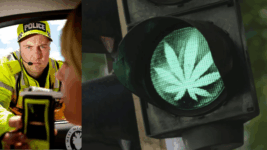
The Minns government should be congratulated in having passed laws establishing a medicinal cannabis drug driving defence last month, as cannabis medicine has been legal for a decade now. But in having established a maximum limit relating to how much THC, the psychoactive component of cannabis, can be excused in users’ systems, the just thing to do would be to extend this to all drivers.
New South Wales Labor went a step further than other local jurisdictions that have established a defence for drivers legally prescribed cannabis medicine, as it developed a lower positive threshold limit of under 50 nanograms of THC, or delta-9-tetrahydrocannabinol, per millilitre of saliva, which means registered drivers can test positive to this twice, with a third time warranting penalisation.
The understanding would be that the threshold limit, based on Monash University research, represents something of a safe lower limit of THC in a driver’s system, so they’re not considered to be impaired by their past cannabis consumption. Yet, this welcomed development leaves the public with the question as to why other drivers with low levels of THC aren’t provided the same benefit.
The 2007-established NSW drug driving regime differs from the 1982-launched random breath testing for alcohol, as RBT is based on levels of alcohol in the blood, whilst drug driving penalises any presence of a prescribed drug in a driver’s system. And prior to the need for a cannabis driving defence, the local campaign contesting the illegitimate NSW drug driving laws focused on this issue.
So, as those drivers in NSW who are legitimately prescribed cannabis medicine by their doctor are about to be protected against loss of licence for simply having traces of their legally prescribed drug in their system, the argument ought to turn to why drivers with low level traces of THC, which aren’t dangerous, in their system, should be penalised, and why lower levels aren’t set for other drugs too.
Illegitimate presence-based testing
In their 2017 paper ‘Zero Tolerance’ Drug Driving Laws in Australia: A Gap Between Rationale and Form academics Julia Quilter and Luke McNamara highlight the “weak correlation” the NSW presence-based drug driving regime – and indeed all such regimes across the country – has with the “important road safety objective of deterring substance-impaired driving”.
Quilter and McNamara point out that random breath testing for alcohol turned the once “common practice” of drink driving in this state into “highly stigmatised criminal behaviour” precisely because it is an evidence-based impairment model predicated upon scientifically proven levels of alcohol in the blood, with a rising scale of penalisation linked to rising levels of inebriation.
But under the NSW drug driving regime, drivers are tested for the mere presence of four specific drugs in their system, and all drivers are penalised in the same manner, regardless of how concentrated the presence of a particular drug is. This means there is no direct correlation between a positive test and a driver being too intoxicated to drive and hence, being a danger on the road.
Indeed, in the case of cannabis driving, there are three example cases that former NSW Magistrate David Heilpern presided over in Lismore Local Court over 2016 and 2017, in which separate defendants were not found guilty of cannabis driving, as it was understood that the THC had entered their systems either long before testing, or otherwise, via means other than direct consumption.
So, NSW drug driving laws continue to penalise drivers who are not impaired when on the road, and as the Quilter-McNamara report asserts, a driving regime based on unjust laws will not garner the same societywide respect as legitimate RBT laws, and hence, these laws have not succeeded in producing the same societywide stigma for drug driving that has been established with drink driving.
A dubious regime
The offence of drug driving or driving with the presence of certain drugs (other than alcohol) in oral fluid, blood or urine sits under subsection 111(1) of the Road Transport Act 2013 (NSW) (the RTA). The criminal offence relates to four prescribed illicit drugs: THC, MDMA, amphetamines and cocaine. And the devices used by NSW police on the roadside test saliva samples for any presence of them.
A driver testing positive for drug driving receives an on-the-spot fine of $722 and an automatic 6-month licence suspension, which a court can drop to 3 months. If a first-time offender challenges their charge in court, a maximum fine of $2,200 applies. And second- or third-time offenders within 5 years face a fine of $3,300 and 12 months suspension, which can be dropped down to 6 months.
The illegitimacy of this regime that punishes drivers for being impaired by drugs in a similar manner to those who are not affected in the slightest was heightened in July 2023, when the NSW District Court ruled in Narouz versus R that drug driving is an absolutely liability offence, which is a crime where the prosecution only has to show that an act occurred for an accused to be found guilty.
Prior to the ruling in Narouz, drug driving had always been a strict liability offence, which means the prosecution had to prove three elements: that the accused was driving, that they had the presence of a drug in their system and they had no excuse for this. So, strict liability offences can be defended against via the raising of the legal defence of an honest and reasonable mistake of fact.
The 2024 NSW Court of Criminal Appeal case R versus Narouz then confirmed that the NSW drug driving crime is indeed an absolute liability offence, which means there are only two elements to the defence: that the accused was driving and that they had the presence of the drug in their system. This means that once a driver does test positive there is absolutely no way to avoid conviction.
Extending the legal threshold
The new medicinal cannabis drug driving defence sits under subsection 111(1A) of the RTA and it provides that a “registered medical cannabis user does not commit” a drug driving offence if limited THC is detected in a driver’s system, along with no other drug or alcohol. The limit for THC is 50 nanograms per millilitre of oral fluid or in terms of blood, the limit is 3.5 ng/ml.
Drivers are further required to register as a medicinal cannabis user with Transport for NSW to be put onto a database that makes them eligible for the defence. The database can be accessed by NSW police. A registered driver can then test positive for an amount of THC below the legal threshold twice without being penalised, with a third strike warranting a fine and licence disqualification.
The obvious question left to be asked is that if some drivers are testing below 50 nanograms of THC per millilitre of oral fluid or below 3.5 nanograms of THC per millilitre of blood, why should others be penalised for the same levels when they’re obviously not inebriated and not a danger to other drivers?
Indeed, it is these irrational aspects of the NSW drug driving regime, which means that these laws will never garner the reverence that drug driving laws have due to the inherent justice involved with the RBT testing regime.
The other can of worms that the medicinal cannabis defence opens up are questions around why there isn’t a lower threshold for cocaine, amphetamines and MDMA. It is well understood that all of four prescribed illicit substances involved in the NSW drug driving regime stick around in a driver’s system for a period after intoxication, so why should straight drivers be suspended?
The nation of Norway has had a drug driving regime in place since 2012. This tests drivers for scientifically based levels of legal and illegal drugs in their blood to ascertain whether they’re driving in an intoxicated capacity. This first of its kind regime continues on until the present day, with its initial number of 20 substances having been upped to 28 different drugs in the interim.
So, just as Australian academics Quilter and McNamara posited in their 2017 paper on this country’s drug driving laws, the NSW roadside drug driving regime that continues to be applied by NSW police is rather acting “as a de facto mechanism for punishing individuals who are suspected of having committed the crime of possession and/or self‐administration of an illicit drug”.
Image: West Midland Police officer is licensed under CC BY – SA 2.0. Cannabis traffic light from Shutterstock

Paul Gregoire

Receive all of our articles weekly
Related Articles
 Sydney Criminal Lawyers® success in defending fraud charges
 Judge Swaps Sex for Freedom
 Victorian MPs May Support Euthanasia Laws
 The Law, Penalties and Defence for Sexual Touching in New South Wales
 Sydney Criminal Lawyers® Weekly Rundown – Articles from 14 to 20 November 2022
 New South Wales Launches Yet Another Crackdown on Youth Crime