WA Police Bans a Dozen Activists from Perth Weapons Expo
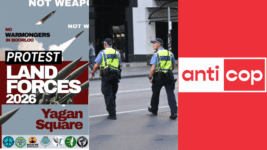
Right now marks three years since the Gaza genocide began, and this stark anniversary coincides with Israeli arms manufacturers showcasing their military wares at a weapons expo in Boorloo-Perth, while the Western Australian government has set up a buffer zone around the festival to exclude demonstrations, and it’s further specifically banned 12 ardent activists from entering the area.
Land Forces 2026, the largest weapons expo of its kind in this country, is taking place over 6 to 8 October 2026. The likely unconstitutional laws the WA Cook government passed to add a layer of protection to local and global companies spruiking their death machines were prompted by activists having run the 2022 expo out of Magan-djin-Brisbane and the 2024 event out of Naarm-Melbourne.
Passed on the 16 September 2026, the Land Forces Event (Special Powers) Act 2026 contains a set of laws that has imposed an exclusion zone around the Perth Convention and Exhibition Centre from 1 to 10 October 2026. The legislation includes the “excluded persons” law that can prohibit specific activists from the buffer zone, via threat of up to 3 years prison time and/or a $36,000 fine.
In a sign of how flimsy WA Labor considers its rights-eroding legislation is, following the Human Rights Law Centre and SCALES Community Legal Centre having filed a legal challenge to the ban specifically targeting WA Greens staffer Matilda Lane-Rose from attending the Land Forces site, the state backed down to allow her entry and to avoid court action, but she can only enter on one day.
But the idea of passing an entire bill to protect arm dealers in spruiking their wares has been decried as draconian, and WA police having last week posted letters to a dozen activists nationwide to inform them they’re not welcome is being touted as beyond the pale.
While anticop is pointing out that whilst these laws may be extreme, these are the types of measures that activists are now facing nationwide when taking a political stand.
The dirty dozen
“The police have provided no evidence that excluded persons are a serious threat to property or anyone’s safety. There is no hearing, no appeal process,” anticop founder Tom Raue told Sydney Criminal Lawyers. “The trappings of liberalism, like free speech and procedural fairness, fall away when it comes to protecting war and big business.”
“The WA police minister Reece Whitby says that the exclusions are intended to prevent violence,” Raue continued. “But activists on that list have no history of violence, unlike the soldiers and arms dealers at Land Forces. It reminds me of Dr Strangelove’s famous line, “Gentlemen, you can’t fight in here! This is the War Room!”
Included on the list of one dozen activists singled out as being too good at their job to be present at Land Forces are Lane-Rose, Will Shanahan and Joanna Partyka from Disrupt Burrup Hub, and Violet CoCo and Brad Homewood from Extinction Rebellion. WA police has targeted well known activists from right across the country and not simply within the jurisdiction in which it operates.
Lane-Rose is a 22-year-old law student, who works for WA MLC Sophie McNeil, and she has been banned from the exclusion zone. But once a court challenge to this prohibition was filed, she was promptly permitted to enter on 6 October, as part of her employment duties.
And the Human Rights Law Centre had already put to WA attorney general Tony Buti that the suite of Land Forces laws likely illegitimately burden the implied right to political communication.
‘As well as the restricted persons list, the new law allows police to restrict what protesters can carry, banning flag poles, jars and drink cans,” Raue further explained.
“Police can stop and search anyone in the exclusion zone, and they have evicted rough sleepers from the area to make way for the arms fair.”
Unconstitutional laws
The Land Forces Bill explanatory memorandum sets out that it “confers a range of security powers on police officers operating within a Land Forces security area, including powers to create checkpoints, cordons and roadblocks, stop people from entering, direct people to leave, search people and vehicles; take identifying particulars from people and give reasonable directions to people”.
Section 3 of the Land Forces Act lists the prohibited items that cannot be taken into the Land Forces buffer zone. There are dozens of items, which include rope, chains, spray paint, handcuffs, bike locks, padlocks, adhesive, poles, marbles, smoke devices, flares, flammable liquids, laser pointers, prohibited weapons, reptiles and insects. These prohibitions are to prevent protester actions.
Section 41 of the Act makes it a criminal offence to enter the zone with a prohibited item, which carries a $6,000 fine. Section 40 makes it a crime to behave in a threatening manner within the zone, which includes the use of offensive language or using a prohibited item, which can land a person in prison for up to a year and/or see them served a $12,000 fine.
Sections 44 and 45 of the Act make it a crime to fail to follow a direction or a move on order in the zone respectively, with both offences carrying up to 1 year inside and/or a $12,000 fine.
In terms of the excluded persons law, it sits under section 46 of the Act, and it makes it an offence for those individuals “named in an excluded persons list” to enter or attempt to enter or be present at “the event area during the event period without the written authorisation of the commissioner”. And this crime carries up to 3 years prison time and/or a $36,000 fine.
Part of a broader shift
“Laws like this are increasingly common across Australia,” Raue further stressed in raising concerns about the likely unconstitutional measures that the WA Cook government has progressed, and which they’ve already avoided taking to court.
“We need to stop this descent into authoritarianism and assert our right to protest before it disappears completely.”
The right to protest has been increasing under attack, ever since the NSW Perrottet government established the 2022 NSW antiprotest regime, with bipartisan approval from NSW Labor. And since the Minns Labor government took power in March 2023, it’s been building upon these measures, often in a manner, which, just like the Cook government, runs roughshod over constituent rights.
In terms of legislative packages that make sweeping changes to the law to heavily restrict constituent rights, the Minns government passed the public assembly restriction declaration, or the PARD law, in the wake of the December 2025 Bondi Beach massacre, which permitted the NSW police to ban street protest marches in declared areas, following the commission of a terrorist act.
NSW premier Chris Minns then made sure that a demonstration protesting the official visit of Israeli president Issac Herzog on 9 February 2026 was not only covered by the PARD prohibition, but it was also subject to the terms of the Major Events Act 2009 (NSW), which is a law that enhances policing powers during major events, in a similar manner to the Land Forces legislation now in force in WA.
Heavy with the restrictions of both the PARD and Major Event laws, the Herzog protest descended into violence, as 3,000 NSW police officers bashed and brutalised 20,000-odd NSW constituents protesting the visit.
But the PARD law was later challenged in the NSW Supreme Court and was struck down as unconstitutional, and this was the second antiprotest law championed by Minns, which was found by the NSW judiciary to impermissibly burden the implied right to political communication within the Australian Constitution.
And rather than apologise for the unprecedented police violence and the implementation of a law that arguably caused it, the premier, the NSW police minister and the NSW police commissioner have all dug in their heels, whilst Minns has suggested that despite the court ruling, the passing of his unconstitutional PARD law was “necessary and important” and he “stands by the decision”.
Image: Anticop logo and Land Forces 2026 protest poster supplied. WA police from Shutterstock. Image ID 1629213946
Paul Gregoire

Receive all of our articles weekly
Related Articles
 The Dilution of the Doctrine of Double Jeopardy and the Gordon Wood Case
 Judge’s Associate Allegedly Dupes Judge into Providing Reference
 Karen Refugees from Myanmar Spend Decades in UN-Run Thai Camps, as Recent Arrivals Are Returned
 Strip Searches: Minns Probes Whether Sexual Assault by the State Is Right for Kids
 How to Surrender Yourself to Police in New South Wales
 The Finks Bikie Gang Is Providing Security for Noncitizens Detained on Nauru