The NSW Offence of Robbery with Arms and Wounding
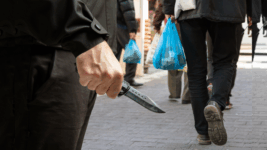
A Broken Hill man was charged with robbery with arms and wounding, after the 38-year-old was arrested on 14 September 2026, in relation to an alleged assault and robbery of an 81-year-old on Wiljaali land at a home on Broken Hill’s Argent Street on the afternoon of 13 September. And it remains unclear as to whether the charges will be upgraded, after the elderly man died on 30 September.
It was reported to the New South Wales Police Force that the 38-year-old, who was known to the complainant, had threatened the 81-year-old with a knife before assaulting him, taking his money and fleeing. After arriving at the scene, paramedics took the injured man to hospital. And Orana Mid-Western Police District officers then arrested the alleged robber at a motel on Wiradjuri land in the New South Wales town of Dubbo.
The assailant was then taken to Dubbo police station, and he was further charged with one count of detain person with intent to obtain an advantage and intentionally causing grievous bodily harm, as well as a backup charge of assault occasioning actual bodily harm. And while the 38-year-old is now being held in custody on remand, the elderly man died in hospital on 30 September, due to his extensive injuries.
A report detailing the elderly man’s death is now being compiled and will be presented to the NSW Coroner’s Court on completion. However, following the announcement of the elderly man’s death, it remains unclear as to whether the 38-year-old’s charges will be upgraded to murder.
Robbery with arms and wounding
The primary offence charged against the 38-year old man is currently robbery with arms etc and wounding under section 98 of the Crimes Act 1900 (NSW), which carries a maximum penalty of 25 years’ imprisonment.
Robbery with arms and wounding also carries a standard non-parole period of 7 years. An SNPP applies to certain offences to act as a guidepost for sentencing judges, when imposing a non-parole period, or the minimum time that an offender must spend behind bars before being eligible for release on parole.
Section 98 sets out that the offence of robbery with arms and wounding can take three forms: robbery whilst armed with an offensive weapon or instrument that causes wounding or grievous bodily harm, or stealing in the company of at least one other that causes wounding or grievous bodily harm, or assault with intent to rob that causes wounding or grievous bodily harm.
So, to prove that robbery with arms and wounding has been perpetrated by the accused, the prosecution must prove beyond a reasonable doubt that the accused intended to steal property, that they took property from the person, that this was done without the owner’s consent, and it was further achieved via actual violence or threat of violence, which caused the victim to submit.
Section 98 further explains that the wounding involved in the offence can occur “immediately before, or at the time of, or immediately after, such robbery, or assault”.
Wounding is not defined in statutory law, but case law has established over time, that wounding involves the breaking of the continuity of the victim’s skin. This means that both the top layer of skin, the epidermis, and the bottom layer, the dermis, must both be broken. A split lip can, therefore, be considered a wound under this definition.
And section 4 of the Crimes Act defines grievous bodily harm as “any permanent or serious disfiguring” of a person or causing an individual to contract a grievous bodily disease, along with the destruction of a foetus of a pregnant woman, regardless of whether she is harmed. And such foetus harm doesn’t include termination carried out in line with the Abortion Law Reform Act 2019 (NSW).
Defences against robbery with arms and wounding
A number of defences are available to refute a charge under section 98 of the Crimes Act.
Contained under section 418 of the Crimes Act, self-defence is available to argue against the crime of robbery with arms and wounding. This defence involves the accused arguing that they perpetrated their acts to protect a person or property, or to avoid unlawful deprivation or trespass. However, as this offence also involves robbery, arguing self-defence is more complex than against just wounding.
The defence of duress is also available to a charge of robbery with arms and wounding. This involves the accused asserting that their wrongdoing was perpetrated in order to prevent a serious threat of harm made against themselves or a loved one. In terms of section 98, this might involve the accused arguing that they stole an item from another in order to avoid being harmed with it later on.
Another defence available against a charge of robbery with arms and wounding is necessity, which involves the accused arguing that they perpetrated their crime in order to avoid a much greater peril. So, in the case of section 98, a defendant might argue they aggressively stole a key from a man who planted a bomb on a crowded ship, in order to unlock a door and prevent the bomb from detonating.
The defence of claim of right is another common defence against robbery charges. This involves the accused arguing that they honestly believed the property that they obtained or attempted to obtain from their victim was rightfully theirs. This belief must be shown to have been reasonably held.
Reforms to robbery with arms and wounding
The section 98 of the Crimes Act offence of robbery with arms and wounding appeared in the original Crimes Bill 1900, which was introduced into NSW parliament on 23 August 1900 and passed both houses on 6 September 1900. The Crimes Act 1900 then took effect on 1 July 1901.
The section 98 offence has been the subject of legislated reforms that have involved changes to the original text. The Crimes (Life Sentences) Amendment Bill 1989 altered section 98, so that the maximum penalty of life imprisonment was changed to up to 25 years prison time.
This involved the last phrase of the original 1901 section, which had read, “such person, shall be liable to penal servitude for life”, being amended so that it now reads, “such person, shall be liable to imprisonment for 25 years”.
Then NSW Liberal attorney general John Dowd explained in his 1989 second reading speech on the Crimes Life Sentence Bill that three life sentence reforms were being progressed, as the government moved to truth in sentencing for murder, because up until then, a sentence of life imprisonment was indeterminate, which meant decisions were often made to release offenders early.
The Crimes Life Sentence Bill saw section 19A inserted into the Crimes Act, which ensures that the crimes of murder carry life imprisonment, and that it actually means for the term of one’s natural life. New section 431A was also inserted and that maintained that only murder carries life, and all other crimes, like section 98, that had carried life from thence on carried 25 years prison time.
Another piece of legislation that served to amend the section 98 offence was the Crimes (Home Invasion) Bill 1994, which made two changes to the crime that involved the addition of grievous bodily harm being a potential outcome of it, along with the dropping of “so armed” from the broader phrase of “in company with another person so armed”.
Then NSW Liberal attorney general John Hannaford explained in his 1994 second reading speech on the Home Invasion Bill that amendments were being made to aggravated robbery offences to lower the threshold of when they’ve been made out. So, in terms of section 98, “so armed” was removed so that “robbery in company” can be found when co-offenders aren’t armed.

Paul Gregoire


Ugur Nedim
Receive all of our articles weekly
Related Articles
 The Coal Industry Controls the Coalition
 Report Confirms Endemic Misogyny and Racism Within Queensland Police Service
 Christian Thugs Attack Nonviolent Trans Rights Demonstrators at One Nation Rally
 Minns, Time to De-Christianise Parliament in Multifaith/Nonreligous NSW, Say Rationalists and Greens
 Mardi Gras’ Anti-Trans and Genocide-Denial Turn Is Trumpian, Says Pride in Protest’s Miles Carter
 NSW Police Engage in Campaign of Extreme Harassment Against Prominent Palestinian Activist