Australia’s Top Cop’s Priorities: AI Policing, Foreign Interferers and the Dural Caravan Hoaxer
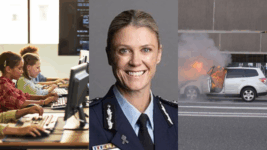
AFP commissioner Krissy Barrett last week gave multiple interviews to mainstream media outlets to mark her one-year anniversary and raise key priorities for the law enforcement agency. The top cop is continuing to prioritise the capture of the mastermind behind the 2025 Dural caravan hoax, as well as the need for AI tools to counter AI crime and the rising threat of foreign interference.
The Australian federal police boss explained to the ABC that kids subjected to sexual victimisation online are turning to artificial intelligence chatbots for help, instead of the police or their parents. Barrett told the Herald that Sayit Akca, the orchestrator of the Dural terror hoax, is top of the most wanted list. And she told the Murdoch press that the threat of foreign interference is rising.
Barrett already raised federal law enforcement desires to use AI tools to protect children online, in June this year. However, at that time, the key issue was online terrorist and criminal networks targeting Australian kids. And she said at that time that she would be attending a meeting of the Five Eyes Law Enforcement Group that would be discussing artificial intelligence policing tools.
The AFP commissioner has been vocal with the public about her priorities over her first year in the top job. This is a similar approach that ASIO director general Mike Burgess has taken since he gave his first Annual Threat Assessment in 2020. And in taking this front facing approach, both the heads of these national agencies have broken with the practice of past top officials.
AI policing tools
An academic paper, Prevalence and Disclosure of AI and Non-AI Online Child Sexual Victimisation, has been cited as providing reason for the AFP to invest in law enforcement AI tools to track down on harms against children online. Researchers have found that “one in 25 Australian adolescents experienced, or have a friend who experienced, AI facilitated online child sexual victimisation”.
The report too finds that generative artificial intelligence has intensified online child abuse, in a number of ways, including the production of deepfake images and persuasive language that enhances solicitation of minors. But the key finding that raised Barrett’s concerns is that more than one in three children are reporting such online abuse incidents to AI chatbots or to no one at all.
Barrett told the ABC that she wasn’t calling on the Albanese government to implement a ban on under 16-year-olds using chatbot sites, like the late 2025-launched block on kids using social media. And the top cop advised that to counter this issue, the AFP is instead partnering with Monash University’s AiLECS Lab to create a welfare tool, which could detect predators online.
The top cop first cited the need for the AFP to develop AI tools to sweep the web for predatory behaviour midyear. But the issue at that point was not sexual victimisation, but instead, it was online adult criminals coercing young kids to harm their siblings or pets, along with terror networks who were sweeping the web looking for kids to commit crimes on the cheap.
As noted earlier, Barrett was off to meet her counterparts in the Five Eyes alliance, which is a long-term intelligence sharing arrangement between the US, the UK, Canada, Australia and New Zealand, to discuss such matters. So, it would appear that the Five Eyes are developing more sophisticated AI tools to police the online environment, which could too be used to monitor political dissent.
Foreign interferers
The “diabolical reality” that Barrett warned the Daily Telegraph about last week is that hostile governments are teaming up with local gig criminals to cause havoc on the ground in Australia. According to the AFP chief, “despots, dictators and disruptors” are likely to be increasingly responsible for the commission of crimes by proxy on this continent.
“In effect, state actors are increasingly capitalising on existing criminal underworld connections, especially with those who share ethnicity or ideology, to carry out offences such as foreign interference, sabotage or terrorism,” Barrett made clear, and she added that increasingly in the West there are “individual offenders and networks… willing to carry out serious crimes” for cash.
Barrett pointed to the key instances of foreign interference-related crimes identified by the ASIO boss in August 2025, which were the October 2024 Sydney arson attack on a Bondi Jewish deli and the December 2024 attack on a Melbourne synagogue. Burgess revealed that he’d received intelligence that these attacks were the work of Iranian agents, and the source was likely Israel.
The AFP commissioner further suggested that these crimes directed by foreign agents are also occurring in other Five Eyes nations, and in particular, it’s happening in the UK. She too expects that these types of crimes will start targeting “high officials and politicians”, and these sorts of terror-related crimes are expected to be on the rise in the near future.
“In terms of 2027, we (expect to) see criminal activity become more decentralised, more tech-enabled, more convergence with illicit finance, offshore facilitators, all allowing increasingly agile networks to operate across international borders,” Barrett further told the Murdoch rag last week, and she added that illicit drugs and tobacco will continue to be other key areas of concern.
The shifting blame
Barret told the Herald last week that the offender at the top of the AFP most wanted listed is Sayit Akca, who the AFP and NSW police identified as the orchestrator of the spate of so-called antisemitic arson and graffiti attacks on Jewish properties in the Greater Sydney region in May last year. But the AFP now appears to be seeking Akca solely in relation to the 2025 Dural caravan bomb hoax.
Following a media leak in January 2025, it was announced that a caravan filled with explosives had been located on Dharug land on a property in Sydney’s Dural. Acka, who fled Australia to avoid prosecution in 2023, told the ABC last year that he was involved in the caravan but not the 12 other antisemitic incidents. And he propagated the bomb hoax to receive more leniency in his trial.
Both the NSW police and the AFP insisted organised crime was behind all 13 antisemitic attacks in the Greater Sydney region over the summer of 2024-25, in March 2025. So, the attribution of just one incident to Iranian foreign interference appeared questionable. And the NSW police confirmed it continued to find no foreign interference in any of the incidents in October 2025.
So, while the perpetrators of the Dural caravan incident and the arson attack on a Bondi deli appear to have been identified, eleven more so-called antisemitic attacks in Greater Sydney remain unsolved, and as children appear to be under attack on multiple fronts online, it too appears that civilians will soon have to be wary of AFP chatbots policing them when surfing the web.
Image: Official photo of AFP commissioner Krissy Barrett on AFP site. Burning car and kids on computers from Shutterstock. Image IDs 506861911 and 2670892989
Paul Gregoire

Receive all of our articles weekly
Related Articles
 What Happens if You Are Declared a NSW Habitual Traffic Offender?
 Getting a DUI Dismissed if Diagnosed with Depression
 Pair Refused Bail on Charges of Financing Terrorism
 What is the Offence of Sextortion in New South Wales?
 Dutton Is Turfing Vulnerable Refugees Out Onto the Street Mid-Pandemic
 Identify and Disrupt Laws Put Nail in the Coffin of Democracy