Greens Seek to Prohibit NSW Police from Using Sniffer Dogs in Public Places
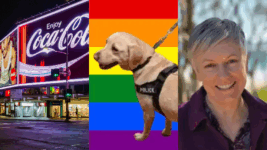
New South Wales Greens MLC Cate Faehrmann just tabled a bill to end the scourge that is the warrantless use of drug detection dogs in public places by NSW police. These laws come at a time when the dogs have garnered heightened attention, after police twice conducted raids on Oxford Street gay bars. But calls to end this highly flawed foil to drug supply have been made for decades.
Introduced on 14 October 2026, the Law Enforcement (Powers and Responsibilities) Amendment (Drug Detection Dogs) Bill 2026 involves the mass repeal of the powers that NSW police has to descend upon a public place with a sniffer dog, and once the canine indicates anybody, then perform a pat down search upon them, which can escalate to a strip search, depending on the circumstances.
“What was originally presented as a tool to target drug dealers has become a system that subjects people to searches and police scrutiny simply for catching a train or enjoying a day or night out at a music festival or a dance party,” Faehrmann said, during her second reading speech on Wednesday. And she added that young people are now “routinely treated as suspects”.
The Greens MLC then cited a few more home truths about the dogs, which include that sniffer dogs were meant to target drug supply, but rather primarily sniff out people who have drugs for personal use. The use of dogs has been shown to encourage drug taking practices in young people that cause death. And on the vast majority of times that the dogs do indicate a person, no drugs are located.
A further key reason that Faehrmann has been advocating for sniffer dog use to end of late is the fact that other “cities that compete with Sydney, as global destinations for tourism, nightlife, culture and major events, do not routinely subject patrons to this type of policing”, and besides the collective embarrassment in treating visitors in this way, the practice is trashing the city’s reputation.
An international embarrassment
“The routine use of drug detection dogs in nightlife precincts, bars, clubs and transport hubs is not standard practice in comparable international cities,” Faehrmann told the chamber midweek. “People visiting Sydney are often shocked to discover that they can be searched, detained and interrogated by police and drug dogs simply for entering a nightclub or catching a train.”
“At a time when this government likes to boast about investing millions in revitalising nightlife and promoting Sydney as a global city, NSW continues to deploy a policing model that is increasingly viewed as heavy-handed, ineffective and inconsistent with contemporary approaches to public health, community safety and drug harm reduction,” the MLC continued.
The Greens member added that NSW police and the state major parties will likely respond to the proposal with “but drugs are illegal” and “we cannot have a freeforall.”. However, Faehrmann then pointed out that, after two and a half decades of drug dog use, one in six NSW constituents continue to report recent drug use and the use of various drugs in general has gone up over that time.
Faehrmann has further raised the point that in other cities, like Melbourne, London, New York, Berlin and Tokyo, police officers are not raiding bars and nightclubs with drug dogs. Yet, NSW police ran drug dogs through multiple Oxford Street gay bars, on a night in June and another in September this year. And this saw only one supply charge laid and trashed relations with the LGBTIQA+ community.
“Other jurisdictions increasingly focus police resources on organised drug supply and treat personal drug use as a health issue. NSW has done the opposite,” Faehrmann further made certain. “The result is a policing regime that is out of step with modern evidence and is increasingly damaging Sydney’s nightlife, cultural life and international reputation.”
The guts of the bill
The laws governing NSW drug dog operations were first enacted into the Police Powers (Drug Detection Dogs) Act 2001 (NSW), which took effect in February 2002. These laws were incorporated into the main policing powers legislation in this state, the Law Enforcement (Powers and Responsibilities) Act 2002 (NSW) (the LEPRA), when it took effect in December 2005.
Faehrmann’s bill serves to repeal division 2 of part 11 of the LEPRA. These are the key drug dog powers. They provide that police can carry out a search of a person if they suspect them of a drug offence, following a drug dog indication. They provide for the warrantless use of the dogs on persons leaving or entering licensed premises, public transport stops, events, tattoo shops and in Kings Cross.
The amendment further removes the various LEPRA clauses that facilitate the warranted use of drug dogs in other places. The bill removes the various clauses in the Law Enforcement (Powers and Responsibilities) Regulation 2016 (NSW) relating to drug dog warrants, and it repeals the provision in the Tattoo Industry Act 2012 (NSW) that permits drug dog use in tattoo parlours.
“So, how did we get here?”
Faehrmann, the Greens drug law reform spokesperson, also provided NSW parliament with the historical set of circumstances that led to the establishment of the aberration that is the NSW police drug dog unit.
At the turn of the century, the NSW state was reeling from the revelations of the 1990s Wood Royal Commission. This included NSW police involvement in the drug trade. The state was also stricken by a heroin crisis, with a spike in overdoses on Gadigal land in Kings Cross and mass distribution on Dharug land in the southwestern suburb of Cabramatta. This spurred the 1999 NSW Drug Summit.
Then NSW premier Bob Carr announced a crackdown on the drug trade in Cabramatta, which included the use of the sniffer dog unit established for the 2000 Sydney Olympics. Indeed, in March 2001, the dogs suddenly became “politically attractive”. Then over the course of that year, 14 specially trained dogs started hitting Sydney’s nightlife and transport, along with the western suburb.
Yet, while NSW police couldn’t put down their new toys, there were no laws governing their use. Then in October 2001, police hit two Oxford Street nightclubs, two clubs in the Cross and another in Double Bay. Roads were shut down and 1,000 patrons were searched. And as NSW police told the media it was going to shut down these venues, it was apparent things had gotten out of hand.
And after two court cases involving a Sydney man and another in Byron Bay were found to have involved wrongfully searches, as the dogs’ conduct didn’t warrant the procedure, then NSW police minister Michael Costa promised to legislate for the random use of drug dogs in public, which he did. And he insisted the dogs were to assist in tracking, in particular, “those supplying prohibited drugs”.
“Some 25 years later, we know how that experiment turned out. We know that most people searched after a drug dog indication are not found with drugs,” Faehrmann told the chamber on Wednesday.
“I look forward to common sense prevailing and to members supporting this bill,” the Greens parliamentarian said in ending.
“It is time to stop wasting police resources, stop damaging Sydney’s reputation and stop harassing people who go to nightclubs, dance parties and music festivals. It is time to save our nightlife. It is time to ditch the dogs.”
Image: Sniffer dog image supplied by Sniff Off. Image of Cate Faehrmann supplied. Rainbow flag is in the public domain. Sydney city photo Shutterstock Image ID 2688474225

Paul Gregoire

Receive all of our articles weekly
Related Articles
 ‘We’re Sorry’: Premier Apologises for Past Criminalisation of Homosexuals
 Sex Toy Mistaken for Bomb
 The Offence of Unauthorised Possession or Use of a Pistol or Prohibited Firearm in New South Wales
 NSW Police with Drug Dogs Saturate Global Mardi Gras: An Interview With Greens MLC Cate Faehrmann
 Can I Check if I’ve Been Caught by a Speed Camera in New South Wales?
 Numerous NSW Antisemitism Inquiry Witnesses Highlight McCarthyite Witch Hunt Underway