High Court Challenge Launched Against Ban on Political Slogans
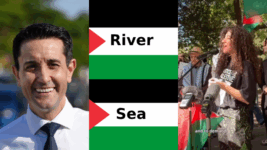
A legal suit was lodged with the High Court of Australia last week, challenging the Queensland Crisafulli government’s recently applied prohibition against the uttering or displaying of specific pro-Palestinian political protest slogans in public, with the plaintiffs’ claim being that these laws impinge on the implied right to freedom of political communication contained in the Australian Constitution.
Seven plaintiffs, led by Justice for Palestine organiser Remah Naji, announced on 27 July 2026 that they’d lodged the filing with the High Court, and four of the plaintiffs are amongst the 31 people in Queensland who’ve been charged under the controversial ban enacted on 11 March 2026, so that they now, along with calling for their charges to be dropped, want the entire law revoked.
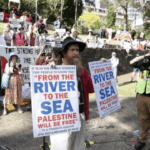
The ban prohibits the recital, distribution, publication or display of two specific expressions: “from the river to the sea” and “globalise the intifada”. The Country Liberals have banned them, as they insist they’re antisemitic in nature, despite the political way in which they’re used. The plaintiffs argue that these phrases have no inherent meaning, and therefore, cannot be antisemitic.
The idea for the ban was conceived by New South Wales premier Chris Minns in the wake of the Bondi massacre, which targeted a Jewish event on Gadigal land on 14 December 2025. And although the mass murder was inspired by ISIS, which is opposed to the Palestinian cause, Minns suggested the then 15-month-long protest campaign opposing the Gaza genocide had contributed to the killing.
The Minns government determined not to go ahead with its proposed prohibition in April, in part because of the High Court challenge of the Queensland version was being hinted at, and a similar activist-led constitutional challenge to a prohibition on protest marches that NSW Labor had enacted post-Bondi massacre had just been struck down by the NSW Supreme Court as unconstitutional.
Challenging the prohibition
“This is about a genocide and our right to protest genocide, and to demand that this government uphold its obligations under international law,” Naji said on announcing the legal challenge out the front of Queensland parliament in Magan-djin-Brisbane last Monday. “We have officially filed a High Court challenge to strike down the repressive and frankly stupid laws that criminalise” the slogans.
“We are going after this government and we are forcing it to answer publicly and on the record for its targeting of a grieving community in the middle of a genocide,” the Palestinian Australian woman continued. “Rather than stepping up to stop the weapons shipments from going to a genocidal country… this government determined to punish the people upholding human rights.”
The two phrases that have been banned were those singled out by Minns as warranting prohibition in NSW. The broader complaint was that pro-Palestinian demonstrators had been protesting in the Sydney CBD for 15 months, which was making local Jewish people feel unsafe, as these actions were considered antisemitic, or prejudicial against Jews, even though the criticism was of the Israeli state.
Similar to the recent NSW case that saw a protest march ban revoked, the plaintiffs claim the freedom of political communication in the Constitution is being eroded by these blocks on what is essentially political speech. The group further argues in its filing that the phrases don’t have an inherent meaning and provided 12 different interpretations of ‘from the river to the sea’.
“Protesting these crimes is our right,” Remah continued before Queensland parliament. “And I want to be able to say ‘from the river to the sea’ without fear of being arrested.”
The law banning certain words said together
The offence of recital, distribution, publication or display of prohibited expressions is contained in section 52DA of the Criminal Code 1899 (Qld).
The crime involves a person uttering or displaying a “prohibited expression” in any of the aforementioned ways and in a manner “that might reasonably be expected to cause a member of the public to feel menaced, harassed or offended”.
In breaking the law, it does not matter if the member of the public was present to hear or observe the citing of the expression to feel menaced, harassed or offended. And the 31 civilians currently charged under these laws are facing maximum penalties of up to 2 years prison time and/or a fine of $25,035.
The section states the phrases that are banned. University of Sydney constitutional lawyer Anne Twomey has explained that this was the second version of the law and as it does specifically detail the banned phrases, she considers it more open to court challenge. And she further explained that laws burdening one side of a political debate, rather than all, are more likely to be struck down.
The law further provides reasonable excuses for having used a phrase in public, which include for “genuine artistic, religious, educational, historical, legal or law enforcement” purposes, or that it was in the public interest, or otherwise, that the user intended to show opposition to the ideology represented by the phrase.
Indeed, many of the arrestees consider they’ll avoid conviction as their use of the phrase is covered by the reasonable excuses.
This law relies on the conflation of political criticism of Israel with prejudice against Jewish people. Political criticism is permitted under the law, however racial and religious prejudice are not. And this conflation has long been what the Israel lobby has used to shield the Israeli state from criticism over its apartheid system, its settler colonialism and its genocidal practices targeting Palestinians.
This conflation has been propagated to produce this effect since the 1970s, although it has not played a significant role in the Australian public realm until it was gradually employed to do so, which has been since a mass Palestinian solidarity movement rose up in the second half of 2023, due to the commencement of the continuing genocide in the Gaza Strip.
The Australian state is currently implementing Australia’s Special Envoy to Combat Antisemitism Jillian Segal’s Plan to Combat Antisemitism, which seeks to insert the IHRA (International Holocaust Remembrance Alliance) working definition of antisemitism into all Australian government institutions, as it serves to conflate and assert that political criticism of Israel is antisemitic.
A legal absurdity
The Queensland prohibition on political slogans has appeared somewhat performative. The Crisafulli government passed it, via the Fighting Antisemitism and Keeping Guns out of the Hands of Terrorists and Criminals Amendment Bill 2026, which was omnibus legislation that mimicked similar laws passed in NSW and federally, in the wake of the Bondi massacre.
Along with rushing out the NSW post-Bondi legislation that included gun controls and the since struck down ban on protest marches, Minns also flagged the slogan ban. And so desperate was the need for the prohibition immediately following Bondi, that the premier convened an emergency sitting of a NSW parliamentary committee to consider the proposal over the summer break.
The slogan ‘from the river to the sea’ has long been an expression used at Palestinian demonstrations. The problem said to be with it is that it suggests the erasure of Israel. Although this so-called antisemitic phrase also features in the original 1977 Likud party political platform, which is the party current Israeli prime minister Benjamin Netanyahu belongs to.
Pro-Palestinian activists in both NSW and Queensland have been stumped over why “Globalise the Intifada” was slated for prohibition, as no one whose taken part in the rallies on Gadigal land in Sydney or in Magan-djin-Brisbane are aware of this phrase ever having been used at protests.
However, in the post-truth political climate of the present, where a Royal Commission into Antisemitism and Social Cohesion is being run with the chief aim of silencing political criticism of Israel as it commits a genocide, logic is something that can be checked in at the door when entering into the political debate.
Image: Screenshot of Rema Naji taken from Justice for Palestine footage of High Court challenge announcement. The Palestinian flag is in the public domain. Crisafulli 2005 was taken by The State of Queensland and is licensed under CC BY 4.0
Paul Gregoire
Receive all of our articles weekly
Related Articles
 Banning Political Slogans: The Absurd New Way to Stamp Out Pro-Palestinian Support
 NSW Government’s Proposal to Criminalise the Public Display of Political Slogans Is Concerning
 “Just Too Absurd”: Socialist Alliance’s Alex Bainbridge on His Arrest for Using a Political Slogan
 NSW Government Continues Its Rights-Eroding Bonanza
 AUKUS Nations Are Increasingly Framing Leftwing Activists as Terrorists
 Antisemitism Interim Report Finds No Legislative or Systems Gaps, But the Stickler Is Still to Come