The Principle of Policing by Consent Is Falling Across Australia
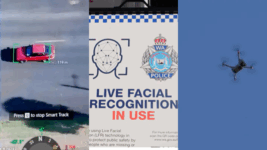
Australian policing systems are understood to operate with the consent of the public. This principle considers the police are empowered by and made up of the people, and therefore, operate with their approval. Yet, this consent would be expected to translate to the manner in which the law is enforced, and of late, expanding police powers and new technological policing advances are instead being foisted onto the public without any consultation.
Over 2026, significant developments in policing technology have begun being trialled, which have involved drone aerial surveilling over Gomeroi land in the vicinity of the New South Wales regional town of Moree and the random face scanning of the public to match civilians to images on a police watchlist on Noongar land in the Western Australian cities of Perth and Fremantle.
Like the Westminster system of governance in Australia, local policing systems mirror those developed in the UK. And in 1829, as the father of modern policing, Sir Robert Peel, established the London Metropolitan Police Force, he developed the nine Peelian principles of policing, which repeatedly insist on the need for public consent and approval for police to operate effectively.
Of course, the idea that the various Australian police forces have operated in the Peelian manner to the extent that their wielding of policing powers to fulfill their mandate “is dependent on public approval” has never applied to the First Peoples of this continent, and in this regard, it might be noted that the aggressive colonial policing approach of the Royal Irish Constabulary was influential.
The principle of being policed with consent is still a powerful idea in the community, however, as in our democracy, the people vote for the government, and it controls and empowers the police force, so therefore, law enforcement is answerable to the people.
Yet, increasingly so in the present, it appears that new privacy-eroding policing practices are being trialled and rolled out without any warning.
Nonconsensual face scanning
The idea of randomly scanning people’s faces in public using modern technology to ascertain their identity and further whether they require any law enforcement attention, is a proposal that has long been derided in the public sphere, and those who’ve been paying attention to such technology are aware that it is hopelessly flawed and it produces false and racially prejudicial outcomes.
So, when the Western Australian police quietly announced in June that it is conducting a five-month trial of live facial recognition technology to randomly scan the faces of passersby in public to match them in real time to a watchlist containing the images of 4,000 photos of wanted persons and missing people, and then apprehend them if possible, this development sounded alarm bells.
The Western Australian police did not carry out any consultation with the public about the introduction and use of the highly invasive technology. The pilot is said to have already scanned the faces of over 130,000 constituents since June. And the local Aboriginal Legal Service has questioned how this will affect already overpoliced First Nations communities.
Another significant aspect to how this has played out is that the WA government didn’t pass any laws to facilitate or govern the program, which skirted around any widespread public debate about the initiative that could have resulted in limiting its scope.
WA police has not suggested that if the trial is successful that the practice will be rolled out statewide, but this is understood to be the reason why the agency is trialling the technology.
And beyond WA there’s the entire country, which is exactly what’s occurring in the United Kingdom, where face scanning the public was first trialled in South Wales in 2017, and it’s now being used by 13 of 43 police forces across England and Wales, with nationwide rollout now on the horizon.
Surveilling the public from the sky
Whilst it appears obvious that WA police would want to expand its use of random face scanning in public if it finds the five-month trial a success, the NSW government and the NSW police were much more upfront about wanting to expand the six month trial of drone technology its using to police the community in Moree with, as from first spruiking, it was clear statewide rollout was on the cards.
The announcement of the drone trial in NSW was much the same as that of face scanning in WA. The authorities from Sydney dropped it on the town of Moree in January and then quietly told the rest of the state in February. There was no legislative process to facilitate the trial and therefore, neither a political debate. And this is again despite the highly invasive nature of policing the public in this way.
Just like WA police commissioner Col Blanch assured the public over in the west in June, that the use of biometric face scanning in public was “not about mass surveillance”, NSW police commissioner Mal Lanyon told the press in February that the drone trial was “not about surveillance”, and he then insisted that the devices will only be used for policing purposes in the same way helicopters are.
Aboriginal Legal Service acting CEO Sharif Deen told NITV’s Living Black in July that he was hearing reports about locals feeling too scared to go outside because of these “eyes in the sky”, and the other concerning aspect is that the two drones are usually seen to be flying over “areas of Moree where we have a high proportion of Aboriginal people”.
This example of introducing new drone technology on the public is completely bereft of any consent. In fact, this process relies on the discreet insertion of these new methods into public use and isolated to a particular area to slowly normalise the approach in the community without the need for any consultation, and then to gradually rollout the technique into new areas, as if it was an inevitability.
Skirting around public opinion
Data analytics multinational Palantir Technologies is creating broad artificial intelligence-driven surveillance platforms that increasingly incorporate more data and in turn, produce more information on subjects. And US journalist Whitney Webb has suggested that having a private company do this as opposed to the US government skirts around public privacy and rights concerns.
The manner in which the NSW and WA governments are currently rolling out new policing technologies, whereby they’re relying on preexisting legislative and policy frameworks and avoiding any rights or privacy debate, appears to have a similar effect to the manner in which Palantir surveillance are avoiding proper public scrutiny.
Edith Cowan University security science lecturer Nicola Lockhart notes in the Conversation that the WA police pilot of face scanning is not even a proper trial, as there will be no evaluation of the technology afterwards and there will be no contemplation of its privacy impact. And instead, she insists that as only the success of the trial will be monitored, it is actually “a product launch”.
The understanding of these trials as product launches is much clearer in the NSW example as police minister Yasmin Catley has been waxing lyrical about the rollout of law enforcement use of drones across the entire state from the time that the trialling of the devices in Moree began, which implicitly contemplated trial success and the intention to see this technology rolled out without any debate.
So, with these developments happening on either side of the continent, it would appear that the appeal to public consent is now a thing of the past, and rather this new process of introducing surveillance technologies, via a trial that’s guaranteed success and then continentwide rollout, is the rather convenient way that the authorities have developed to bypass the need for public approval.
Main image: Published by NSW and WA police to promote their trialling of new technologies

Paul Gregoire

Receive all of our articles weekly
Related Articles
 Are the Boys in Blue Really There to Protect You?
 Thugs in Blue Uniforms: Raptor Squad Raid Party, Assault Students and Trash House
 Defund the NSW Police Force Movement Gains Traction
 Who do you call when you need help? The police apologist’s mantra
 The Ever-Increasingly and Unfounded Encroachments of Policing Powers in Public Places
 AntiCop on Why Young People Should Not Consider a Career in the NSW Police Force