Local Activists Ought to Take Heed, as UK Court Sentences Pro-Palestinians as Terrorists
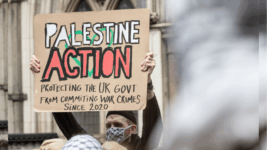
Four pro-Palestinian activists in the United Kingdom were sentenced as terrorists last week in respect of criminal damage charges relating to a direct action on a factory near Bristol belonging to Israeli arms manufacturer Elbit Systems in August 2024.
So, Australian pro-Palestinian activists currently asking why counterterrorism police have been raiding them of late, might want to take heed.
If criminal acts are considered terrorist in nature, they receive heightened penalties. The UK property damage charges relating to the Elbit factory direct action resulted in terrorism sentencing, as Woolwich Crown Court Judge Jeremy Johnson determined a “terrorism connection” to them, under section 69 of the Sentencing Act 2020 (UK), which aggravates a crime, meaning it makes it more serious for the purposes of sentencing.
The four activists, the Filton 4, were Palestine Action members when they perpetrated almost £1.2 million-worth of damage to over 40 drones and other weapons. This occurred prior to the UK listing Palestine Action as a proscribed terrorist organisation in July 2025. The Bristol action and a June 2025 direct action against RAF Brize Norton airbase in Oxfordshire were the catalysts for the listing.
Amnesty International UK have been warning that this move marks a reversal of the long-standing practice of the UK courts to treat property damage that occurs as part of protest action with a degree of tolerance compared to other such criminal offences in order to protect basic democratic rights, so that certain protest can now be treated as more serious than regular crimes.
And this shift from treating activists as public members with a conscience to national security threats in the UK further shines a different light on the increasing use of counterterrorism police officers by New South Wales and Victorian law enforcement as they’ve recently been raiding pro-Palestinian activists in a seemingly disproportionate manner compared to their protests.
From public conscience to public threat
As part of Palestine Action, the Filton 4 perpetrated their acts in direct response to Israel’s ongoing genocide in Gaza.
The Filton 4 includes two 30-year-olds, Charlotte Head and Leona Kamio, who were both imprisoned for 5 years over property damage, as well as Fatema Rajwani, a 21-year-old activist, who was sentenced to 4 years and 8 months in prison.
While the fourth member of the group, 23-year-old Samuel Corner, received 7 years and 8 months inside, as his longer sentence included an extra count of grievous bodily harm, as he struck a UK police sergeant Kate Evans with a sledgehammer, during the incident.
Each of the convicted protesters will have to spend an additional year on parole following release, and they’ll also be required to be registered as terrorists for the next 15 years.
In handing down terrorism connection sentences, Judge Johnson based his determination to do so on the fact that each defendant’s property damage crime was serious in nature, and he considered it was “designed to intimidate the UK government and a section of the public and was for the purpose of advancing a political or ideological cause”. So, on his reasoning, it fits the definition of terrorism.
Section 1 of the Terrorism Act 2000 (UK) defines terrorism as an act that involves serious violence to a person, serious property damage, endangers the life of others, creates serious risk of public health or safety or is designed to disrupt an electronic system, and the act is meant to threaten the government or intimidate the public to advance a political, religious or ideological cause.
Several defence lawyers spoke out against the sentences, asserting that it was unprecedented to penalise activists as terrorists over nonviolent action, that the group had initially been arrested over suspected terrorism but weren’t charged in that way, so such an outcome had been sought early on, and that this means past activists, including the suffragettes, would today be classed as terrorists.
Prior to the handing down of the terror sentences, Amnesty explained that the reason that the judiciary took a light touch when sentencing activists in relation to breaking the law, including property damage, as part of demonstrations, is because it serves to uphold the democratic right to protest, the freedom of political communication, peaceful assembly and the right to association.
The Filton 25 Defence Committee NGO declared after sentencing that the outcome would be appealed as it was a “serious miscarriage of justice”, as the direct action “saved lives”, because the weapons were those that Israel uses against Palestinians as part of the Gaza genocide.
However, on Monday, five judges of the UK Court of Appeal ruled that the UK home secretary’s listing of Palestine Action as a terror group was lawful, which overturned the UK High Court February finding that it was “disproportionate” and “unlawful” to have listed the group as terrorist.
Enforcement that frames
Sydney Criminal Lawyers has been receiving reports from activists in Naarm-Melbourne about being raided by Victoria police counterterrorism officers, which has included the Security Investigation Unit (SIU) in some instances. There have also been reports around heightened raids by the NSW Police Operations Support Group in respect of pro-Palestinian activists.
Activists involved in these raids aren’t sure why terrorism police are performing these operations, as their actions have often been satirical in nature, and whilst people have been reprimanded over such demonstrations in the past, this hasn’t usually involved specialist police who prioritise hunting down individuals causing serious threats to public safety to further a political or ideological cause.
Some of the raids in Naarm-Melbourne have resulted in arrests and charging, whilst others have only led to the seizure of electronic devices. Indeed, electronic devices appear to have been a key concern to law enforcement in carrying out these operations, as reports involve tech-detecting sniffer dogs, along with the seizure of devices without any pressing of charges.
Pro-Palestinian activists have been increasingly demonised in the Australian public sphere since October 2023. The Queensland law banning the utterance of certain pro-Palestinian slogans shows their increasing criminalisation. And the raiding of pro-Palestinian and antiwar activists by terrorism or speciality police already hints at the framing of these groups as a national security threat.
The decision of the NSW authorities to permit NSW police officers to brutalise a group of 20,000 pro-Palestinians demonstrating against the visit of the Israeli president on Gadigal land at Sydney Town Hall on 9 February 2026, and then later justifying it as officers doing as they were told, has again served to criminalise such activists and to convey that their purpose warrants force to prevent it.
Prosecuting activists as terrorists down under
Australian federal statutory law doesn’t have a mechanism similar to the “terrorism connection” UK sentencing principle, under section 69 of the Sentencing Act 2020 (UK), that can be used to frame a crime as being terrorist in nature at time of sentencing. Indeed, in this country, if activists were to be targeted as terrorists, then they would need to be charged in this manner prior to trialling.
The Albanese government has neither proscribed any social justice groups as listed terrorist organisations similar to the British government. Local activists have neither carried out direct actions similar to the magnitude of the Filton 4 and Oxfordshire airbase actions that might be held up to push for such listing, and there’s neither been a serious assault committed by a local activist.
But highlighting these differences does not take away from the fact that law enforcement is increasingly taking a hard line towards protest, and especially pro-Palestinian actions. And whilst there’s no terror sentencing law to take this further, one could foresee that if the lines between being a pro-Palestinian supporter and a supporter of Hamas were blurred, circumstances could shift.
Hamas was placed on the list of Australian listed terrorist organisations in March 2022. And amongst the swag of terrorism offences sitting in part 5.3 of the Criminal Code Act 1995 (Cth) is the offence of providing support for a terrorist organisation, which carries up to 25 years imprisonment. And the prosecution only has to prove that intentional support was given to a known terrorist group.
Of course, the regular Palestine Action Group protests held on Gadigal land in Sydney, and those by other pro-Palestinian groups across the continent, are specifically in support of the Palestinian cause and do not regularly show support any for Hamas, as it is a known listed terrorist organisation in this country.
However, in legal matters, it can be as much about the framing of circumstances as it can be about the interpretation of the law, and right now, in the UK, pro-Palestinian activists are being framed as terrorists.

Paul Gregoire

Receive all of our articles weekly
Related Articles
 NSW Police to Continue Raiding Herzog Protesters to Sully Police Watchdog Inquiry
 NSW Police Officers Assault and Arrest Pro-Palestinian Protesters in Sydney
 Challenging the Power to Extinguish Protest Across Sydney: Interview with Palestine Action Group’s Josh Lees
 No Apologies: Threat of Police Violence Stands After Protest Ban Ruled Unconstitutional
 NSW Police Engage in Campaign of Extreme Harassment Against Prominent Palestinian Activist
 Pro-Palestine Protest Triumphs Over NSW Police Attempt to Sow Social Discord