March for Australia Rallied to Uphold Free Speech to Protect Expression of Racial Hatred
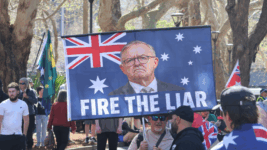
The takeaways from the 30 August 2026 March for Australia rallies are that even with One Nation having surged to the top of the polls, those making up the grassroots white nationalist movement continue to be a fringe element, while its main concern over mounting hate speech laws appears to involve the stifling of expression of racial hatred, rather than any legitimate political concerns.
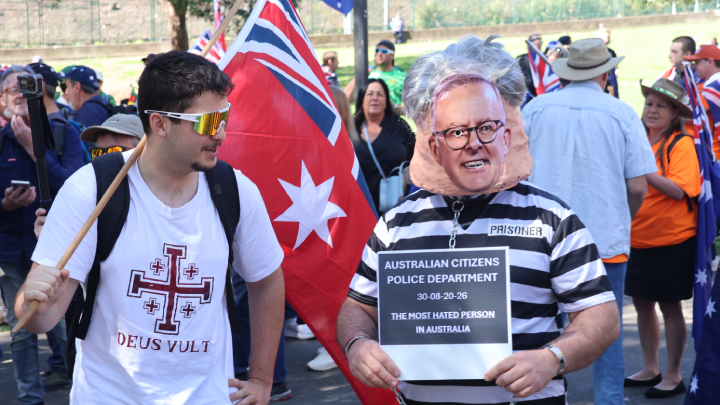
March for Australia gathered in capital cities across the continent on Sunday. On Gadigal land in Sydney, this saw hundreds of predominately white people gather in Belmore Park to listen to far-right political figures express concerns about recently enactment hate speech laws, and to call out this “leftist plot” that’s curbing political debate around the issues of mass migration and reimmigration.
A proliferation of hate speech laws has recently been passed. These were enacted federally and in Queensland in the wake of the 14 December 2025 Bondi Beach mass murder, whilst in New South Wales a plethora of hate speech laws were passed in early 2025, which responded to 13 so-called antisemitic arson and graffiti crimes perpetrated in Greater Sydney over the summer of 2024/25.
March for Australia sprung up a year ago to rally nationwide on 31 August 2025. The initial events saw an explosion of violent white nationalism on city streets. These mobilisations appeared to be in response to the massive 3 August 2025 pro-Palestine march across the Sydney Harbour Bridge. And the local grouping tips its hat to a similar white nationalist movement ongoing in the UK.
But while those gathered in Belmore Park heard from current and former politicians about hate speech laws making it difficult to have “honest debates” around mass migration, footage capturing their counterparts in Naarm-Melbourne revealed a bunch of racist white people, chiefly concerned over their right to mock and deride nonwhite peoples, taking a moment to express the forbidden.
White nationalists at the gate
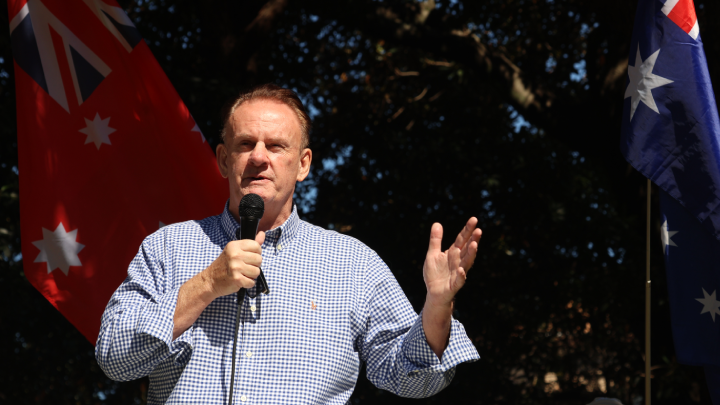
‘Freedom of speech is the fight of our lives. It is so important to the future of this country,” said NSW Independent MLC Mark Latham. “We know that the woke left, they gave up on economic socialism and embraced cultural socialism, which basically meant they wanted to control all our values, our beliefs, our statements, our speech, and make everyone like them.”
“They talk about diversity, but they don’t believe in diversity of opinion and speech,” continued the former leader of federal Labor. “The number of hypocrites out there is absolutely amazing. The mother of all hypocrites is Tanya Plibersek, who had no problem with Albo saying he wanted to root Kylie Minogue and offend the Japanese prime minister with the melons.”
The former NSW One Nation politician then set out some movement demands. The first was getting reforming section 18C from the Racial Discrimination Act 1975 (Cth). This involves a preoccupation of the federal Coalition going back a decade ago, when it sought to remove “offend” and “insult” from a prohibition on public acts that “offend, insult, humiliate or intimidate” others based on race.
The member of the NSW Legislative Council further called for the abolition of “all the Chris Minn’s hate speech laws in NSW, where he is the puppet of a certain ethnic group, saying that you can’t say things”, and the divisive politician further called for the allowance for all political parties to run in elections, as well as an “end to the insidious spread of lawfare”.
A common theme raised by the speakers on the day was that the government’s hate speech laws are designed to stifle what the public can say, which also has the further aim of manipulating what it thinks. And as March for Australia MC Brian Marlow insisted, the media is trying to paint the white nationalist movement as “extremist, fringe and anti-Australian”, when the truth is they are “patriots”.
Speaking from the podium, Marlow, the founder of Revive Australia, recalled that twelve months ago, when the first March for Australia protests took place, “One Nation was polling at less than 8 percent” but now they’re “at almost 30”. He further outlined that the party is now “romping it home at byelections”, whilst the far-right grassroots movement has learnt that if it organises, it can win.
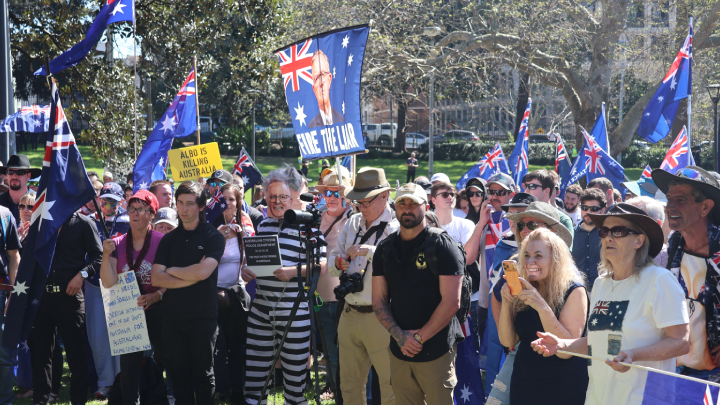
“The Chris Minns hate speech laws”
A comment was made during the Sunday rally about the fact that it was constituents with rightwing political leanings gathered in the park to defend free speech, when this has traditionally been the concern of the left side of politics. And it was further suggested that it is now the left trying to silence free speech. However, grassroots leftwing activists have been vocally opposing these same laws.
The “Chris Minns hate speech laws”, as Latham put it, refer to the laws the current NSW premier has overseen the passing of over his time in office.
The first such legislating involved a late 2023 change to the section 93Z of the Crimes Act 1900 (NSW) offence of publicly threatening or inciting violence on grounds of race, religion, sexual orientation, gender identity or intersex or HIV/AIDS status, so that such prosecutions can be progressed by a police officer, as well as the Director of Public Prosecutions, as not enough were being charged.
The Minns hate speech laws also involve the enactment of the offence of publicly inciting hatred on the grounds of race, which is contrary to section 93ZAA of the Crimes Act. This law, passed in February 2025, is controversial as it is so broad that it might capture legitimate public debate or political protest.
A religious and racial hatred bill was also passed in early 2025, which created an aggravated form of the crime of displaying a Nazi symbol in public, which involves when it is placed near a synagogue, a Jewish School or the Sydney Jewish Museum, as well as an aggravated form of the offence of graffiti when on places of worship, and it made the ‘partial motivation of hatred’ an aggravating factor.
Minns’ final hate crime laws passed in June this year, and they comprised of broadening the law that criminalises the display of Nazi symbols, so that it also captures neo-Nazi conduct and ideology being displayed in public, and such an offence becomes aggravated if the act takes place near a synagogue, a Jewish school or the Sydney Jewish Museum.
Freedom of belligerence
NSW Libertarian MLC John Ruddick asserted that freedom of speech initially came under attack during COVID, and instead of it being wound back, the NSW premier has been attacking the right to freedom of expression. He then recalled that Minns has repeatedly asserted that the reason the state of NSW does not have broader free speech protections is due to its multicultural makeup.
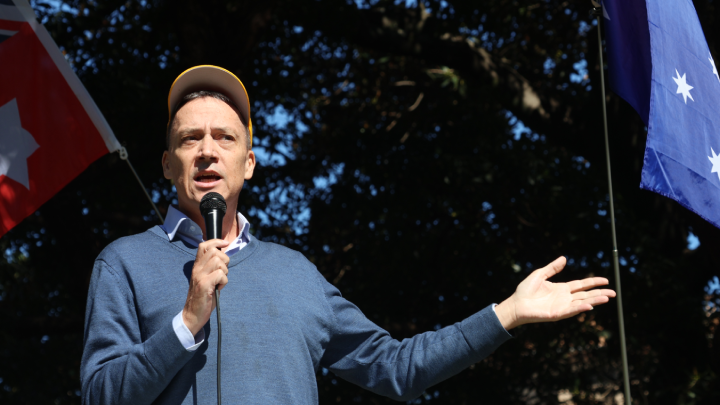
“The Minns doctrine is we can’t have free speech because we have multiculturalism,” the parliamentarian continued, “We weren’t told that when we embarked on this journey of multiculturalism.” And he then questioned why the media, the Liberals and the Nationals have failed to call the premier out on this.
However, despite the surge in support for One Nation over 2026, which has been spurred by the nation’s billionaire class led by Gina Rinehart, as it’s thrown its support behind its leader Pauline Hanson, whose built a decadeslong career out of stirring up racial hatred in the public sphere, the March for Australia rallies did not reflect white nationalist sentiment having become mainstream.
Indeed, the turnout in Belmore Park and other state capitals did not capture the white nationalist fervour that appeared on the city streets one year ago, and instead last weekend’s March for Australia rallies appeared as a fringe group, which isn’t garnering any surge in widespread grassroots support, with a few divisive far-right politicians throwing in their two cent’s worth.
But the sad truth was on display at Victorian parliament that afternoon, when a bunch of nationalists and Nazis sniggered at the spectacle of a white comedian performing a Welcome to Country that comprised of mocking derision of First Nations peoples, and revealed not a quest to protect free speech but rather an attempt to legitimise a dubious racial superiority via the basest of racist attacks.
All images taken by Paul Gregoire
Paul Gregoire

Receive all of our articles weekly
Related Articles
 March for Australia Is Mobilising Again, and This Month It’s to Protect Free Speech
 March for Australia Demonstrators Appeared to Harbour Racist Sentiment, Despite Denials
 Police Thuggery Is the New Blue in Ever-Creeping Authoritarian Australia
 Racism and Hate Crimes Fuel the National Debate for Some, But Not Others
 Neo-Nazis Are Launching the White Australia Party to Run in the Next Federal Election
 The Tricky New Laws Designed to Respond to Rising Neo-Nazism in New South Wales