Requiring Government Permission to Protest Is an Erosion of the Fundamental Right
The Australian Democracy Network and Deakin University have released a joint report into the various protest permission frameworks operating in local states and territories, such as the Form 1 process in New South Wales, and the study found that they “largely function as authorisation systems or de facto authorisation systems, requiring permission from authorities to protest”.
Released on 14 October 2026, the Permission to Protest report outlines that the various permission systems that are operating in jurisdictions across the continent buck against constituents’ rights to peacefully assembly, especially, when considering general comment 37 on the International Covenant on Civil and Political Rights, which stipulates that seeking permission undercuts the right.
The NSW Form 1 process was first legislated in 1979, and it hasn’t undergone any major changes since then, besides being shifted from its original home in the Public Assemblies Act 1979 (NSW) to be incorporated into the Summary Offences Act 1988 (NSW), which is where it remains. Prior to this, the NSW police could shut down unapproved assemblies, via the Summary Offences Act 1970 (NSW).
The report further finds that most comparable democracies, such as the United States, the United Kingdom, Canada, New Zealand and South Africa, don’t have protest permission systems in place, and in fact, courts in these nations have consistently struck down any attempts to place restrictions on the ability of citizens and residents from assembling together peacefully in public.
The NSW Council for Civil Liberties has welcomed the release of the Permission for Protest report, maintaining that it serves to validate concerns around these systems that have been raised by human rights experts and community members for years, and it comes at a time when these frameworks are being increasingly weaponised by government and law enforcement to stifle legitimate dissent.
Please sir, may I exercise my right
Further key findings in the Australian Democracy Network and Deakin University report involve civilians not only having to seek the permission of the state to exercise a basic right, but then law enforcement has the power to oppose any protest, leaving demonstrators then having to prove to the courts why it should permit the public assembly to progress.
The researchers pointed to the fact that in the Northern Territory and the Australian Capital Territory, organisers are required to produce a traffic management plan in order to see their rallies approved, whilst in the states of Tasmania and South Australia, the authorities may require public liability insurance of up to $20 million for a protest to proceed.
No Australian permission system permits for spontaneous assemblies, or snap rallies, as most require 7 days’ notice to be given to the local law enforcement agency to obtain go-ahead. However, another key finding is that despite these barriers being placed in the way of public assemblies, these measures do not have any impact on protest disruptions, frequency or policing costs.
The report notes that the systems operating in NSW, SA and Queensland were enacted following extreme police violence against protesters to establish the current “negotiated management” approach to protect activists. This followed the violence of the 1978 Mardi Gras in NSW, the 1970 SA Vietnam protest and assemblies in general, under the then Queensland Bjelke-Petersen government.
The report researchers note that the brutalisation the NSW Police Force unleashed upon anti-Herzog protesters on Gadigal land in Sydney city on 9 February 2026 marks a return to this past violence.
However, the permissions systems in NSW, SA and Queensland now operate as “authorisation systems” that increase conflict between protesters and police, especially when combined with increasing laws that seek to stamp out protest via threat of draconian fines and prison time. And these permission systems do result in discriminatory decisions against rallies based on race.
Stifling protest in the premier state
The 1979 developed NSW protest permission regime, which is known as the Form 1 process, was developed as a result of the unbridled violence that NSW police set upon the initial 1978 Mardi Gras with, as it was a protest rally that sought to end the criminalisation of people with diverse sexualities and gender identities, at a time when the law continued to prohibit homosexual relations.
Today, this regime is contained within part 4 of the Summary Offences Act. It requires protest organisers to submit a filled-out Form 1 at least seven days prior to a scheduled protest. If organisers don’t hear back beforehand, the demonstration is understood to be approved. If police oppose a rally, organisers are invited to negotiate, prior to the matter then going to the NSW Supreme Court.
Approval of protests then guarantees that the summary offences that apply to any unapproved public assemblies cannot be pressed. Such immunity captures obstruction of traffic, contrary to section 6 of the Summary Offences Act. Approval further removes the ability of NSW police to move on demonstrators from an area for reasons such as traffic obstruction or blocking entrances.
Form 1 approval, however, doesn’t provide immunity to criminal offences guarding against protest. These include knowingly joining or continuing in an unlawful assembly, under section 545C of the Crimes Act 1900 (NSW), whilst resisting arrest or hindering police, contrary to subsection 60(1AA) of that Act, is not allayed by Form 1 approval, but it is a commonly pressed offence against protesters.
The situation regarding protest in NSW really hit the fan in April 2022, when the then Perrottet government enacted a law against unapproved protests that obstruct major roads, facilities, bridges and tunnels in this state, via the threat of 2 years imprisonment and/or a $22,000 fine. This law, that shocked the constiuency, was too voted through by the Minns-led NSW Labor opposition.
Bad faith lawmaking
The Permission to Protest report makes five recommendations, including that such systems be updated, so they comprise of “genuine notification systems”. This should see the removal of a list of restraining features. Penalties should be dropped to an appropriate level, police should be schooled on facilitating protests and officer powers should not impinge upon the right to protest.
The NSW Council for Civil Liberties welcomes the timely report, which reveals that governments and local councils continue to approach public assemblies as a privilege to bestow upon constituents, rather than a fundamental right under international law. And it adds that it has received numerous complaints from constituents being priced out of protesting due to insurance requirements.
The NSWCCL further asserts that the NSW Minns government has continued to “dramatically accelerate the erosion of protest rights by actively trying to criminalise public dissent”. This has involved the imposition of the public assembly restriction declaration, or the PARD law, and a place of worship move on order.
Both these new protest restrictions were enacted at the same time that NSW premier Chris Minns has been waging a campaign to delegitimise the local pro-Palestinian movement, which is opposing a genocide. The NSW Supreme Court struck down both these laws as unconstitutional, as they impeded upon the implied right to political communication.
The premier has continued to justify the passing of these laws even though they were invalid. He claims that they served a momentary purpose. However, the PARD law enabled the mass police violence at the February 2026 anti-Herzog rally, whilst the place of worship move on power saw NSW police senior constable Christopher Davis punch legal observer Hannah Thomas in the eye.
“The Permission to Protest report must serve as an urgent wake-up call for the NSW government,” said NSWCCL president Timothy Roberts. “The rights to protest and march are fundamental to democracy, yet our current permit system has mutated into a de facto authorisation regime that aims to restrict assembly by all means.”
“We are seeing a terrifying regression back to the 1970s, where dissent is vilified, unconstitutional laws like the PARD regime are rammed through parliament, and heavily armed police are deployed to intimidate peaceful crowds,” the respected lawyer added late last week.
“The NSW government must seriously reconsider its approach to protests and adopt the Australian Democracy Network’s recommendations to build a genuine protest notification system that facilitates public participation.”
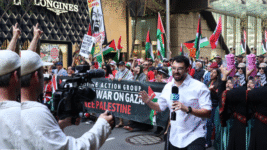
Image of Palestine Action Group rally marking three years of the Gaza genocide taking place on Gadigal land in Sydney City was taken by Paul Gregoire

Paul Gregoire

Receive all of our articles weekly
Related Articles
 The Offence of Unlawful Assembly in New South Wales
 Criminal Offences That Apply to “Unauthorised Protests” in New South Wales
 Restore the Right to Protest: An Interview With Democracy Is Essential’s Vinil Kumar
 Encroachments Upon the Right to Protest: An Interview With RAC’s Dr Nicholas Riemer
 The Right to Protest: A Thing of the Past
 NSW Police Commissioner Bans Protests, Suppressing Fundamental Democratic Rights