The NSW Offence of Reckless Wounding in Company
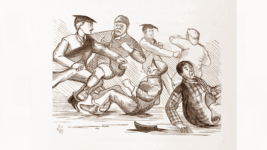
Two New South Wales men have been charged with reckless wounding in company, following an incident involving an alleged assault on a 31-year-old man at a licensed premises in on Wiradjuri land on Yapunyah Street in the southwestern NSW town of Barellan at around 9.30 pm on Friday, 28 August 2026.
Officers attached to Murrumbidgee Police District commenced an investigation on the Friday evening, after a report about the assault at the licensed premises on Yapunyah Street. The 31-year-old victim had serious injuries to his face when he self-presented at Griffith Base Hospital, following the assault. He’s since been discharged.
After making inquiries, Murrumbidgee police arrested the alleged assailants, a 42-year-old and a 38-year-old, on Barellan Showgrounds Road. The two men were then taken to Griffith police station and were both charged with reckless wounding while in company. The 42-year-old man has also been charged with one count of common assault.
Both men have been released on bail and are set to appear in Griffith Local Court on 21 October 2026.
Recklessly wounding another in company
Both NSW men are facing one count of recklessly wounding in company, which sits under subsection 35(3) of the Crimes Act 1900 (NSW). To secure a conviction, the prosecution must prove beyond a reasonable doubt that the accused wounded the other, that they were “reckless as to causing actual bodily harm” to another and further, that the person was with at least one other person.
Wounding is not defined in NSW statutory law, but it is rather defined in common law, as the breaking of both layers of skin. The breaking of the outer layer of skin, or the epidermis, does not comprise of wounding but is simply a scratch. So, a wound must involve the breaking of the interior layer of skin as well, or the dermis, along with the outer lawyer.
Recklessness is neither defined in the statutes. This mental fault element is instead set out in the common law authorities. The 2011 NSW Court of Criminal Appeal case Blackwell versus R found recklessness involves an accused being aware that grievous bodily harm could occur, yet continued to act, while the same court found in 2013’s Chen versus R, that this too held for wounding.
Being ‘in company’ is an aggravating factor, or an aspect of a crime that makes it more serious. The authority on the factor is the 2002 NSWCCA case Button versus R. It found that in company means an accused was with another or others, that they held a ‘common cause’, that all of them were present, or assisting in the crime, such as a lookout, and the victim’s perspective is not determinative.
Subsection 35(4) of the Crimes Act contains the crime of recklessly wounding another, which is the basic form of the crime the two accused are charged with, and it involves an individual having perpetrated such an offence by themselves. This crime carries up to 7 years inside.
Subsection 35(5) maintains that if an accused is being charged with one of the offences contained in section 35 of the Crimes Act, and “the jury is not satisfied that the offence is proven but is satisfied that the person has committed an offence against any other subsection of this section”, it can then acquit the individual standing trial and find them guilty of the crime that comprises their actions.
Section 35 also contains the crime of reckless grievous bodily harm in company, under subsection 35(1), which carries up to 14 years prison time. And the final offence in this section sits under subsection 35(2), and it comprises of the offence of reckless grievous bodily harm, which carries up to 10 years gaol time.
The defences against reckless wounding in company
The most common legal defence against a charge of reckless wounding in company is self-defence, and it’s contained under section 418 of the Crimes Act. This defence comprises of the accused claiming that they perpetrated their crime in order to protect themselves or another against a threat of violence.
Duress is also another defence that’s often raised against the crime of reckless wounding. It involves the accused claiming that they committed their criminal acts, as they’d been threatened or coerced into doing so, via the threat of harm against themselves or a loved one.
The defence of necessity is raised at times against a charge of reckless wounding, and it maintains that the acts that resulted in the accused being criminally charged had served to avoid a greater peril from happening. So, if the victim in the current case was about to blow up a factory full of people in Barellan, and the two accused were stopping this from happening, such a defence may work.
Another legal defence that can be raised against reckless wounding when a child is involved is the defence of lawful correction of a minor, which is contained under section 61AA of the Crimes Act. This comprises of the accused being the parent of the child that the act was committed against, that they had applied the force to the child and that the force had been reasonable.
The historic fault element of malice
Prior to the enactment of Crimes Amendment Act 2007 (NSW), the main fault element in NSW law was ‘malice’. Since repealed section 5 of the Crimes Act had maintained that to commit a crime “maliciously” could involve either the fault element of intentionally committing a crime, as well as that of recklessly committing it. And under malice, intent and recklessness, were equally culpable.
The Crimes Amendment Bill 2007, however, served to revoke the use of malice, and replaced it with the modern elements of ‘intent’ and ‘recklessness’. This meant that crimes that had earlier been prosecuted as being committed maliciously are now considered to have either been committed with intent or recklessly. And a crime committed with intent is more serious than one done recklessly.
The 2007 amendments also inserted section 4A into the Crimes Act, which maintains that if a fault element of an offence is recklessness – as is the case of reckless wounding – “that element may be established by proof of intention or knowledge”, which means that if a person is charged with committing a ‘reckless crime’, they can’t avoid guilt by asserting the act was instead intentional.

Paul Gregoire


Ugur Nedim
Receive all of our articles weekly
Related Articles
 The Offences of Reckless Wounding and Intentional Wounding in NSW
 The Offence of Recklessly Causing Grievous Bodily Harm in NSW
 What is ‘Wounding’ in the New South Wales Criminal Law?
 The Offence of Wounding or Causing Grievous Bodily Harm With Intent in NSW
 The Law, Defences and Penalties for the Offence of Common Assault
 Assault Offences in New South Wales