Permanent NSW Wanding Laws Give Police More Power to Harass Members of the Public
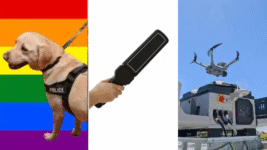
The Minns government last week made permanent 2024-enacted temporary wanding laws, which empower New South Wales police officers to randomly approach anyone in a declared zone to run a handheld metal detector over the outside of their clothing. And this shift to permanency comes at a time when calls are being made to wind back the ability of NSW police to approach civilians in public.
Passed on 13 October 2026, the Law Enforcement (Powers and Responsibilities) Amendment (Knife Scanning) Bill 2026 not only provided NSW police officers with a permanent power to conduct knife scanning of civilians in declared public places, but it further serves to expand the manner in which these laws have been operating since December 2024.
The NSW wanding regime mirrors similar laws first trialled in Queensland in 2021, where the power is referred to as Jack’s Law. The law was rolled out locally following several high-profile stabbings, including the 13 April 2024 Bondi Junction mass murder.
Six jurisdictions now have such regimes, including the Northern Territory, Western Australia, South Australia and Tasmania. And in Queensland, wanding now takes place anywhere at any time.
Police need a ‘reasonable suspicion’ to stop and search civilians. But the use of sniffer dogs in the Sydney metropolitan region permits officers to breach this rule, as, after a dog indicates a person, police can search them. But wanding laws are another matter entirely, as police are empowered to approach anyone for a scan based on their own prejudices and without need of a canine middleman.
However, in the same week as Labor ensured that NSW police has more excuses to scrutinize civilians as they go about their daily lives, NSW Greens MLC Cate Faehrmann introduced laws to end the entire NSW police drug detection dog regime, as officers being empowered to conduct these invasive procedures involves regular constituents being “routinely treated as suspects” just for being out.
Wanding made permanent
“The knife wanding scheme allows police to stop and scan persons without a warrant in certain designated areas using handheld metal scanning devices known as knife wands,” NSW attorney general Michael Daley explained, on introducing the wanding bill in June. “Wanding operations can only occur in certain public locations after a declaration is made by a senior police officer.”
“Since the knife wanding powers commenced in December 2024, they have become a crucial part of police operations,” the NSW chief lawmaker continued. “In the scheme’s first 12 months, 285 knife wanding operations were conducted in NSW that resulted in 296 knives and other weapons being removed from people carrying them on their person in the community.”
Wanding laws are set out in part 4A of the Law Enforcement (Powers and Responsibilities) Act 2002 (NSW) (the LEPRA). Warrantless scanning can only proceed in certain areas in public, following a declaration from a senior police officer. These areas had been public transport stations, shopping precincts and sporting venues. The amendment has added major entertainment venues to the list.
The rule for declaring a zone remains the same. For an area to be declared, one of three things must have occurred there within the last 12 months, which includes an offence by a person armed with a knife, a violent indictable offence against a person or more than one possess knife in public offence. And the timeframe around designated zones has been upped from 12 hours to a 24-hour window.
Daley further explained that the bill also clarifies that when a public transport station is the designated area, this allows police to conduct wanding scans “on board a public transport vehicle while it is travelling within two scheduled stops in any direction of the station and in a public place at a station within two scheduled stops of the designated station if a person leaves the vehicle”.
Encroachments into civilian space
NSW police can approach a person in public and talk to them like anybody else. But civilians can exercise their right to silence at these times. NSW police only have the right to demand a civilian’s name and address, in certain circumstances, like suspicion of a crime or if a person is driving, while an officer can stop and search a person only if they reasonably suspect them of committing crime.
Butthe roll out of drug detection dogs in 2002 changed all this, as it allowed NSW police to approach people in certain places whilst accompanied by a sniffer dog, and if the canine then indicates a civilian, this serves as grounds to conduct a pat down search. The vast majority of these searches, however, don’t find any illegal drugs. Indeed, nothing is found on at least two-thirds of occasions.
Reports suggesting that NSW police were increasingly accompanying pat down searches that turned up no drugs with a follow up strip search started emerging circa 2014. And by the end of the decade, so widespread was this use of strip searches that they’d become routine.
The fever for carrying out drug dog operations with accompanying strip searches had become so strong in NSW by 2019, that on Gadigal land at Sydney’s Central Station, NSW police was placing screens on platforms, so that people who were indicated by a dog and a pat down proved unfruitful, were then being taken behind the screens to get their kit of during their commute home.
Wanding laws breach the legislated protections that prevent NSW police officers from randomly approaching people in public based on their own prejudices and the way a person looks, as these laws empower officers to stop and search people with a metal detecting device without any distinct reasons to suspect a crime, other than the clothes people are wearing giving off gangster vibes.
Powers at the crossroads
The NSW Greens has been consistently campaigning for the removal of the warrantless use of sniffer dogs in public places since the beginning of the 2010s. As Greens MLC Faehrmann introduced her bill to end the use of drug dogs, she told parliament that the authorities had rolled out the use of sniffer dogs at the turn of the century, as it was a politically expedient move at the time.
Faehrmann has been raising the fact that police are not empowered to subject civilians, including international visitors, to the random approach of drug dogs in public that could result in a strip search, in comparable cities, like Melbourne, New York, London or Tokyo. And she underscores that these operations result in the mass criminalisation of people out in public having a good time.
The Greens MLC’s bid to rid the constiuency of this overbearing policing tactic, however, has come at a point when NSW police has been flexing its muscles. NSW police conducted two old school raids on Oxford Street gay bars using drugs dogs, once in June and again in September. And the force has started imposing highly invasive drone surveillance on Gomeroi land in the regional town of Moree.
But the key concern regarding NSW police breaching the line that protects the public from the force that it is empowered to use on civilians given the right circumstances, relates to the excessive force officers applied en masse to constituents protesting against the official visit of Israeli president Isaac Herzog on 9 February 2026.
Despite the widespread excessive force having been captured on numerous social media feeds on that night on Gadigal land before Sydney Town Hall, the NSW premier, the police minister and the NSW police commissioner have all doubled down on refusing to apologise for the unbridled use of force, and rather, they’ve consistently maintained that officers were just following orders that night.
This incident that appears to comprise of state-sanctioned police violence used against the public is now being scrutinised by the state’s sole police oversight body, the Law Enforcement Conduct Commission. And the NSW Police Force has been actively attempting to railroad this inquiry process.
Indeed, in the present it would seem that the NSW state and its law enforcement arm consider that the protocols that protect the public from the random scrutiny and brute force of NSW police are a hurdle that should be overcome, and to accompany this new attitude increasing powers are being rolled out that permit NSW police officers to surveil and search the public in a preemptive manner.
Image: Drug dog from Sniff Off. Police metal detector from Shutterstock. NSW police drone is an official press photo.

Paul Gregoire

Receive all of our articles weekly
Related Articles
 The NSW Surveillance Bill Is Set to Impact Us All, Regardless of Any Guilt
 NSW Government Continues Its Rights-Eroding Bonanza
 Victoria Police Can Now Randomly Search Anyone in the Melbourne CBD
 The Offence of Custody of a Knife in a Public Place or School in NSW
 Protesters Be Wary: The NSW Premier Is Launching a 24/7 Police State with Rifles
 Pseudo-Cops Enforcing Bylaws Are Starting to Appear on Australian Streets