Sydney Rallies to Demand that NSW Cops Stop Targeting Oxford Street Gay Bars
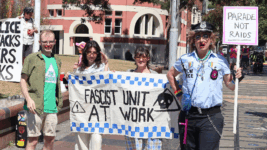
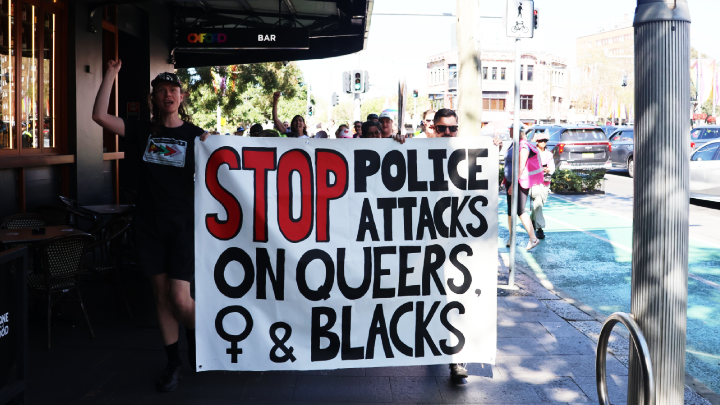
Hundreds of protesters gathered on Gadigal land at Sydney’s Taylor Square on Sunday afternoon to rally against New South Wales police having twice raided gay bars with sniffer dogs, on Oxford Street and its surrounds, once in Pride month and again only a fortnight ago, which marks a shift in terms of the agency having long been attempting to repair its fraught relations with the LGBTIQA+ community.
The 20 September 2026 Cops Out of Gay Bars snap rally at Taylor Square involved community members decrying the two incidents that occurred, as packs of around a dozen NSW police officers descended upon multiple nightclubs to bail up patrons, perform pat down searches on those indicated by a drug dog and if that failed, follow it up with a strip search.
The original 13 June raids caused so much outcry in Pride month that Independent NSW MP Alex Greenwich and Sydney lord mayor Clover Moore sent a letter of complaint to oversight body the Law Enforcement Conduct Commission, and it ordered NSW police to perform an internal review, which has been reopened after the agency first cleared itself, and the LECC ordered it to reinquire.
Those speaking out at 12 pm on Sunday recalled a history of NSW police targeting queer venues for special treatment going back to the 1970s, as well as its having neglected a crisis of gay hate crimes back then. And its further been acknowledged that this return to the prejudicial policing of the past has come amongst a general shift in law enforcement attitude towards the broader community.
Queer rights activist Rachel Evans and Dennis Newsome, also known as drag queen Kiama Blowhole, co-MCed the rally. And Evans explained at the top that despite the aim of drug dog operations being the targeting of drug supply, the two sets of raids over 3 months, saw 158 patrons searched, 70 drug detections made, yet only one charge of supply drugs laid, which is a success rate of 0.63 percent.
Intimidating the queer community
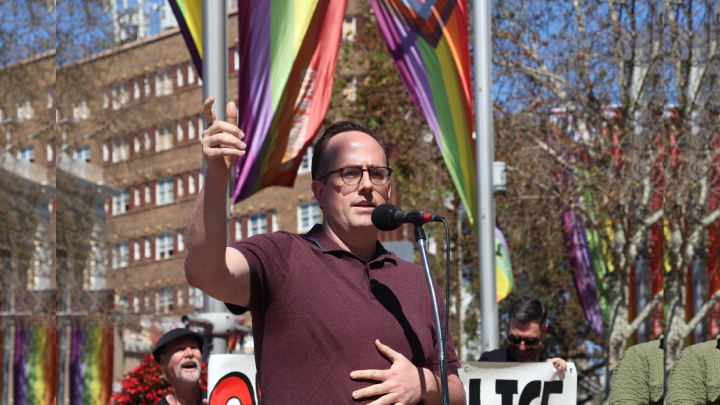
“Despite what the commissioners are saying in the media this doesn’t make sense,” NSW Council for Civil Liberties president Timothy Roberts told the Sunday afternoon crowd. “There is an obvious overrepresentation of the venues in this community in the raids that are taking place. The policing is unsafe and ineffective, and a waste of our taxpayer resources.”
“Then we see the numbers. Even today, we’ve got way too many police standing over there, doing I don’t know what,” continued the lawyer, as he pointed in the direction of a sizable group of officers in the square. “Then you look at the numbers who turn up in these clubs, you see the glee in their faces, and you can’t help but think about this as, not only a waste, but a tactic of intimidation.”
Greenwich and Moore pointed out in their June letter to the LECC that the first set of raids resulted in the most complaints from the LGBTIQA+ community in a decade. Yet, after the outcry over the second set of raids on Oxford Street venues, NSW police deputy commissioner Peter McKenna has attempted to deny there was any targeting of gay bars involved in the recent operations.
Evans and Newsome organised the rally in the wake of the 12 September 2026 midnight raids on 14-odd venues. And the demonstration was endorsed by Socialist Alliance, The Greens, Pride in Protest, Trans Justice Sydney, Watch the Cops and the NSW Council for Civil Liberties, with Roberts having turned up to address the crowd on its behalf.
“The real disgrace here involves liberty and freedom,” the NSWCCL president added. Roberts recalled that the council was established in 1963, as part of a civil society pushback against an unjustified NSW police raid on a party in an apartment in Kings Cross and it later stood beside the queer community following the police attack on the initial 1978 Mardi Gras march.
“Part of the success, we have fought for and won since then, is the light and the love and the joy of this community rolling over our lives and making us better for it,” Roberts underscored. “As this community gets to stand up and be exactly who they are, we all are better for it, better informed and freer to be ourselves. And that is really what is at stake here today.”
Authoritarian creep
Gay bashings and the targeted murder of gay people were not uncommon over the last three decades of the 20th century, and NSW police was notorious for its lack of adequate response. The first Mardi Gras was a protest march calling for an end to discrimination and criminalisation of the LGBTIQA+ community. The NSW police set upon those marching at the time and beat them up.
As for the lack of complaints from the community over the last decade that Moore and Greenwich cited, the 2013 Mardi Gras parade was marred by numerous police violence incidents, with a particular focus on the brutalisation of a then 18-year-old Jaime Reed. The fallout out from this incident led to the establishment of the Mardi Gras Police Accord between the festival and the force.
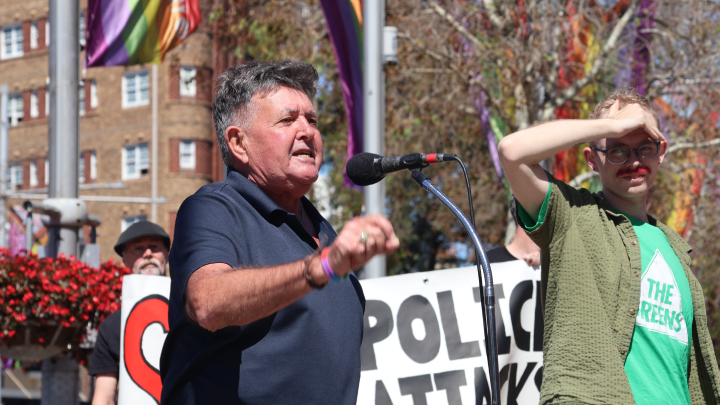
“We know when we see what has been happening here in NSW specifically, not just with the June raids and now the September raids on Oxford Street venues here, but also on other venues in the inner Sydney areas, what we see is a wider pattern,” Mark Gillespie, an original 78er from the first Mardi Gras demonstration, told the crowd.
Gillespie then listed recent events that tend to reveal a creeping authoritarianism in this state. He recalled a group of uni students protesting the Gaza genocide in March 2024, who sprayed red dye to symbolise blood, and were set upon and beaten by police, while in July 2025, legal observer Hannah Thomas was punched in the eye by a male officer for questioning the validity of a move on order.
The 78er then recalled the death of Waterloo man Colin Burling, who was wrestled down by several police officers until he stopped breathing at his home on 15 July 2025. Fire brigade officers had called on NSW police to check on Burling suggesting a drug psychosis, which was not true. But a welfare check turned macabre as officers piled on top of him, as others held up a sheet to conceal them.
The final authoritarian event that Gillespie raised was the 9 February 2026 protest rally against the official visit of Israeli president Isaac Herzog, which saw NSW police straightout brutalise the crowd. The “ferocity and the venom exhibited by NSW police against peaceful protesters that night was as bad, or worse, as at that first Mardi Gras when we were brutally attacked”, the 78er added.
The difference, Gillespie went on, was “over the past 48 years since that first Mardi Gras”, the NSW police has morphed into “a military operation”.
No excuse for targeting community
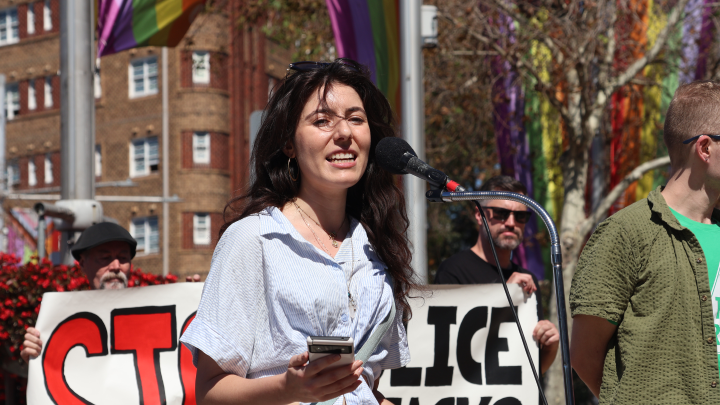
“We are standing on the streets, where our queer elders of the first Mardi Gras were brutalised by police, and right now, we are watching history echo itself with a pattern of clearly targeted raids on queer venues,” Greens Inner West councillor Izabella Antoniou told the crowd. “Our community is once more facing aggression and intimidation. And this is supposed to be for our benefit?”
NSW police asserted amongst the fallout from the raids a fortnight ago, that the operation was “intelligence-led” in respect of information regarding a large number of illicit substances being present in the local area. But the commentariat refutes the idea that raids on clubs were going to amount to anything beyond simple arrests of people who use drugs for possession of small amounts.
“This is another example of Chris Minns and his love of police overreach – for his surveillance agenda. Police violence is a weapon of the state wielded against the marginalised and we are seeing this government deploying it time and time again with absolutely no recourse,” added the Greens candidate for Summer Hill in next year’s NSW election. “They are a tactic and a tool to intimidate.”
“We are witnessing this Labor government bending over backwards to appease bigots and billionaires,” Antoniou said in ending. “There is absolutely no excuse for the persistent targeting of queer people. Just as there is no excuse for police violence against those exercising their democratic right to protest.”
All photos by Paul Gregoire
Paul Gregoire

Receive all of our articles weekly
Related Articles
 Police Search Powers Under a Firearms Prohibition Order in NSW
 Celebrity No Barrier to Charges of Negligent Driving in NSW
 Can I Charge Someone with a Crime?
 Police May Pursue Pell in Rome
 “Tibetan Sovereignty Hasn’t Been Ceded”: An Interview With Greens Senator Janet Rice
 Trump Is Invoking a New Era of Western Colonialism Inspired by Netanyahu