Criminal Offences Relating to Possessing, Supplying or Making Explosives in NSW
Police officers conducted a raid at a residence on Wiradjuri land on Rockley Street in Perthville, on the New South Wales Central Tablelands, that uncovered a clandestine laboratory and bomb-manufacturing site at 9 am on Wednesday, 20 May 2026.
A 46 year-year-old man was arrested at the scene and taken to nearby Bathurst police station where he was charged with possession, supply or making explosives without lawful purpose.
Officers from Chifley Police District, who executed the warrant, declared the address a crime scene and the Rescue and Bomb Disposal Unit attended the Central Tablelands premises as well.
Police also seized a number of registered firearms, and the 46-year-old has further been charged with two counts of not keeping firearm safely, and he was refused bail and is due to appear in Bathurst Local Court on 27 May 2026.
An 80-year-old man was also arrested at the property at around 4 pm that same day. He was too charged with the same firearm offence, before being granted conditional bail.
Further inquiries led to police attending a home on Perthville’s Hollis Lane on Friday, 22 May 2026, and arresting another 49-year-old man, who was taken to the police station in Bathurst and charged with one count of possession of digital blueprint for manufacture of firearms.
This third man was also refused bail at the police station and his matter was subsequently listed for a release application, which is also known as a bail application.
Possessing, supplying or making explosives without lawful purpose
Subsection 93FA(2) of the Crimes Act 1900 (NSW) contains the offence of possessing, supplying or making explosives for an unlawful purpose.
For the prosecution to prove this offence against the 49-year-old, it will have to show he was making explosives, and it was being done “under circumstances that give rise to a reasonable suspicion” that it was not “for a lawful purpose”.
This offence carries maximum penalties of up to 3 years imprisonment and/or a fine of $5,500.
This section of the Crimes Act also contains the subsection 93FA(1) offence of possess an explosive in a public place, which is a crime that carries up to 5 years prison time.
A public place is defined by section 8 of the Crimes Act as place was that is open to the public regularly or one that is usually considered private, like a vessel, vehicle, room, field, or a place open to the public on payment.
It is important to be aware that a person must be found not guilty of either explosives offence if the defence satisfies the court that they had a reasonable excuse or a lawful purpose for their actions.
Possessing, making or manufacturing explosives with intent
Possessing explosives with intent is an offence under section 55 of the Crimes Act 1900 (NSW) which carries a maximum penalty of 10 years in prison.
To establish the offence, the prosecution must prove beyond reasonable doubt that a person possessed, made or manufactured gunpowder, or any explosive substance or dangerous or noxious thing, and that the person did so with intent to injure, or enable someone else to injure, another person or commit a serious indictable offence against a person.
A serious indictable offence is one which carries a maximum penalty of at least five years in prison.
Definition of explosive
Schedule 3 of the Explosive Act 2003 defines an explosive as “a substance, or a thing containing a substance, manufactured or used with a view to produce a practical effect by explosion, or a pyrotechnic effect”, or “an article or substance that is classified under the ADG Code as too dangerous to transport, and can produce an explosive or pyrotechnic effect”.
Regulatory requirements relating to explosives
The Australian Dangerous Goods (ADG) Code or the Australian Code for the Transport of Dangerous Goods by Road and Rail outlines the technical requirements for transporting dangerous goods across land. It includes guidelines about vehicle requirements, packaging, transfer of bulk dangerous goods and safety equipment. And appendix A of the ADG Code lists goods too dangerous to transport.
An explosive also includes Class 1 dangerous goods. The United Nations Committee of Experts on the Transport of Dangerous Goods operates an international classification system of dangerous goods with nine classes. These are substances that can cause immediate hazard to people, property or the environment. Class 1 involves explosives and there are six divisions of explosives within that class.
The definition of explosives also includes any prescribed articles or substances contained in the Explosives Regulation 2024 (NSW).
General defences against explosives offences
In addition to having to prove the essential elements of explosives offences beyond reasonable doubt, the prosecution will also need to disprove to the same high standard any general legal defence raised by the evidence.
Given the right circumstances, the defence of duress can be raised against an explosives charge. The defence arises where the conduct occurred due to a threat made against them or a loved one and carrying out the wrongdoing was the only way to avoid the harm. The conduct must be shown to be a reasonable response to the threat.
The defence of necessity can also arise in relation to explosives charges if the circumstances allow for it. This would involve evidence the conduct occurred in order to avoid a much greater and imminent harm.
Prestige girls school student looking to make a blast
Another explosives scandal to have rocked NSW recently involved a WhatsApp chat comprised of year 7 students from the prestigious Sydney girls’ schools SCEGGS, which is located on Gadigal land in Darlinghurst. This chat was referred to the NSW police, after it was discovered that one of the students had inquired as to whether any of her fellow classmates knew how to make explosives.
A parent of one of the year 7 students became aware that one of the girls had been asking about making a pipe bomb in the chat on Sunday, 17 May 2026. The parent informed SCEGGS school management and on the following day, an email was sent out to all parents to inform them that this event had occurred and that the NSW police had been informed.
The school authorities stressed that some of the posts in the chat “contained material that was extremely serious” and this is why they’d gone to the police with the information. The email further warned parents that if their daughters were involved in the chat, that they ought not to forward the information to anyone else or there could be consequences.
SCEGGS management has explained that “interim school-based disciplinary actions” had occurred but given the nature of what had been said “forwarding threatening or violent information to others can be extremely serious”, which hinted at the fact that there might be the potential for criminal charges to be laid in relation to this incident.
Officers linked to Kings Cross Police Area Command were investigating this matter and had spoken to a child. And whilst it sounds like the individual asking for the bombmaking instructions was not in possession of any explosives, the scenario does hint at the section 55 of the Crimes Act offence of possessing or making explosives with intent to injure, which carries up to 10 years imprisonment.
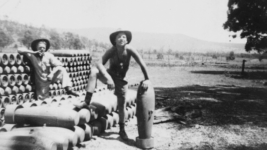
Article image: Two Air Force workers stacking explosives at Kowguran No. 3 Explosives Store, near Miles, during World War II

Paul Gregoire


Ugur Nedim
Receive all of our articles weekly
Related Articles
 The Offence of Destroying or Damaging Property, Previously Known as ‘Malicious Damage’
 Attempted Terrorism Attack at Boorloo-Perth First Nations Rally Deplorably Downplayed
 The Bombing of Gaza Has Ended for Now, But the Oppression of Palestinians Continues
 Terrorism Prosecution of White Australian Over Perth Bomb Attack Sets Important Precedent
 Theo Speaks: Pro-Palestinian Citizen Threatened With Bomb Pushes for Terrorism Charges
 Zionist Who Planted Bomb on Pro-Palestinian’s Vehicle Could Soon be Released