“Far-Left Activists”, Antisemitism and Expanding Powers All Featured in ASIO’s Threat Assessment
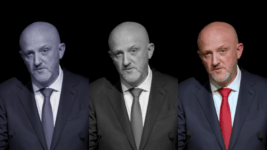
According to ASIO head Mike Burgess, Australians may be shocked but should not be surprised about tolerated antisemitism growing, “inflammatory rhetoric and provocative protest” leading to violence, radicalised individuals or small groups using easy to obtain weapons to perpetrate terrorism, critical infrastructure being disrupted, or if an Australian is killed by a foreign government on local soil.
Some of these examples have occurred in “the new terrorism environment”, while other incidents are yet to transpire, but none of it should be unexpected.
In delivering his annual threat assessment on 24 June 2026, the head of Australia’s domestic spying agency explains that the “dynamic, diverse and degraded” “threat environment” he’d predicted for the end of the decade is already upon us.
The diversity of this situation is reflected in the range of groups who “despise each other” yet are united via their antisemitism. These groups include neo-Nazis, Islamic extremists, nation-states and appearing for the first time on the list, “anarchists and revolutionary groups”, which the ASIO boss further clarifies are “far-left activists”, who have been vandalising local companies linked to Israel.
This is Burgess’ seventh annual threat assessment. Such public appraisal had not been part of the annual calendar until the ASIO head delivered his first in 2020. Each year the situation appears to be worsening, although Burgess did lower the terror threat level to “possible” in 2022, prior to ratchetting it back up to “probable” in 2024. And he currently considers that it could be higher.
This was the first assessment since the ISIS-inspired terrorism attack at Bondi last December, and the ASIO boss clarified that whilst his agency can’t catch every terrorist, it has foiled 31 serious plots since 2014, 14 of which have been since Bondi. And the key shifts this year are that antisemitism is front-and-centre, whilst “far-left activists” are now factored in as a part of the rising terror threat.
A deteriorating environment
“ASIO is not all seeing and all knowing. And we do not want to be,” Burgess insisted midway through his address, which acknowledged that his agency hadn’t foiled the 14 December 2025 Bondi terror attack, but it was also a nod to upholding the right to privacy. “We cannot stop every terrorist, just as we cannot catch every spy. But we continue to work around the clock to keep Australians safe.”
The issue with the “new terrorism environment” is that whilst Australia’s terrorism threat level remains set at “probable”, Burgess finds this is not high enough, while the next level of this system is “expected”, and that is neither the current case. Indeed, the ASIO boss now considers that the local threat level is “more likely” for “politically motivated violence, including acts of terrorism”.
Section 4 of the Australian Security Intelligence Organisation Act 1979 (Cth) defines politically motivated violence as “acts or threats of violence or unlawful harm that are intended or likely to achieve a political objective”, and it includes attempts to change policy, overthrow government, as well as acts of terrorism, foreign incursion, hostage-taking, hijacking or targeting protected persons.
Burgess added that in the wake of Bondi, there were rising calls for “countering Sunni extremism”, such as ISIS, but he deemed this too simplistic, as in its immediate aftermath a white nationalist threw a bomb into a First Nations crowd in Boorloo-Perth, whilst Western Australian police prevented another far-right terrorist attack that was to target government, police and mosques.
“Since then, we have dealt with extremists across the ideological spectrum,” the top spy continued. “Including one, who allegedly combined ideological and extreme Christian beliefs, and an individual allegedly inspired by an extreme left-wing ideology.”
The ASIO boss then insisted that many drivers in the ramped-up environment are “relatively new”, and include embracing “mixed ideologies”, lone people, increasingly minors, radicalised by strangers online in encrypted chatrooms, that radicalisation is now a short process taking weeks, and rather than sophisticated attacks, random “low-capacity attacks” are being perpetrated by individuals.
Left-wing activists posing a threat
As noted above, Burgess called out leftwing activists in the mix of potential actors posing a threat to the nation.
“Anarchists and revolutionary groups can be antisemitic,” the ASIO boss said. “This gets surprisingly little media coverage, but Australian companies with perceived links to Israel are being subjected to repeated acts of vandalism and arson by far-left activists.”
The top spy further clarified on the back of these comments that “criticism of the government of Israel is not of itself antisemitic”, which acknowledged that much of the leftwing protest over recent years has focused on the Israeli state, but he then underscored that such activity can spill over into “threatening statements” being made “that go well beyond political protest or commentary”.
Burgess then returned to the list of groups that have been engaging in rising antisemitism, which includes neo-Nazis, Islamic extremists, hostile nation-states and leftwing activists, as being “united by a common hatred”, and he went on to warn that “violent antisemitism is not a single, or simple, intelligence problem”, and his agency is combating it from “all of these diverse directions”.
Burgess earlier annual threat assessments that commenced at the time of COVID warned of Islamic extremist threats and a rising far-right being radicalised online, and perhaps their defining feature was to draw white nationalism into the terrorism umbrella. Yet now it appears that leftwing elements, who’ve been protesting the Gaza genocide for over 30 months, have made the grade.
And these newly included “far-left activists” holding their “extreme leftwing ideology” are being thrown into the mix by the spy boss at a time when western powers are increasingly framing those on the left of politics and their antigenocide actions, as comprising of politically motivated violence and terrorism, which has included local Australian terrorism police investigating leftwing protesters.
Expanding the questioning regime
Following the ASIO annual threat assessment, often abstract scenarios about the spying agency’s work that Burgess has cast out like breadcrumbs suddenly take shape in the press. This year three such scenarios were divulged, which included a nation pursuing “coerced repatriations”, nation-state hackers attempting to sabotage critical infrastructure and a foreign spy targeting AUKUS.
These three were part of four examples with the final involving more information pertaining to Iran’s Islamic Revolutionary Guard Corp having allegedly perpetrated two of fourteen arson attacks targeting Jewish properties in New South Wales and Victoria. And this involved Burgess identifying, but not naming, those orchestrating these attacks: one man located in Iran and another in Iraq.
Burgess repeatedly raised the threat of sabotage during his speech last week, along with twice noting the promotion of communal violence and a threat against Australia’s defence capabilities in the form of AUKUS, which are three of the four areas that the Albanese government is seeking to expand ASIO’s controversial questioning regime into.
Introduced into the lower house mid-last year, and having crept into the upper house in February, the extremely controversial Australian Security Intelligence Organisation Amendment Bill (No. 2) 2025 was seeking to make ASIO’s 2003-established questioning regime permanent, as well as broadening its scope when it comes to the questioning of adults.
ASIO’s questioning powers are contentious as they turn the spying agency into a secretive police force. These laws have been sunsetting and have then been temporarily extended again every couple of years since 2003. And while the Albanese government was seeking to make them permanent, due to public outcry, Labor decided early last month to drop the idea of making them a fixed power.
The compulsory questioning warrants involved in this regime allow ASIO to haul in people as young as 14 to be questioned for up to a cumulative 24 hours in order to prevent politically motivated violence, including terrorism, along with espionage and foreign inference. Yet, this only covers three of the seven areas the spying agency’s security mandate covers.
As home affairs minister Tony Burke pointed out during his second reading speech on the ASIO bill, the legislation also seeks to “enable ASIO to obtain an adult questioning warrant in relation to sabotage, attacks on Australia’s defence systems, the promotion of communal violence and serious threats to Australia’s territorial and border integrity, in addition” to the three areas already involved.
And at least three of these four aspects of security that ASIO is seeking to expand its questioning regime into were areas that Burgess repeatedly suggested his agency is confronting on an increasing basis.
Main image of Mike Burgess by Australian Security Intelligence Organisation is licensed under CC BY 3.0
Paul Gregoire

Receive all of our articles weekly
Related Articles
 Got a Parking Fine: Your Robot Lawyer Can Help!
 Greens Push to Legalise Cannabis
 Parking Rules to be Relaxed in NSW
 Ice Inquiry Makes Recommendations, But Government Has Its Head in the Sand
 The Next Social Justice Movement: An Interview With the Animal Defenders Office’s Tara Ward
 If Assange Is Sent to the US, He Will Die, Pilger Says, as Australia Continues to Collude